


A complex of Cas proteins 5, 6, and 7 is required for the biogenesis and stability of clustered regularly interspaced short palindromic repeats (crispr)-derived rnas (crrnas) in Haloferax volcanii
- PMID: 24459147
- PMCID: PMC3945376
- DOI: 10.1074/jbc.M113.508184
A complex of Cas proteins 5, 6, and 7 is required for the biogenesis and stability of clustered regularly interspaced short palindromic repeats (crispr)-derived rnas (crrnas) in Haloferax volcanii
Abstract
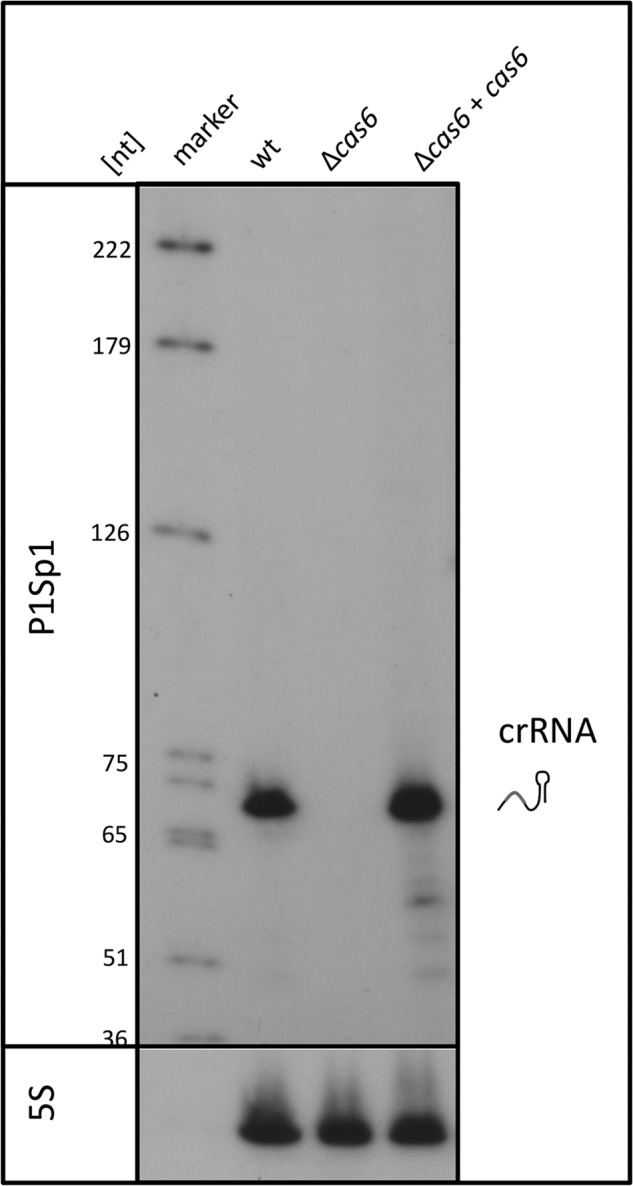
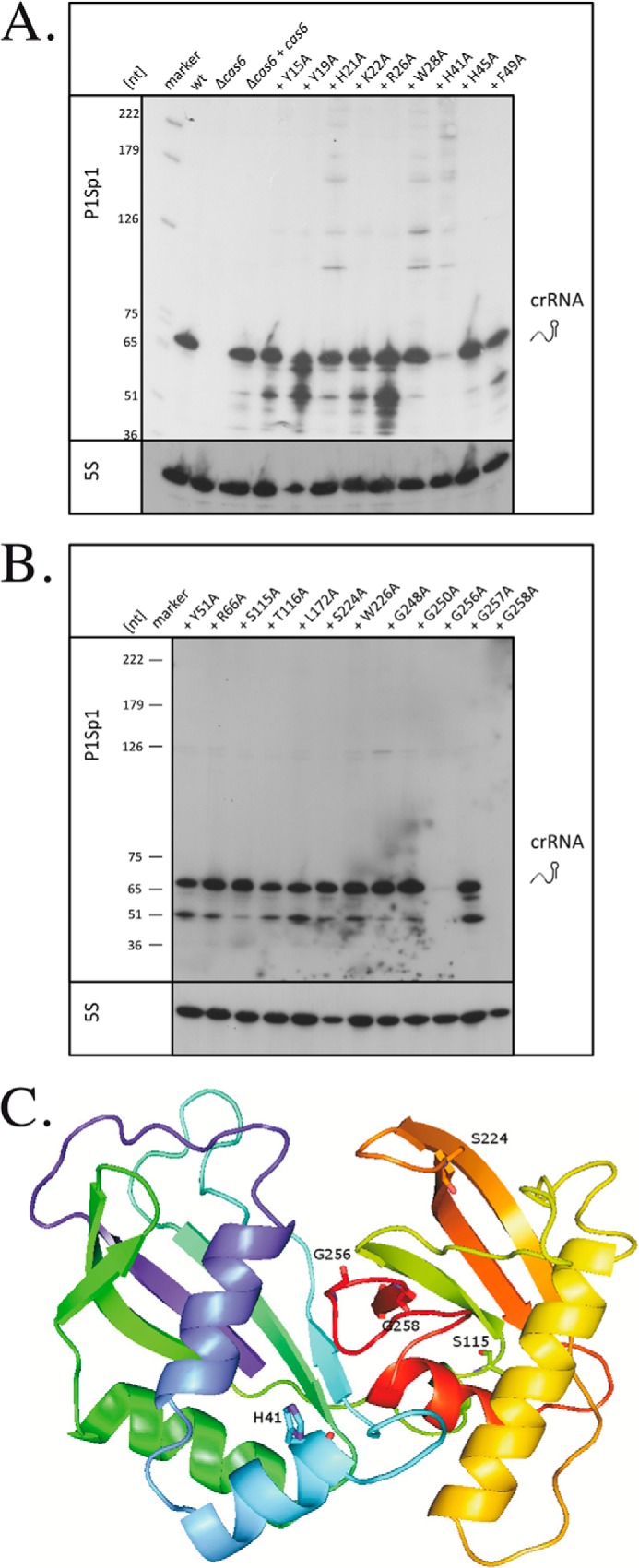
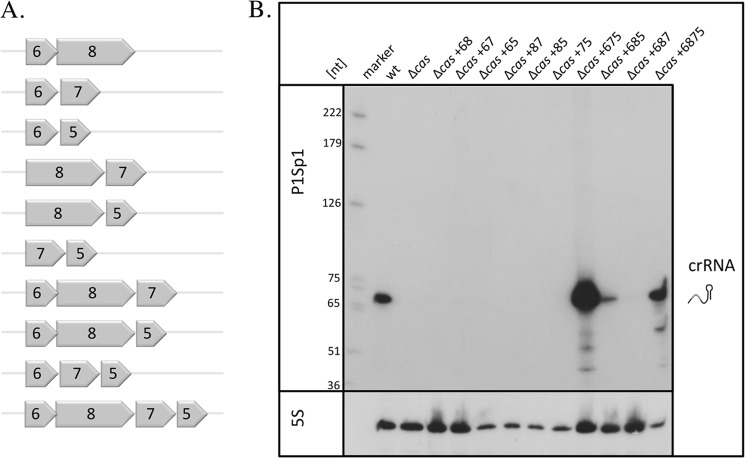
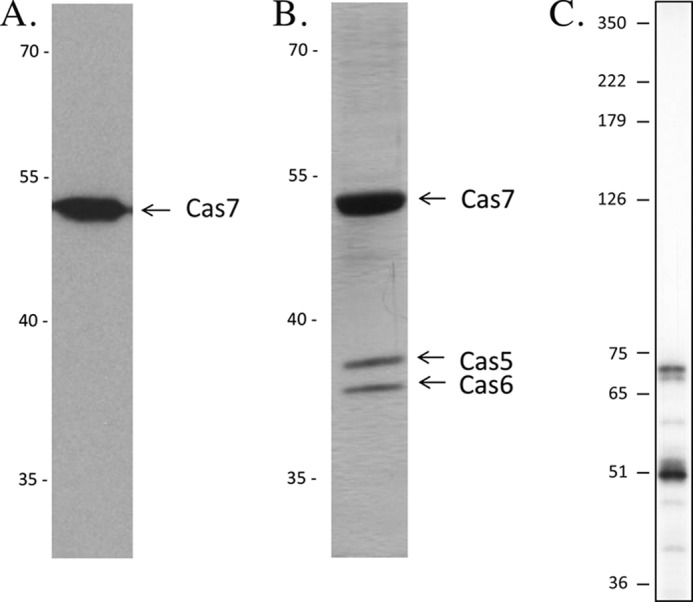
The clustered regularly interspaced short palindromic repeats/CRISPR-associated (CRISPR-Cas) system is a prokaryotic defense mechanism against foreign genetic elements. A plethora of CRISPR-Cas versions exist, with more than 40 different Cas protein families and several different molecular approaches to fight the invading DNA. One of the key players in the system is the CRISPR-derived RNA (crRNA), which directs the invader-degrading Cas protein complex to the invader. The CRISPR-Cas types I and III use the Cas6 protein to generate mature crRNAs. Here, we show that the Cas6 protein is necessary for crRNA production but that additional Cas proteins that form a CRISPR-associated complex for antiviral defense (Cascade)-like complex are needed for crRNA stability in the CRISPR-Cas type I-B system in Haloferax volcanii in vivo. Deletion of the cas6 gene results in the loss of mature crRNAs and interference. However, cells that have the complete cas gene cluster (cas1-8b) removed and are transformed with the cas6 gene are not able to produce and stably maintain mature crRNAs. crRNA production and stability is rescued only if cas5, -6, and -7 are present. Mutational analysis of the cas6 gene reveals three amino acids (His-41, Gly-256, and Gly-258) that are essential for pre-crRNA cleavage, whereas the mutation of two amino acids (Ser-115 and Ser-224) leads to an increase of crRNA amounts. This is the first systematic in vivo analysis of Cas6 protein variants. In addition, we show that the H. volcanii I-B system contains a Cascade-like complex with a Cas7, Cas5, and Cas6 core that protects the crRNA.
Keywords: Archaea; CRISPR/Cas; Cas6; Haloferax volcanii; Microbiology; Molecular Biology; Molecular Genetics; Protein Complexes; Type I-B; crRNA.
Figures
References
-
- Al-Attar S., Westra E. R., van der Oost J., Brouns S. J. (2011) Clustered regularly interspaced short palindromic repeats (CRISPRs). The hallmark of an ingenious antiviral defense mechanism in prokaryotes. Biol. Chem. 392, 277–289 - PubMed
-
- Barrangou R., Fremaux C., Deveau H., Richards M., Boyaval P., Moineau S., Romero D. A., Horvath P. (2007) CRISPR provides acquired resistance against viruses in prokaryotes. Science 315, 1709–1712 - PubMed
-
- Bhaya D., Davison M., Barrangou R. (2011) CRISPR-Cas systems in bacteria and archaea. Versatile small RNAs for adaptive defense and regulation. Annu. Rev. Genet. 45, 273–297 - PubMed
-
- Garneau J. E., Dupuis M. È., Villion M., Romero D. A., Barrangou R., Boyaval P., Fremaux C., Horvath P., Magadán A. H., Moineau S. (2010) The CRISPR/Cas bacterial immune system cleaves bacteriophage and plasmid DNA. Nature 468, 67–71 - PubMed
-
- Garrett R. A., Vestergaard G., Shah S. A. (2011) Archaeal CRISPR-based immune systems. Exchangeable functional modules. Trends Microbiol. 19, 549–556 - PubMed
Publication types
MeSH terms
Substances
LinkOut - more resources
Full Text Sources
Other Literature Sources
Molecular Biology Databases
