Review
. 2013 Dec;15(4):399-410.
doi: 10.31887/DCNS.2013.15.4/rgur.

Memory in health and in schizophrenia

Affiliations
Review

Memory in health and in schizophrenia

Ruben C Gur et al. Dialogues Clin Neurosci. 2013 Dec.

Abstract

Memory is an important capacity needed for survival in a changing environment, and its principles are shared across species. These principles have been studied since the inception of behavioral science, and more recently neuroscience has helped understand brain systems and mechanisms responsible for enabling aspects of memory. Here we outline the history of work on memory and its neural underpinning, and describe the major dimensions of memory processing that have been evaluated by cognitive neuroscience, focusing on episodic memory. We present evidence in healthy populations for sex differences-females outperforming in verbal and face memory, and age effects-slowed memory processes with age. We then describe deficits associated with schizophrenia. Impairment in schizophrenia is more severe in patients with negative symptoms-especially flat affect-who also show deficits in measures of social cognition. This evidence implicates medial temporal and frontal regions in schizophrenia.

La memoria es una importante capacidad necesaria para la supervivencia en un ambiente cambiante y sus bases son compartidas a través de las especies. Estas bases ban sido estudiadas desde el inicio de las ciencias conductuales y más recientemente las neurociencias han ayudado a comprender los sistemas cerebrates y los mecanismos responsables de los aspectos que hacen posible la memoria. En este artículo se revisa la historia de los trabajos sobre la memoria y sus bases neurales, y se describen las principales dimensiones de los procesos de memoria que ban sido evaluados por las neurociencias cognitivas, enfocándose en la memoria episódica. Se presenta la evidencia en poblaciones sanas, las diferencias por sexo (las mujeres superan en memoria verbal y facial) y los efectos de la edad (los procesos de memoria se enlentecen con la edad). Finalmente se describen los déficits asociados con la esquizofrenia. El deterioro en la esquizofrenia es más grave en pacientes con síntomas negativos (especialmente aplanamiento afectivo), quienes también muestran déficits en mediciones de la cognición social. En la esquizofrenia esta evidencia compromete las regiones temporal medial y frontal.

La mémoire est une aptitude importante, indispensable à la survie dans un environnement changeant et ses principes sont partagés au sein des espèces. Ces principes ont été étudiés depuis le début des sciences comportementales et plus récemment les neurosciences ont permis de comprendre les systèmes et les mécanismes cérébraux responsables d'un environnement favorable à la mémoire. Nous soulignons ici le travail antérieur sur la mémoire et ses fondements neuronaux, et nous décrivons les dimensions majeures des processus mémoriels évaluées par les neurosciences cognitives, en nous concentrant sur la mémoire épisodique. Nous présentons des données de populations saines: différences sexuelles, les femmes étant meilleures en mémoire verbale et plus physionomistes ; et effet de l'age, qui ralentit les processus mémoriels. Puis nous décrivons les déficits associés à la schizophrénie. Dans cette pathologie, la détérioration est plus importante chez les patients ayant des symptômes négatifs, en particulier un affect émoussé, qui sont aussi déficitaires dans les mesures de cognition sociale. Tout ceci prouve que les régions frontales et temporales internes interviennent dans la schizophrénie.

Keywords: aging; development; episodic memory; neurocognition; schizophrenia; sex difference.


Figures
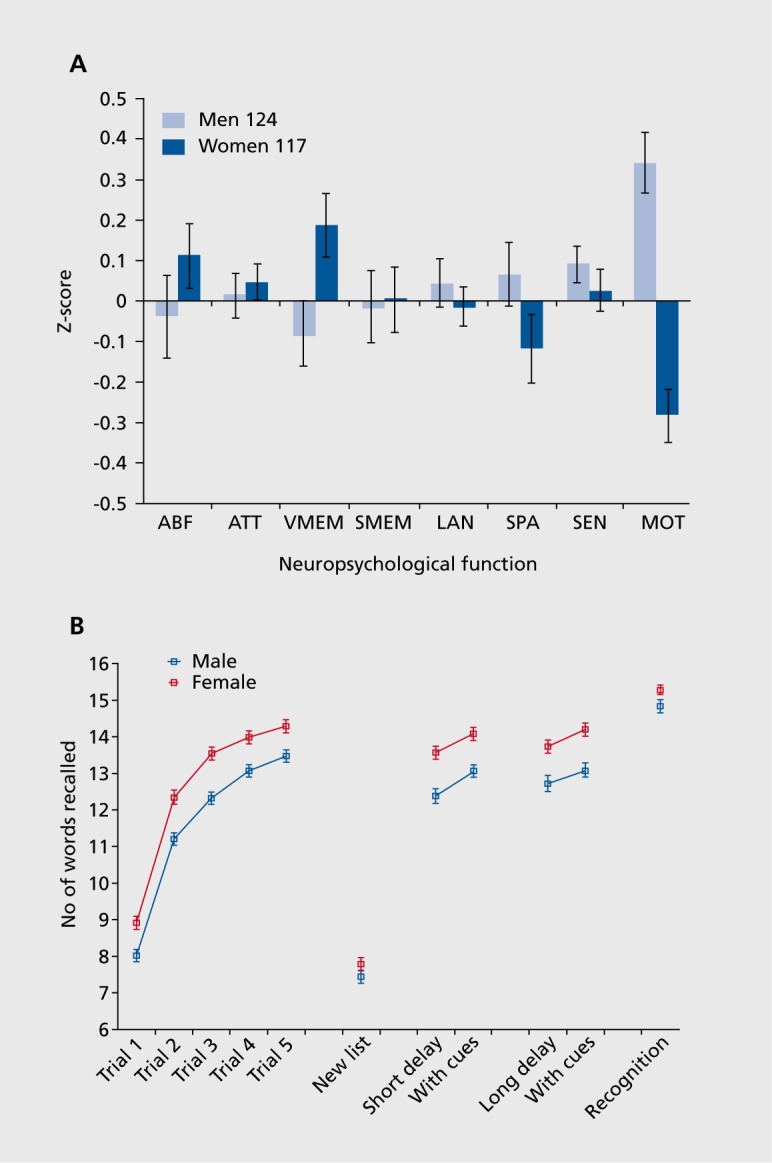
Figure 1.
Figure 1.. Sex differences. A. Sex differences in neurocognitive profile. ABF, abstraction and mental flexibility; ATT, attention; VMEM, verbal memory; SMEM, spatial memory; LAN, language reasoning; SPA, spatial processing; SEN, sensory; MOT, motor speed. B. Sex differences on the California Verbal Learning Test (CVLT). The CVLT presents 16 words and the participant is asked to repeat them in any order during the recall phase. This is repeated for 5 trials. Then a new list of 16 words is presented, followed by immediate and delayed recall with and without cuing. Recognition is determined at the end by showing words that were and were not included in the first list, and the participant is asked to classify them into old and new.
Figure 2.
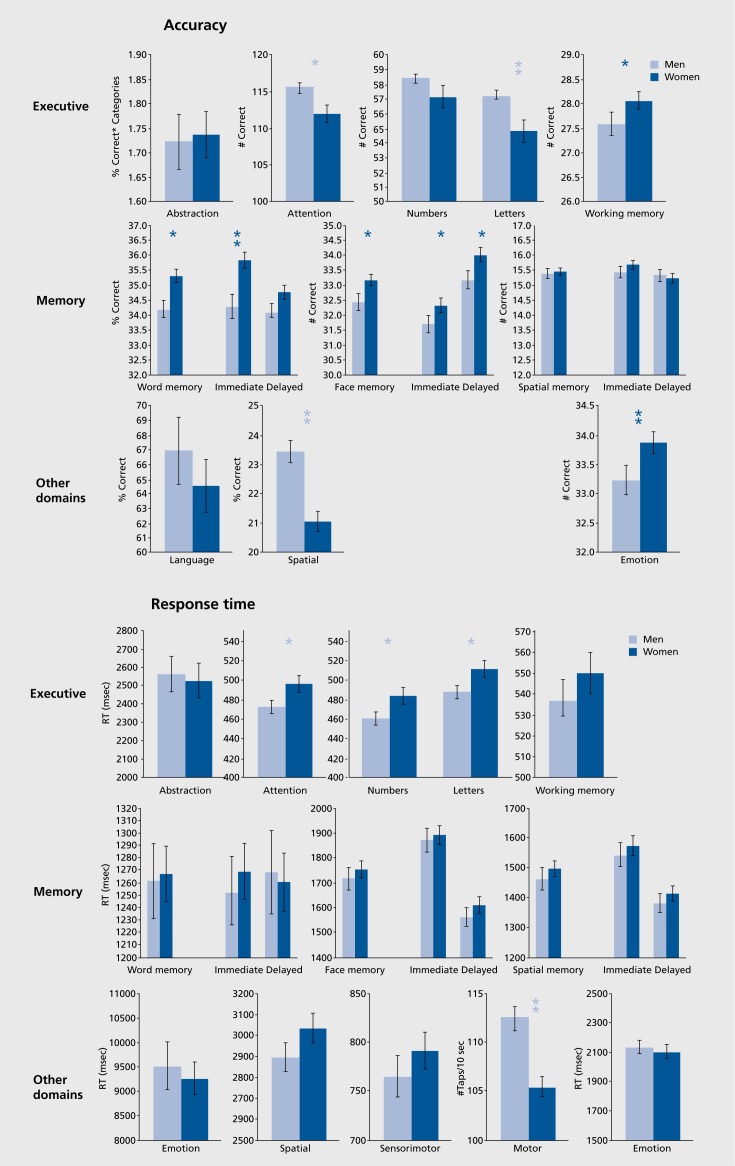
Figure 2.. Mean (±SEM) of men (light blue bars) and women (dark blue bars) on the tests included in the battery. Note that no accuracy measures are available for the sensorimotor test because no errors were made and for the motor speed test because no errors were possible. *, P<.01 ; **, P<.001 . Dark blue stars indicate that women had better performance, while light blue stars indicate better performance in men. Note that accuracy and speed provide complementary information, and while performance is similar overall for men and women, some well-known sex differences are replicated (better performance for women in memory and affect recognition, and for men in spatial and motor domains), and some novel ones revealed (better performance for men on CPT and working memory). Reproduced from ref 19: Gur RC, Richard J, Hughett P, et al. A cognitive neuroscience-based computerized battery for efficient measurement of individual differences: standardization and initial construct validation. J Neurosci Methods. 2010;187:254-462. Copyright© Elsevier 2010
Figure 3.
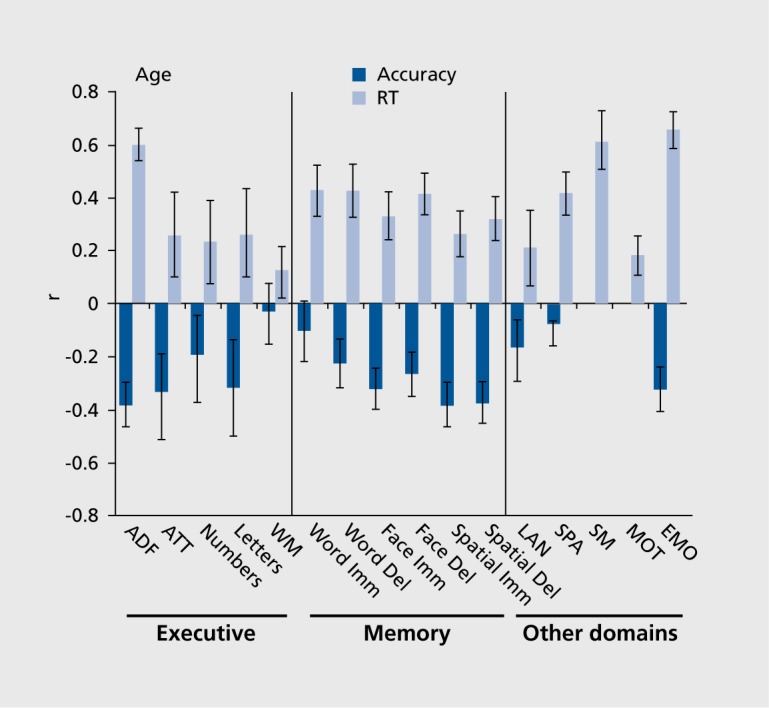
Figure 3.. Correlations of age with accuracy (black bars) and response time (RT; gray bars) indices of performance on the tests. Error bars indicate 95% confidence intervals based on 1 000 bootstraps. As seen, the effects of age are stronger for speed than for accuracy, and more pronounced for abstraction/flexibility and episodic memory than for attention and working memory. ABF, abstraction and mental flexibility; ATT, attention; WM, working memory; Imm, immediate; Del, delayed; LAN, language reasoning; SPA, spatial processing; SM, sensorimotor speed; MOT, motor speed; EMO, emotion processing Reproduced from ref 19: Gur RC, Richard J, Hughett P, et al. A cognitive neuroscience-based computerized battery for efficient measurement of individual differences: standardization and initial construct validation. J Neurosci Methods. 2010;187:254-462. Copyright © Elsevier 2010
Figure 4.
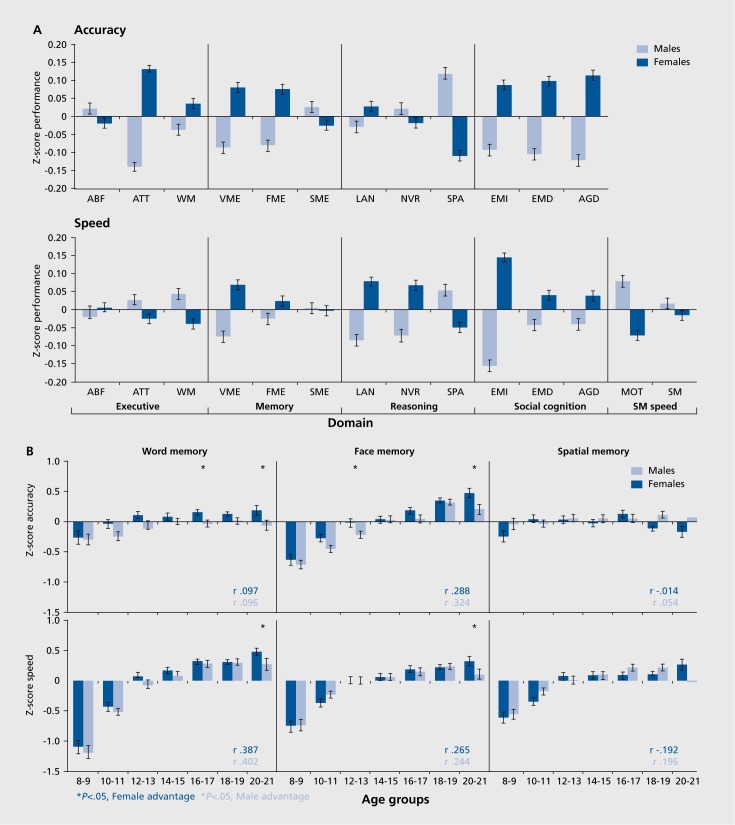
Figure 4.. (Opposite) Age-related increase in memory performance. A. Means (+ SE) of z-scores for accuracy (top panel) and speed (bottom panel) for females (dark blue bars) and males (light blue bars) across the sample on each behavioral domain. ABF, abstraction and mental flexibility; ATT, attention; WM, working memory; VME, verbal memory; FME, face memory; SME, spatial memory; LAN, language reasoning; NVR, nonverbal reasoning; SPA, spatial processing; EMI, emotion identification; EMD, emotion differentiation; AGD, age differentiation; SM, sensorimotor speed; MOT, motor speed. B. Means (+ SE) of z-scores for accuracy (top panel) and speed (bottom panel) for females (dark blue bars) and males (light blue bars) on episodic memory tasks. The results are shown by age groups and correlations with age are provided by sex (bold correlations are significant at P<.001). Reproduced from ref 20: Gur RC, Richard J, Calkins ME, et al. Age group and sex differences in performance on a computerized neurocognitive battery in children age 8-21. Neuropsychology. 2012;26:251-265. Copyright © American Psychological Association 2012
Figure 5.
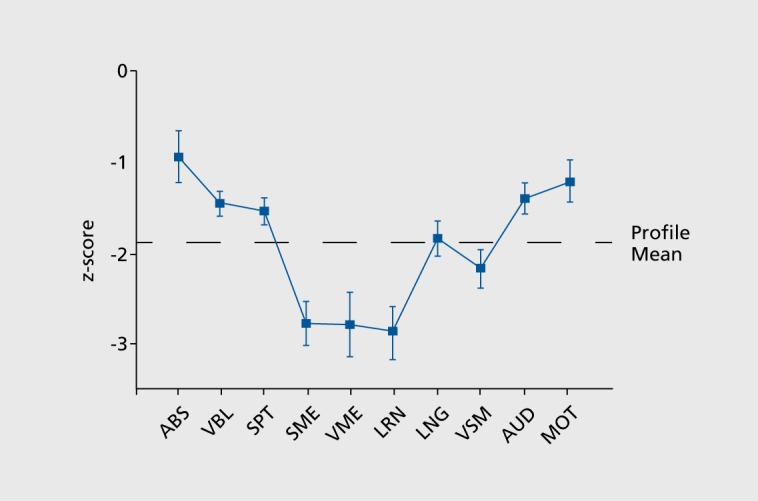
Figure 5.. Neuropsychological profile (±SEM) for patients with schizophrenia (n=36) relative to controls (n=36) whose performance is set to zero (±1 SD). Functions are abstraction (ABS), verbal cognitive (VBL), spatial organization (SPT), semantic memory (SME), visual memory (VME), verbal learning (LRN), language (LNG), visual-motor processing and attention (VSM), auditory processing and attention (AUD), and motor speed and sequencing (MOT). Reproduced from ref 21: Saykin AJ, Gur RC, Gur RE, et al. Neuropsychological function in schizophrenia. Selective impairment in memory and learning. Arch Gen Psychiatry. 1991;48:618-624. Copyright © American Medical Association 1991
Figure 6.
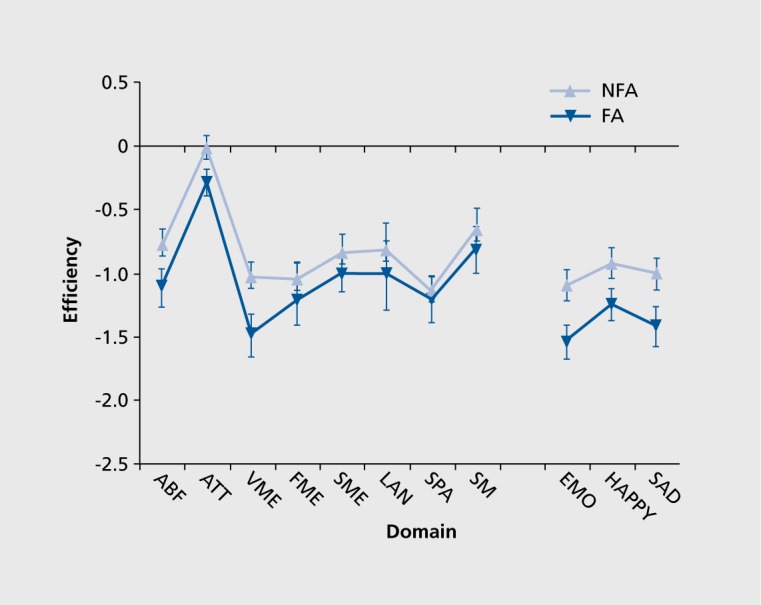
Figure 6.. Neurocognitive and emotion processing performance (z-score mean ± SEM for efficiency) in flat affect (FA) and non-flat affect (NFA) groups. ABF, abstraction/flexibility; ATT, attention; VME, verbal memory; SME, spatial memory; FME, facial memory; LAN, language; SPA, spatial; SM, sensor-motor; EMO, average emotion processing tests. Reproduced from ref 31: Gur RE, Kohler CG, Ragland JD, et al. Flat affect in schizophrenia: relation to emotion processing and neurocognitive measures. Schizophr Bull. 2006;32:279-287. Copyright © Oxford University Press 2006

References

    1. Yerkes RM., Dodson JD. The relation of strength of stimulus to rapidity of habit-formation. J Comp Neurol Psychiatry. 1908;18:458–482.
    1. Courts FA. Relation between experimentally induced muscular tension and memorization. J Exp Psychol. 1939;25:235–256.
    1. Hebb DO. Drives and the CNS (conceptual nervous system). Psychol Rev. 1955;62:243–254. - PubMed
    1. Malmo RB. Activation: a neuropsychological dimension. Psychol Rev. 1959;66:367–386. - PubMed
    1. Eysenck MW. Anxiety and cognitive-task performance. Person Individ Diff. 1985;6:579–586.

Publication types