. 2014 Jan 24:15:63.
doi: 10.1186/1471-2164-15-63.

Cost-efficient high-throughput HLA typing by MiSeq amplicon sequencing

Affiliations

Cost-efficient high-throughput HLA typing by MiSeq amplicon sequencing

Vinzenz Lange et al. BMC Genomics. .

Abstract

Background: A close match of the HLA alleles between donor and recipient is an important prerequisite for successful unrelated hematopoietic stem cell transplantation. To increase the chances of finding an unrelated donor, registries recruit many hundred thousands of volunteers each year. Many registries with limited resources have had to find a trade-off between cost and resolution and extent of typing for newly recruited donors in the past. Therefore, we have taken advantage of recent improvements in NGS to develop a workflow for low-cost, high-resolution HLA typing.

Results: We have established a straightforward three-step workflow for high-throughput HLA typing: Exons 2 and 3 of HLA-A, -B, -C, -DRB1, -DQB1 and -DPB1 are amplified by PCR on Fluidigm Access Array microfluidic chips. Illumina sequencing adapters and sample specific tags are directly incorporated during PCR. Upon pooling and cleanup, 384 samples are sequenced in a single Illumina MiSeq run. We developed "neXtype" for streamlined data analysis and HLA allele assignment. The workflow was validated with 1140 samples typed at 6 loci. All neXtype results were concordant with the Sanger sequences, demonstrating error-free typing of more than 6000 HLA loci. Current capacity in routine operation is 12,000 samples per week.

Conclusions: The workflow presented proved to be a cost-efficient alternative to Sanger sequencing for high-throughput HLA typing. Despite the focus on cost efficiency, resolution exceeds the current standards of Sanger typing for donor registration.


Figures
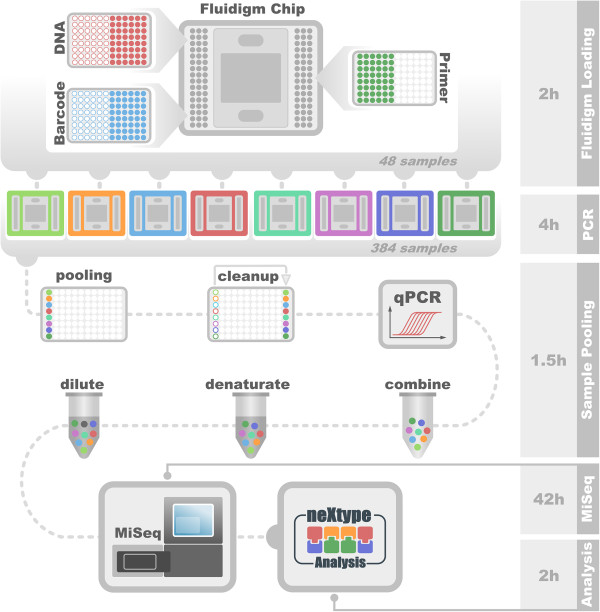
Figure 1
Figure 1
Workflow for analyzing 384 samples. 8 Fluidigm chips with 48 samples each are pooled for one MiSeq run.
Figure 2
Figure 2
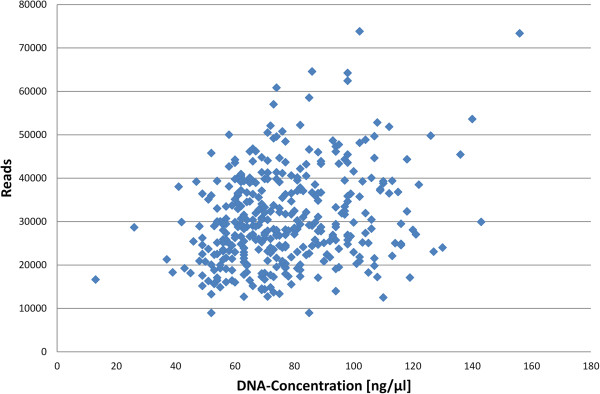
Correlation of DNA concentration and total reads for 384 samples. Mean DNA concentration: 77 ng/μl, mean number of reads: 30,605, coefficient of correlation: 0.26.
Figure 3
Figure 3
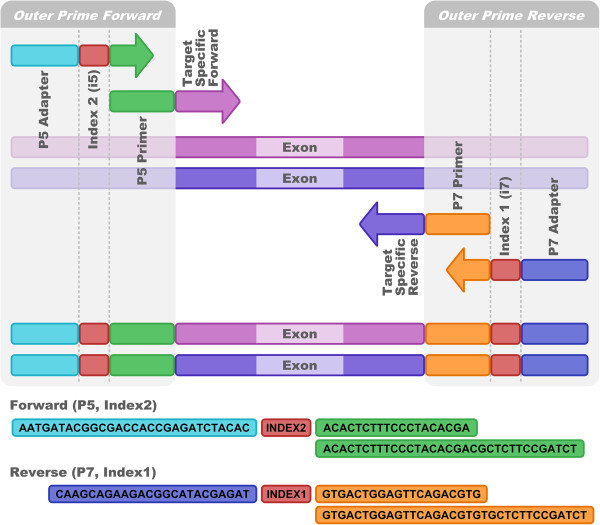
Dual indexing in a 4-primer approach. The 2 outer and 2 inner primers are combined in one PCR reaction to yield a MiSeq compatible product with dual indexing. Each sample is first mixed with a unique combination of outer primer indexes. The 48 samples are then combined with up to 48 target-specific primer sets in 2304 separate reaction chambers on the Fluidigm chip for PCR.
Figure 4
Figure 4
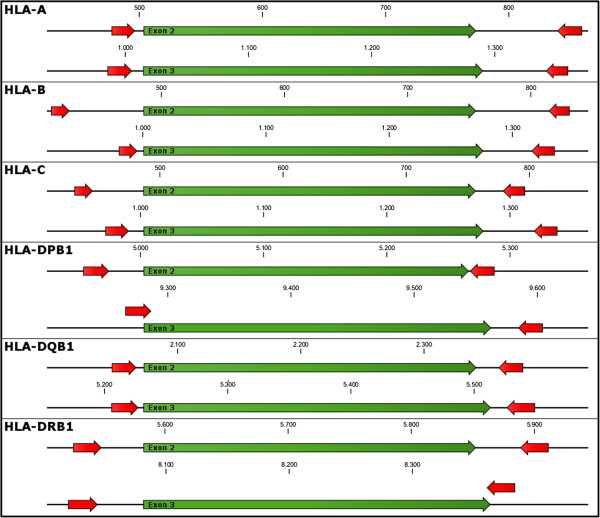
Location of HLA specific primers. Primers are located in the introns surrounding exon 2 or 3 respectively. There is no overlap with the exonic sequence with the exception of HLA-DQB1 exon 3 forward and HLA-DRB1 exon 3 reverse which overlap by few bases with the exonic sequence.
Figure 5
Figure 5
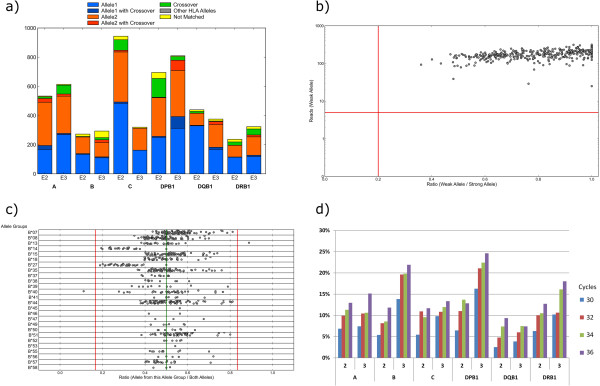
Optimization and performance of primer sets. (a) Classification of reads based on known typing results using sequence and Q-values. PCR artifacts resulting in artificial hybrids of allele1 and allele2 are reported as “crossover“. (b) Optimization of primer sets - Allele balancing: Example of an optimized primer set (A Exon 2) demonstrating balanced amplification and sufficient read counts. (c) Optimization of primer sets - Allele amplification bias: Example of an unoptimized primer set (B Exon 3) demonstrating negative amplification bias for allele groups B*14 and B*27. (d) Crossover artifact quantification: 48 samples were amplified using 30 to 36 PCR cycles and the rate of crossover formation was quantified for each locus and exon. Sample-loci with homozygous results were not considered for analysis. Lowering the number of PRC cycles reduces the crossover-rate.
Figure 6
Figure 6
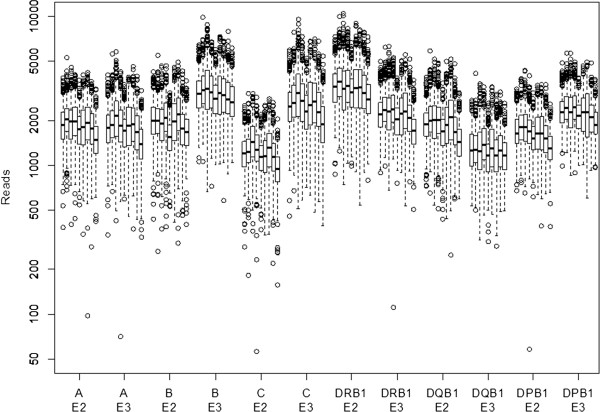
Coverage. Reads per amplicon and sample over 9 runs (3398 samples). Boxes represent median and first and third quartile, whiskers correspond to the interquartile range and outliers are plotted.
Figure 7
Figure 7
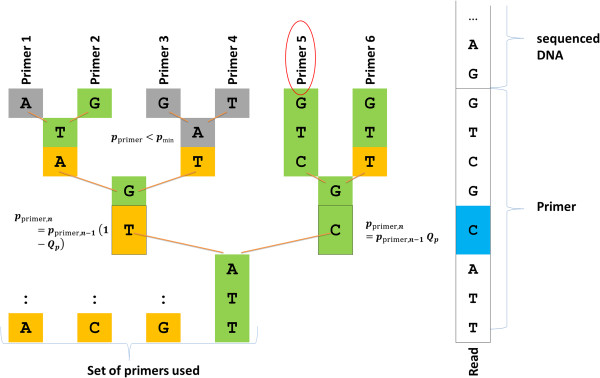
Schematic representation of primer recognition level three. In this example, primer 5 would have been assigned to the tested read.
Figure 8
Figure 8
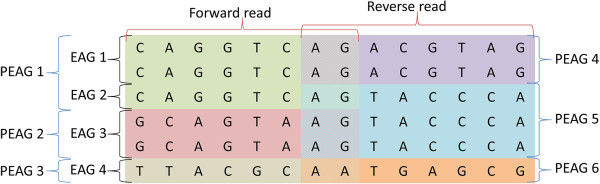
Sketch showing generation of EAGs and PEAGs in forward and reverse read direction. Each row represents the exon sequence of one HLA allele on a specific locus and exon. The chart shows how the EAGs and PEAGs in forward and reverse direction are generated.

References

    1. Petersdorf EW, Anasetti C, Martin PJ, Gooley T, Radich J, Malkki M, Woolfrey A, Smith A, Mickelson E, Hansen JA. Limits of HLA mismatching in unrelated hematopoietic cell transplantation. Blood. 2004;15:2976–2980. doi: 10.1182/blood-2004-04-1674. - DOI - PubMed
    1. Tu B, Cha N, Yang R, Ng J, Hurley CK. A one-step DNA sequencing strategy to HLA type hematopoietic stem cell donors at recruitment - rethinking typing strategies. Tissue Antigens. 2013;15:150–160. doi: 10.1111/tan.12072. - DOI - PMC - PubMed
    1. Wang C, Krishnakumar S, Wilhelmy J, Babrzadeh F, Stepanyan L, Su LF, Levinson D, Fernandez-Viña MA, Davis RW, Davis MM, Mindrinos M. High-throughput, high-fidelity HLA genotyping with deep sequencing. Proc Natl Acad Sci USA. 2012;15:8676–8681. doi: 10.1073/pnas.1206614109. - DOI - PMC - PubMed
    1. Shiina T, Suzuki S, Ozaki Y, Taira H, Kikkawa E, Shigenari A, Oka A, Umemura T, Joshita S, Takahashi O, Hayashi Y, Paumen M, Katsuyama Y, Mitsunaga S, Ota M, Kulski JK, Inoko H. Super high resolution for single molecule-sequence-based typing of classical HLA loci at the 8-digit level using next generation sequencers. Tissue Antigens. 2012;15:305–316. doi: 10.1111/j.1399-0039.2012.01941.x. - DOI - PubMed
    1. Lind C, Ferriola D, Mackiewicz K, Heron S, Rogers M, Slavich L, Walker R, Hsiao T, McLaughlin L, D’Arcy M, Gai X, Goodridge D, Sayer D, Monos D. Next-generation sequencing: the solution for high-resolution, unambiguous human leukocyte antigen typing. Hum Immunol. 2010;15:1033–1042. doi: 10.1016/j.humimm.2010.06.016. - DOI - PubMed