


Screening for Middle East respiratory syndrome coronavirus infection in hospital patients and their healthcare worker and family contacts: a prospective descriptive study
- PMID: 24460984
- PMCID: PMC7128421
- DOI: 10.1111/1469-0691.12562
Screening for Middle East respiratory syndrome coronavirus infection in hospital patients and their healthcare worker and family contacts: a prospective descriptive study
Abstract
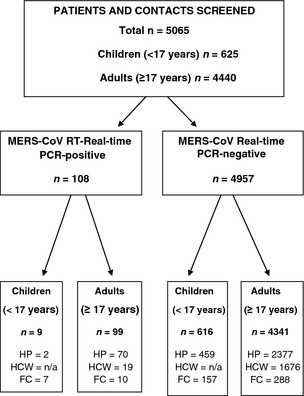
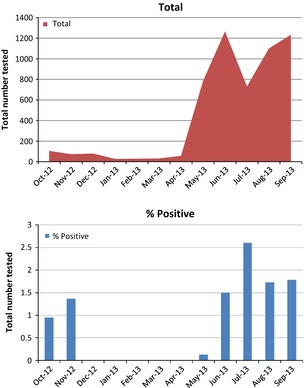
The Saudi Arabian Ministry of Health implemented a pro-active surveillance programme for Middle East respiratory syndrome (MERS) coronavirus (MERS-CoV). We report MERS-CoV data from 5065 Kingdom of Saudi Arabia individuals who were screened for MERS-CoV over a 12-month period. From 1 October 2012 to 30 September 2013, demographic and clinical data were prospectively collected from all laboratory forms received at the Saudi Arabian Virology reference laboratory. Data were analysed by referral type, age, gender, and MERS-CoV real-time PCR test results. Five thousand and 65 individuals were screened for MER-CoV: hospitalized patients with suspected MERS-CoV infection (n = 2908, 57.4%), healthcare worker (HCW) contacts (n = 1695; 33.5%), and family contacts of laboratory-confirmed MERS cases (n = 462; 9.1%). Eleven per cent of persons tested were children (<17 years of age). There were 108 cases (99 adults and nine children) of MERS-CoV infection detected during the 12-month period (108/5065, 2% case detection rate). Of 108 cases, 45 were females (six children and 39 adults) and 63 were males (three children and 60 adults). Of the 99 adults with MERS-CoV infection, 70 were hospitalized patients, 19 were HCW contacts, and ten were family contacts. There were no significant increases in MERS-CoV detection rates over the 12-month period: 2.6% (19/731) in July 2013, 1.7% (19/1100) in August 2013, and 1.69% (21/1238) in September 2013. Male patients had a significantly higher MERS-CoV infection rate (63/2318, 2.7%) than females (45/2747, 1.6%) (p 0.013). MERS-CoV rates remain at low levels, with no significant increase over time. Pro-active surveillance for MERS-CoV in newly diagnosed patients and their contacts will continue.
Keywords: Clinical; MERS-CoV; Middle East; SARS; coronavirus; demographic; diagnosis; real-time PCR; sample type; screening; viral load.
© 2014 The Authors Clinical Microbiology and Infection © 2014 European Society of Clinical Microbiology and Infectious Diseases.
Figures
Comment in
-
Emerging infections and sensationalism: in Aesop's fable, the boy who cried wolf had a dreadful fate.Clin Microbiol Infect. 2014 May;20(5):467-8. doi: 10.1111/1469-0691.12606. Clin Microbiol Infect. 2014. PMID: 24849700 Free PMC article. No abstract available.
References
-
- Zaki AM, Van Boheemen S, Bestebroer TM, Osterhaus AD, Fouchier RA. Isolation of a novel coronavirus from a man with pneumonia in Saudi Arabia. N Engl J Med 2012; 367: 1814–1820. - PubMed
-
- Corman VM, Eckerle I, Bleicker T et al Detection of a novel human coronavirus by real‐time reverse‐transcription polymerase chain reaction. Euro Surveill 2012; 17: pii: 20285. - PubMed
-
- Costabel U, Timm J, Binger T, Meyer B et al Assays for laboratory confirmation of novel human coronavirus (hCoV‐EMC) infections. Euro Surveill 2012; 17: pii: 20334. - PubMed
-
- Hijawi B, Abdallat M, Sayaydeh A et al Novel coronavirus infections in Jordan, April 2012: epidemiological findings from a retrospective investigation. East Mediterr Health J 2013; 19 (suppl 1): S12–S18. - PubMed
-
- World Health Organization . Global Alert and Response. Coronavirus Infections (2012. –2013). Available at: http://wwwwhoint/csr/disease/coronavirus_infections/en/
MeSH terms
LinkOut - more resources
Full Text Sources
Other Literature Sources
Miscellaneous
