


Central terminal sensitization of TRPV1 by descending serotonergic facilitation modulates chronic pain
- PMID: 24462040
- PMCID: PMC3943838
- DOI: 10.1016/j.neuron.2013.12.011
Central terminal sensitization of TRPV1 by descending serotonergic facilitation modulates chronic pain
Abstract
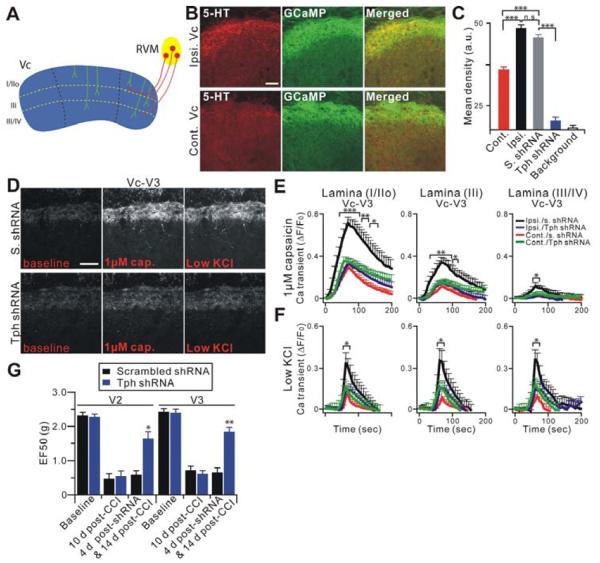
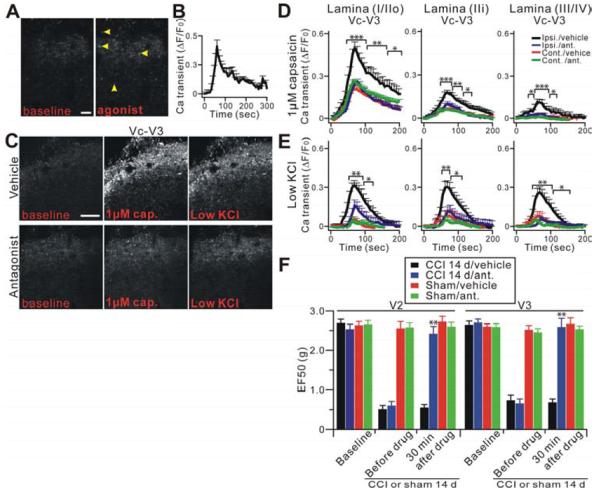
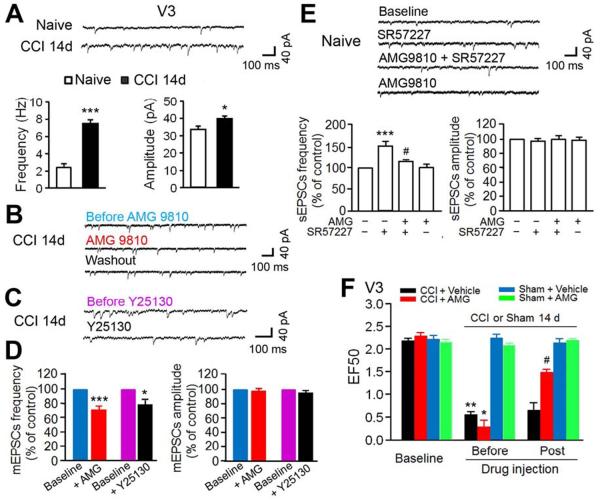
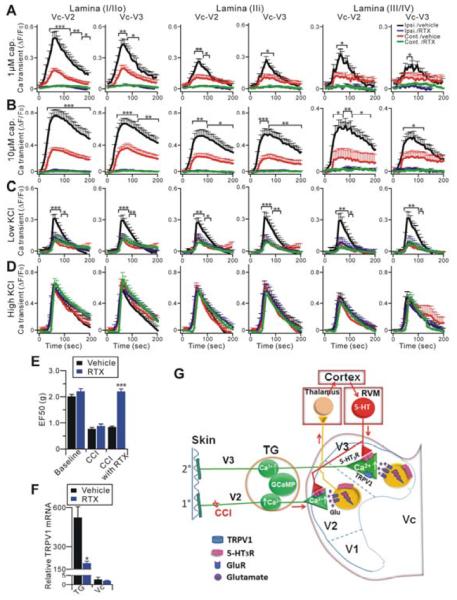
The peripheral terminals of primary nociceptive neurons play an essential role in pain detection mediated by membrane receptors like TRPV1, a molecular sensor of heat and capsaicin. However, the contribution of central terminal TRPV1 in the dorsal horn to chronic pain has not been investigated directly. Combining primary sensory neuron-specific GCaMP3 imaging with a trigeminal neuropathic pain model, we detected robust neuronal hyperactivity in injured and uninjured nerves in the skin, soma in trigeminal ganglion, and central terminals in the spinal trigeminal nucleus. Extensive TRPV1 hyperactivity was observed in central terminals innervating all dorsal horn laminae. The central terminal TRPV1 sensitization was maintained by descending serotonergic (5-HT) input from the brainstem. Central blockade of TRPV1 or 5-HT/5-HT3A receptors attenuated central terminal sensitization, excitatory primary afferent inputs, and mechanical hyperalgesia in the territories of injured and uninjured nerves. Our results reveal central mechanisms facilitating central terminal sensitization underlying chronic pain.
Copyright © 2014 Elsevier Inc. All rights reserved.
Figures
References
-
- Bhave G, Zhu W, Wang H, Brasier DJ, Oxford GS, Gereau R.W.t. cAMP-dependent protein kinase regulates desensitization of the capsaicin receptor (VR1) by direct phosphorylation. Neuron. 2002;35:721–731. - PubMed
-
- Caterina MJ, Leffler A, Malmberg AB, Martin WJ, Trafton J, Petersen-Zeitz KR, Koltzenburg M, Basbaum AI, Julius D. Impaired nociception and pain sensation in mice lacking the capsaicin receptor. Science. 2000;288:306–313. - PubMed
-
- Caterina MJ, Schumacher MA, Tominaga M, Rosen TA, Levine JD, Julius D. The capsaicin receptor: a heat-activated ion channel in the pain pathway. Nature. 1997;389:816–824. - PubMed
Publication types
MeSH terms
Substances
Grants and funding
- P30 NS050274/NS/NINDS NIH HHS/United States
- R01 GM087369/GM/NIGMS NIH HHS/United States
- T32 NS070201/NS/NINDS NIH HHS/United States
- R01GM087369/GM/NIGMS NIH HHS/United States
- R01 NS054791/NS/NINDS NIH HHS/United States
- R01DE022750/DE/NIDCR NIH HHS/United States
- R01 DE022750/DE/NIDCR NIH HHS/United States
- R01 DE021804/DE/NIDCR NIH HHS/United States
- R01DE018573/DE/NIDCR NIH HHS/United States
- K99 NS087088/NS/NINDS NIH HHS/United States
- T32NS070201/NS/NINDS NIH HHS/United States
- R01 DE018573/DE/NIDCR NIH HHS/United States
LinkOut - more resources
Full Text Sources
Other Literature Sources
Medical
Molecular Biology Databases