


Pretreatment brain states identify likely nonresponse to standard treatments for depression
- PMID: 24462230
- PMCID: PMC4063885
- DOI: 10.1016/j.biopsych.2013.12.005
Pretreatment brain states identify likely nonresponse to standard treatments for depression
Abstract
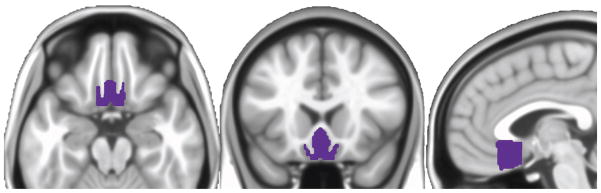
Background: Treatment approaches for major depressive disorder (MDD) result in approximately one third of patients achieving remission after a first treatment. Added treatment generally improves remission rates, but approximately one third of all patients fail to respond after several treatments (sequential monotherapies or combined treatment). A pretreatment biomarker could help identify these patients. Overactivity of the subcallosal cingulate has been associated with failure of response to treatment in MDD, and it is a potential candidate for such a biomarker.
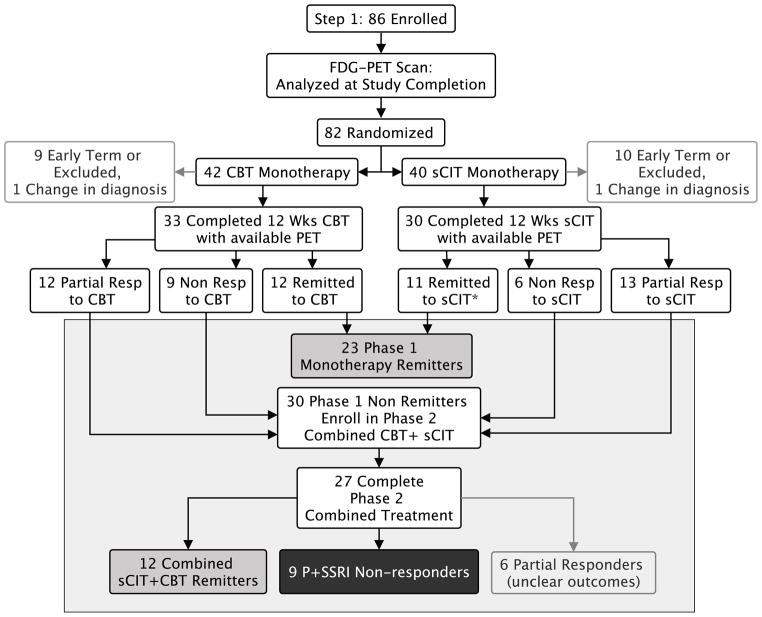
Methods: Investigators enrolled 82 patients with MDD currently not receiving treatment in a two-phase treatment study. Patients underwent a fluorodeoxyglucose positron emission tomography scan. After scanning, patients were randomly assigned to 12 weeks of treatment with either escitalopram or cognitive-behavioral therapy (CBT). Patients not achieving remission after 12 weeks of initial treatment were treated with an additional 12 weeks of escitalopram plus CBT. Subcallosal cingulate metabolism was compared between patients who failed to achieve a response and patients who achieved remission as a result of either phase one or phase two treatment. This analysis was followed by a whole-brain analysis making the same comparison.
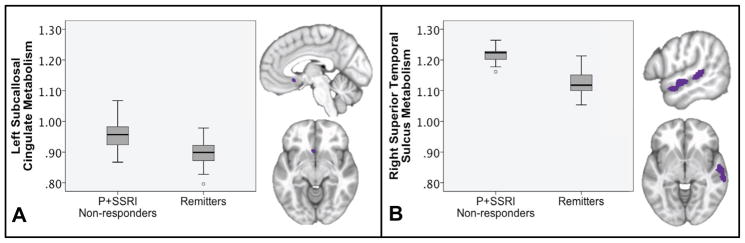
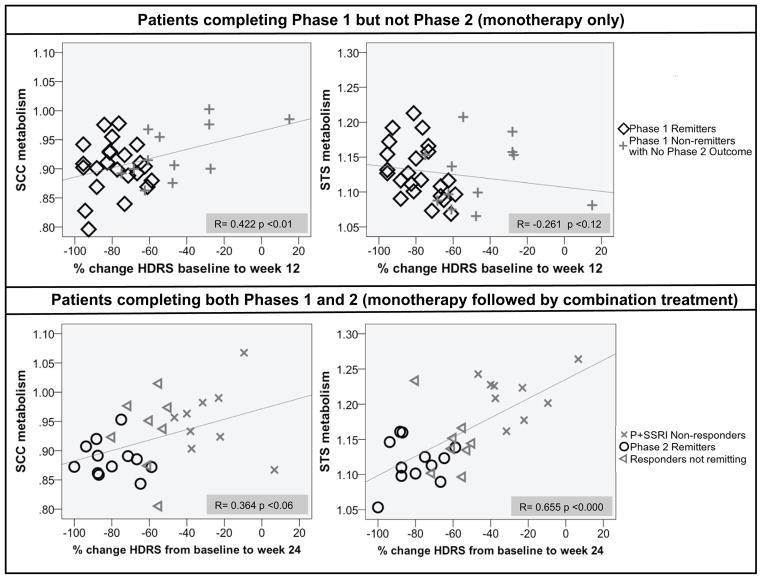
Results: After two phases of treatment (24 weeks), 36 patients were identified as remitters, 6 patients were responders, and 9 patients were nonresponders. Subcallosal cingulate metabolism was significantly higher in nonresponders than remitters. In the follow-up whole-brain analysis, increased superior temporal sulcus activity was also associated with nonresponse to two treatments.
Conclusions: Patients with MDD who fail to achieve remission as a result of CBT or escitalopram, either alone or in combination, have a distinct brain metabolic pattern compared with patients who achieve remission as a result of CBT, escitalopram, or their combination.
Trial registration: ClinicalTrials.gov NCT00367341.
Keywords: Antidepressant medication; biomarker; depression; psychotherapy; subcallosal cingulate; superior temporal sulcus.
Copyright © 2014 Society of Biological Psychiatry. Published by Elsevier Inc. All rights reserved.
Figures
References
-
- American Psychiatric Association. Diagnostic and Statistical Manual of Mental Disorders - Text Revision. 4. Washington, DC: American Psychiatric Press; 2000.
-
- Kennedy SH, Lam RW, Parikh SV, Patten SB, Ravindran AV. Canadian Network for Mood and Anxiety Treatments (CANMAT) Clinical guidelines for the management of major depressive disorder in adults. Introduction. J Affect Disord. 2009;117(Suppl):S1–2. - PubMed
-
- American Psychiatric Association. Treating major depressive disorder: a quick reference guide. Washington, DC: American Psychiatric Press; 2010.
-
- National Collaborating Center for Mental Health. Depression: The treatment and management of depression in adults. Leicester (UK): British Psychological Society; 2009.
-
- Gaynes BN, Dusetzina SB, Ellis AR, Hansen RA, Farley JF, Miller WC, Stürmer T. Treating depression after initial treatment failure: directly comparing switch and augmenting strategies in STAR*D. J Clin Psychopharmacol. 2012;32:114–119. - PubMed
Publication types
MeSH terms
Substances
Associated data
Grants and funding
LinkOut - more resources
Full Text Sources
Other Literature Sources
Medical
