


Minimum pricing of alcohol versus volumetric taxation: which policy will reduce heavy consumption without adversely affecting light and moderate consumers?
- PMID: 24465368
- PMCID: PMC3898955
- DOI: 10.1371/journal.pone.0080936
Minimum pricing of alcohol versus volumetric taxation: which policy will reduce heavy consumption without adversely affecting light and moderate consumers?
Abstract
Background: We estimate the effect on light, moderate and heavy consumers of alcohol from implementing a minimum unit price for alcohol (MUP) compared with a uniform volumetric tax.
Methods: We analyse scanner data from a panel survey of demographically representative households (n = 885) collected over a one-year period (24 Jan 2010-22 Jan 2011) in the state of Victoria, Australia, which includes detailed records of each household's off-trade alcohol purchasing.
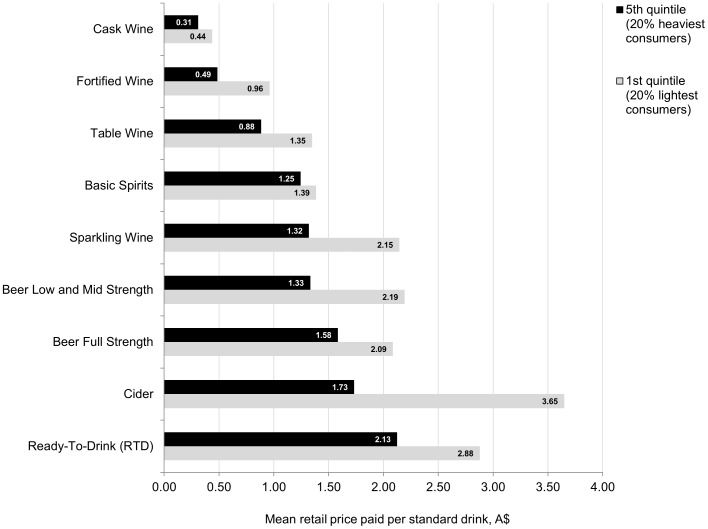
Findings: The heaviest consumers (3% of the sample) currently purchase 20% of the total litres of alcohol (LALs), are more likely to purchase cask wine and full strength beer, and pay significantly less on average per standard drink compared to the lightest consumers (A$1.31 [95% CI 1.20-1.41] compared to $2.21 [95% CI 2.10-2.31]). Applying a MUP of A$1 per standard drink has a greater effect on reducing the mean annual volume of alcohol purchased by the heaviest consumers of wine (15.78 LALs [95% CI 14.86-16.69]) and beer (1.85 LALs [95% CI 1.64-2.05]) compared to a uniform volumetric tax (9.56 LALs [95% CI 9.10-10.01] and 0.49 LALs [95% CI 0.46-0.41], respectively). A MUP results in smaller increases in the annual cost for the heaviest consumers of wine ($393.60 [95% CI 374.19-413.00]) and beer ($108.26 [95% CI 94.76-121.75]), compared to a uniform volumetric tax ($552.46 [95% CI 530.55-574.36] and $163.92 [95% CI 152.79-175.03], respectively). Both a MUP and uniform volumetric tax have little effect on changing the annual cost of wine and beer for light and moderate consumers, and likewise little effect upon their purchasing.
Conclusions: While both a MUP and a uniform volumetric tax have potential to reduce heavy consumption of wine and beer without adversely affecting light and moderate consumers, a MUP offers the potential to achieve greater reductions in heavy consumption at a lower overall annual cost to consumers.
Conflict of interest statement
Figures
References
-
- Lim SS, Vos T, Flaxman AD, Danaei G, Shibuya K, et al. (2012) A comparative risk assessment of burden of disease and injury attributable to 67 risk factors and risk factor clusters in 21 regions, 1990—2010: a systematic analysis for the Global Burden of Disease Study 2010. The Lancet 380 9859: 2224–2260. - PMC - PubMed
-
- Anderson P, Chisholm D, Fuhr DC (2009) Effectiveness and cost-effectiveness of policies and programmes to reduce the harm caused by alcohol. The Lancet 373: 2234–46. - PubMed
-
- Chikritzhs T, Stockwell T, Pascal R (2005) The impact of the Northern Territory's Living With Alcohol program, 1992–2002: revisiting the evaluation. Addiction 100: 1625–1636. - PubMed
-
- Carragher N, Chalmers J (2011) What are the options? Pricing and taxation policy reforms to reduce excessive alcohol consumption and related harms in Australia. Sydney: NSW Bureau of Crime Statistics and Research.
-
- Sornpaisarn B, Shield KD, Rehm J (2012) Alcohol taxation policy in Thailand: implications for other low- to middle-income countries. Addiction 107: 1372–1384. - PubMed
Publication types
MeSH terms
LinkOut - more resources
Full Text Sources
Other Literature Sources
Medical
