. 2014 Jan 17;9(1):e81604.
doi: 10.1371/journal.pone.0081604. eCollection 2014.

Antibiotic resistance determinants in a Pseudomonas putida strain isolated from a hospital

Affiliations

Antibiotic resistance determinants in a Pseudomonas putida strain isolated from a hospital

Lázaro Molina et al. PLoS One. .

Abstract

Environmental microbes harbor an enormous pool of antibiotic and biocide resistance genes that can impact the resistance profiles of animal and human pathogens via horizontal gene transfer. Pseudomonas putida strains are ubiquitous in soil and water but have been seldom isolated from humans. We have established a collection of P. putida strains isolated from in-patients in different hospitals in France. One of the isolated strains (HB3267) kills insects and is resistant to the majority of the antibiotics used in laboratories and hospitals, including aminoglycosides, ß-lactams, cationic peptides, chromoprotein enediyne antibiotics, dihydrofolate reductase inhibitors, fluoroquinolones and quinolones, glycopeptide antibiotics, macrolides, polyketides and sulfonamides. Similar to other P. putida clinical isolates the strain was sensitive to amikacin. To shed light on the broad pattern of antibiotic resistance, which is rarely found in clinical isolates of this species, the genome of this strain was sequenced and analysed. The study revealed that the determinants of multiple resistance are both chromosomally-borne as well as located on the pPC9 plasmid. Further analysis indicated that pPC9 has recruited antibiotic and biocide resistance genes from environmental microorganisms as well as from opportunistic and true human pathogens. The pPC9 plasmid is not self-transmissible, but can be mobilized by other bacterial plasmids making it capable of spreading antibiotic resistant determinants to new hosts.


Conflict of interest statement

Competing Interests: The authors have the following interests: One of the co-authors, Dr. Matilde Fernandez, is affiliated with Bio-Iliberis R&D, a CSIC spin off company. This does not alter the authors' adherence to all the PLOS ONE policies on sharing data and materials.

Figures

Figure 1
Figure 1. The pPC9 map.
Genetic organization of pPC9, in white, genes forming the backbone of pPC9, in grey genes from the insert with homology to genes related to transposition, in black genes from the insert with antibiotic resistance function.
Figure 2
Figure 2. Genetic organization of the pPC9 “insert.”
Black arrows represent genes with functions related to antibiotic resistance. In grey are genes with functions related to transposition and insertion machinery. Non-colored genes are those that encode hypothetical proteins, those with unknown function, or those with functions unrelated to antibiotic resistance, transposition or integration. Horizontal lines over genes represent DNA homology to different microorganisms, and percentages indicate the degree of homology.
Figure 3
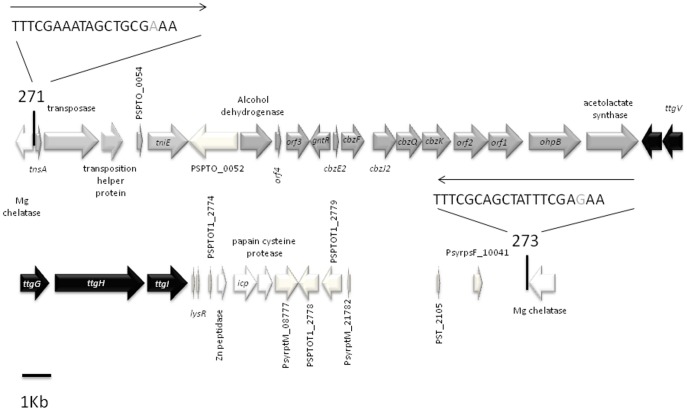
Figure 3. Location of the antibiotic and solvent efflux ttgGHI pumps within a genomic island in the chromosome of strain HB3267.
ttgGHI efflux genes are indicated in black; genes involved in transposition events are in light grey; the cbz operon, which is involved in chlorobenzene degradation, is in medium grey. Vertical lines indicate the insertion point; arrows above the sequence indicate the inverted repeat sequences of the Tn552-like transposon, which are within the magnesium chelatase.
Figure 4
Figure 4. Potential chromosomal determinants for chloramphenicol resistance of HB3267.
(A) In black, chromosomal location of the additional pqqC gene of HB3267.; in grey, the region of the HB3267 chromosome that is not present in KT2440; in white, genes in synteny with KT2440. (B) Protein alignment of AgmR from P. putida HB3267 (HB3267, Locus B479_11475), P. putida S16 (S16, PPS_2213), P. putida KT2440 (PPS_2213, PP_2665), P. putida BIRD-1 (BIRD1, PPUBIRD1_3011), P. putida GB-1 (GB1, PputGB1_3138), P. aeruginosa PA7 (PA7, PSPA7_3317), and P. aeruginosa PAO1 (PAO1, PA1978) strains. Amino acid mutations referred to in the text are indicated in bold.

References

    1. Bielaszewska M, Mellmann A, Zhang W, Köck R, Fruth A, et al. (2011) Characterisation of the Escherichia coli strain associated with an outbreak of haemolytic uraemic syndrome in Germany, 2011: a microbiological study. Lancet Infect Dis 11: 671–676. - PubMed
    1. Rasko DA, Webster DR, Sahl JW, Bashir A, Boisen N, et al. (2011) Origins of the Escherichia coli strain causing an outbreak of hemolytic-uremic syndrome in Germany. N Engl J Med 365: 709–717. - PMC - PubMed
    1. Fernández M, Duque E, Pizarro-Tobías P, Van Dillewijn P, Wittich RM, et al. (2009) Microbial responses to xenobiotic compounds. Identification of genes that allow Pseudomonas putida KT2440 to cope with 2,4,6-trinitrotoluene. Microb Biotechnol 2: 287–294. - PMC - PubMed
    1. Wu X, Monchy S, Taghavi S, Zhu W, Ramos J, et al. (2011) Comparative genomics and functional analysis of niche-specific adaptation in Pseudomonas putida . FEMS Microbiol Rev 35: 299–323. - PMC - PubMed
    1. Dogan NM, Kantar C, Gulcan S, Dodge CJ, Yilmaz BC, et al. (2011) Chromium(VI) bioremoval by Pseudomonas bacteria: role of microbial exudates for natural attenuation and biotreatment of Cr(VI) contamination. Environ Sci Technol 45: 2278–2285. - PubMed

Publication types

MeSH terms

Associated data

LinkOut - more resources