


Texting and walking: strategies for postural control and implications for safety
- PMID: 24465402
- PMCID: PMC3898913
- DOI: 10.1371/journal.pone.0084312
Texting and walking: strategies for postural control and implications for safety
Erratum in
- PLoS One. 2014;9(2):e91489
Abstract
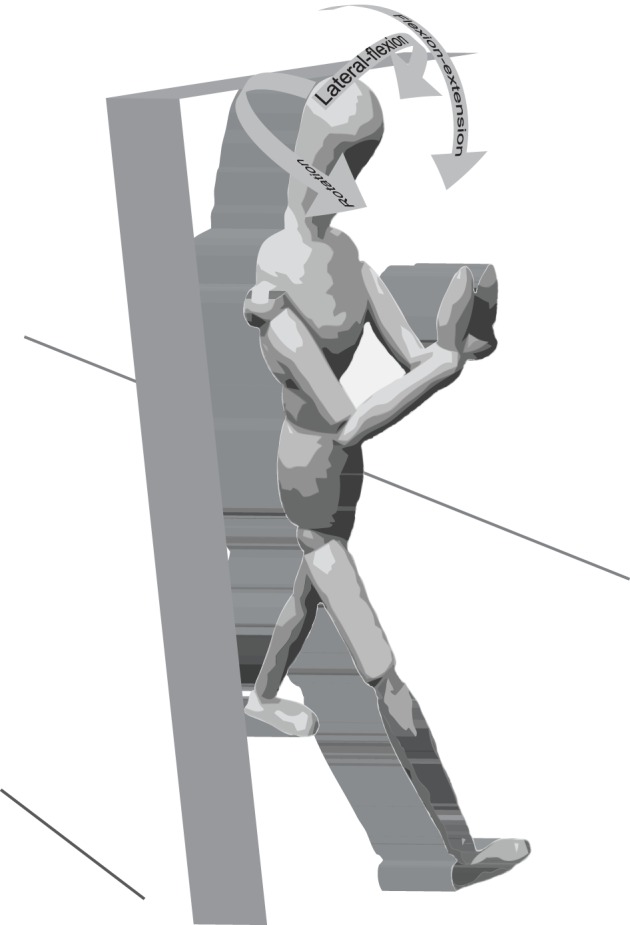
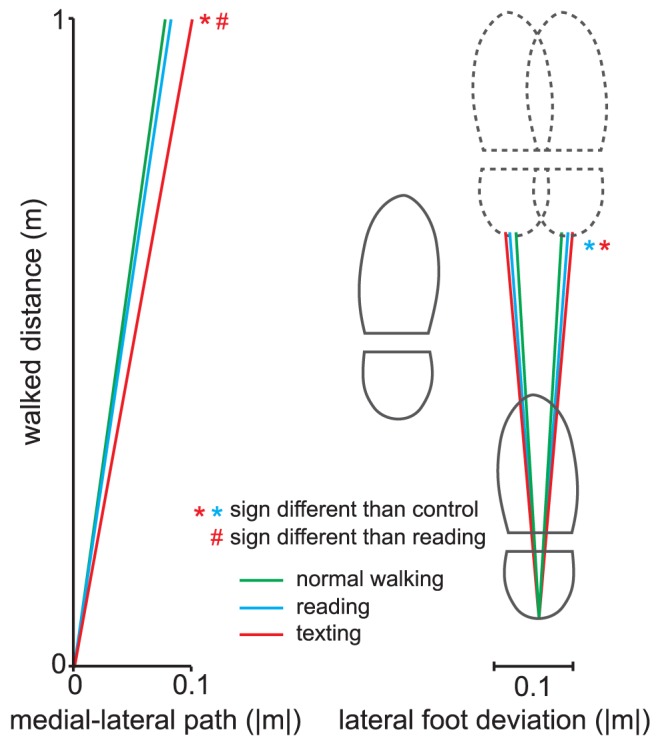
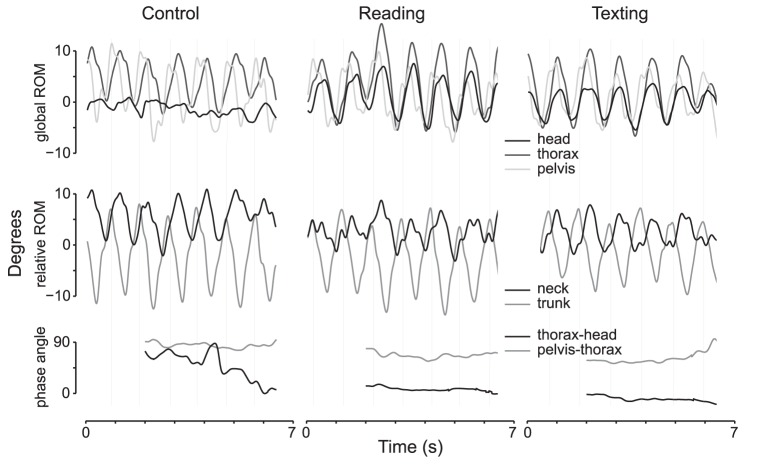
There are concerns about the safety of texting while walking. Although evidence of negative effects of mobile phone use on gait is scarce, cognitive distraction, altered mechanical demands, and the reduced visual field associated with texting are likely to have an impact. In 26 healthy individuals we examined the effect of mobile phone use on gait. Individuals walked at a comfortable pace in a straight line over a distance of ∼8.5 m while; 1) walking without the use of a phone, 2) reading text on a mobile phone, or 3) typing text on a mobile phone. Gait performance was evaluated using a three-dimensional movement analysis system. In comparison with normal waking, when participants read or wrote text messages they walked with: greater absolute lateral foot position from one stride to the next; slower speed; greater rotation range of motion (ROM) of the head with respect to global space; the head held in a flexed position; more in-phase motion of the thorax and head in all planes, less motion between thorax and head (neck ROM); and more tightly organized coordination in lateral flexion and rotation directions. While writing text, participants walked slower, deviated more from a straight line and used less neck ROM than reading text. Although the arms and head moved with the thorax to reduce relative motion of the phone and facilitate reading and texting, movement of the head in global space increased and this could negatively impact the balance system. Texting, and to a lesser extent reading, modify gait performance. Texting or reading on a mobile phone may pose an additional risk to safety for pedestrians navigating obstacles or crossing the road.
Conflict of interest statement
Figures
References
-
- Drews FA, Yazdani H, Godfrey CN, Cooper JM, Strayer DL (2009) Text messaging during simulated driving. Human factors 51: 762–770. - PubMed
-
- Hosking SG, Young KL, Regan MA (2009) The effects of text messaging on young drivers. Human factors 51: 582–592. - PubMed
-
- Demura S, Uchiyama M (2009) Influence of cell phone email use on characteristics of gait. European Journal of Sport Science 9: 303–309.
-
- Richtel M (2010) Driven to distraction. Forget Gum. Walking and using phone is risky. New York Times: A1.
Publication types
MeSH terms
LinkOut - more resources
Full Text Sources
Other Literature Sources
Medical
