. 2014 Jan 21;9(1):e85853.
doi: 10.1371/journal.pone.0085853. eCollection 2014.

Global distribution of two fungal pathogens threatening endangered sea turtles

Affiliations

Global distribution of two fungal pathogens threatening endangered sea turtles

Jullie M Sarmiento-Ramírez et al. PLoS One. .

Abstract

Nascent fungal infections are currently considered as one of the main threats for biodiversity and ecosystem health, and have driven several animal species into critical risk of extinction. Sea turtles are one of the most endangered groups of animals and only seven species have survived to date. Here, we described two pathogenic species, i.e., Fusarium falciforme and Fusarium keratoplasticum, that are globally distributed in major turtle nesting areas for six sea turtle species and that are implicated in low hatch success. These two fungi possess key biological features that are similar to emerging pathogens leading to host extinction, e.g., high virulence, and a broad host range style of life. Their optimal growth temperature overlap with the optimal incubation temperature for eggs, and they are able to kill up to 90% of the embryos. Environmental forcing, e.g., tidal inundation and clay/silt content of nests, were correlated to disease development. Thus, these Fusarium species constitute a major threat to sea turtle nests, especially to those experiencing environmental stressors. These findings have serious implications for the survival of endangered sea turtle populations and the success of conservation programs worldwide.


Conflict of interest statement

Competing Interests: The authors have declared that no competing interests exist.

Figures

Figure 1
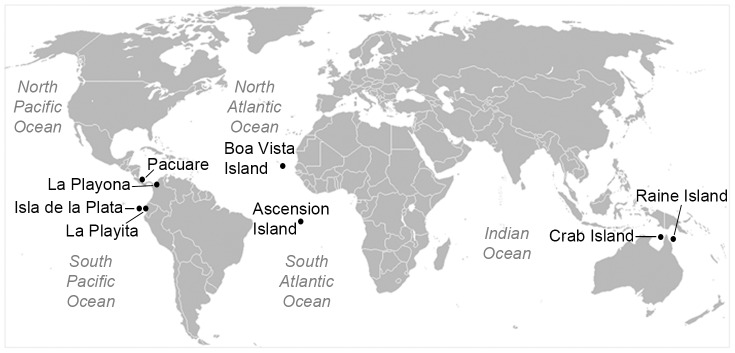
Figure 1. Sea turtle-nesting regions sampled for the presence of Fusarium.
Eggshells from a total of six species of sea turtle were collected from some of the main nesting beaches in the Atlantic, Indian and Pacific Oceans, and the Caribbean Sea, i.e., Chelonia mydas (Raine Island, Australia; Isla de la Plata at Machalilla National Park, Ecuador; and Ascension Island), Caretta caretta (Boa Vista Island, Cape Verde), Eretmochelys imbricata and Lepidochelys olivacea (La Playita, Machalilla National Park), Dermochelys coriacea (La Playona, Colombia and Pacuare Nature Reserve, Costa Rica), and Natator depresus (Crab Island, Australia).
Figure 2
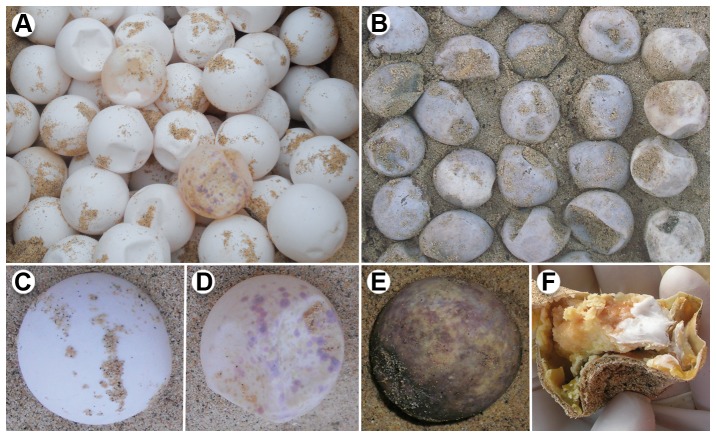
Figure 2. Nests of the sea turtle species Caretta caretta affected by Fusarium at different stages of incubation.
(A) Nest at initial stage of incubation (two weeks) showing an egg with characteristic signs of Fusarium infection (yellowish, reddish and bluish spots). (B) Nest at final stage of incubation (eight weeks) with all eggs with advanced signs of Fusarium infection. (C–D) Eggs at early stage of incubation. (C) Healthy asymptomatic egg. (D) Symptomatic egg. (E–F) Eggs at late stage of incubation. E) Egg with severe signs of Fusarium disease. F) Dead embryo on Fusarium infection with white mycelia inside the egg.
Figure 3
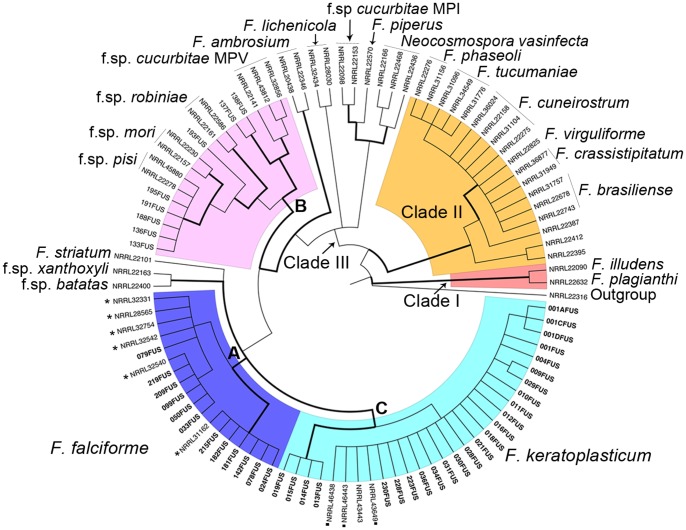
Figure 3. Bootstrapped multilocus out-group-rooted cladogram.
Summarized cladogram of the Fusarium solani species complex inferred from the DNA regions: ITS nrDNA, LSU nrDNA and RPB2. Thick branches correspond to highly supported groups, i.e., posterior probability (PP) and the bootstrap values (BS) of the parsimony and Bayesian analysis when PP≥0.95 and BS≥70. The sea turtle isolates are highlighted in bold. A solid asterisk to the right of an NRRL number identifies the F. falciforme isolates. A solid rectangle to the right of an NRRL number identifies F. keratoplasticum isolates. For full details of three, see Figure S2.
Figure 4
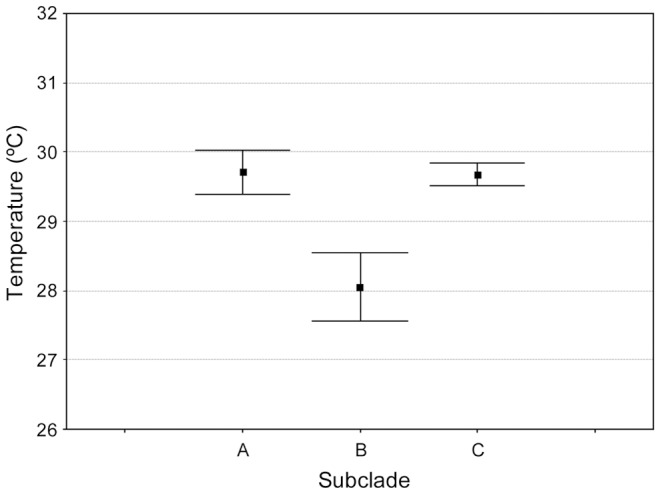
Figure 4. Mean optimal growth temperature (OGT) of Fusarium isolates.
The OGT was calculated for selected isolates from the sea turtle pathogenic species clustered in subclades A (Fusarium falciforme) and C (Fusarium keratoplasticum) and non- sea turtle isolates clustered in subclade B, within the Fusarium solani species complex. Differences in OGT for each group of isolates were determined by one-way ANOVA followed by a post-hoc Tukey HSD test. Data represent mean ± standard error bars (s.e.m) of three independent experiments.
Figure 5
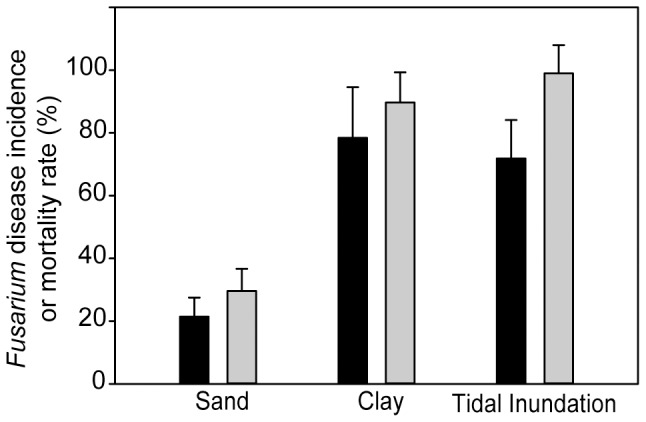
Figure 5. Environmental factors involved on embryonic mortality rate and Fusarium-disease incidence.
The embryonic mortality rate and Fusarium disease incidence were obtained from nests of the sea turtle species Caretta caretta in Boa Vista, Cape Verde. Statistics were determined by one-way ANOVA (p>0.01) followed by a post-hoc Tukey HSD analysis. Columns represent the average of the Fusarium disease incidence (black column) and mortality rate (grey columns) ± standard error bars (s.e.m).

References

    1. Fisher MC, Henk DA, Briggs CJ, Brownstein JS, Madoff LC, et al. (2012) Emerging fungal threats to animal, plant and ecosystem health. Nature 484: 186–194. - PMC - PubMed
    1. Gargas A, Trest MT, Christensen M, Volk TJ, Blehert DS (2009) Geomyces destructans sp. nov. associated with bat white-nose syndrome. Mycotaxon 108: 147–154.
    1. Stuart SN, Chanson JS, Cox NA, Young BE, Rodrigues ASL, et al. (2004) Status and trends of amphibian declines and extinctions worldwide. Science 306: 1783–1786. - PubMed
    1. Kim K, Harvell CD (2004) The rise and fall of six a six-year coral-fungal epizootic. The American Naturalis 163: S52–S63. - PubMed
    1. Cameron SA, Lozier JD, Strange JP, Koch JB, Cordes N, et al. (2011) Patterns of widespread decline in North American bumble bees. Procedings of the National Academy of Science of the United States of America 108: 662–667. - PMC - PubMed

Publication types

LinkOut - more resources