Electrophysiologic investigation during facial motor neuron suppression in patients with hemifacial spasm: possible pathophysiology of hemifacial spasm: a pilot study
- PMID: 24466519
- PMCID: PMC3895524
- DOI: 10.5535/arm.2013.37.6.839
Electrophysiologic investigation during facial motor neuron suppression in patients with hemifacial spasm: possible pathophysiology of hemifacial spasm: a pilot study
Abstract
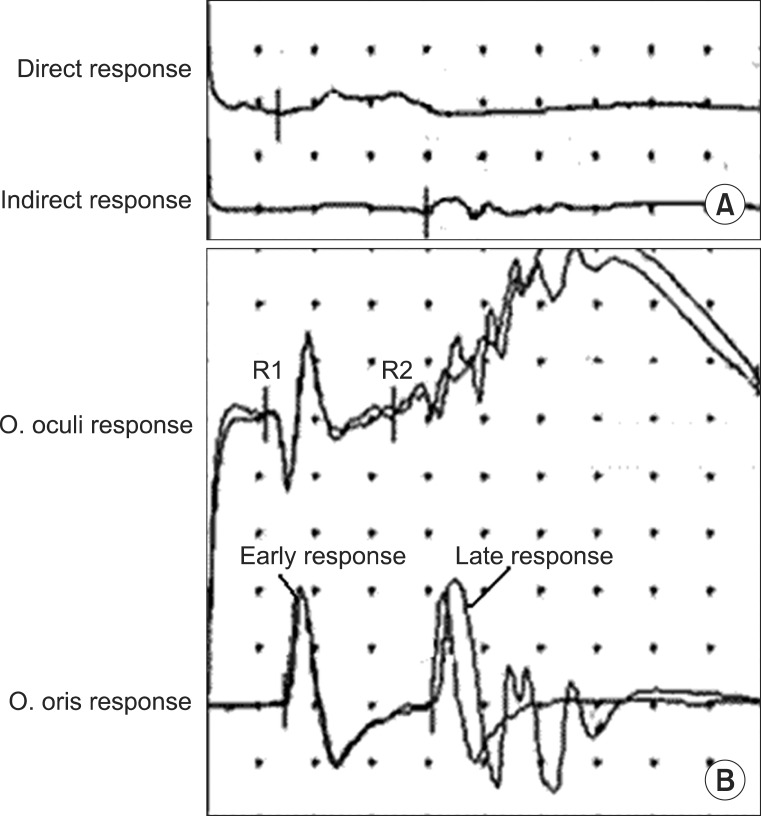
Objective: To evaluate the pathophysiological mechanism of hemifacial spasm (HFS), we performed electrophysiological examinations, such as supraorbital nerve stimulation with orbicularis oris muscle recording and lateral spread tests, after suppressing the patient's central nervous system by administering intravenous diazepam.
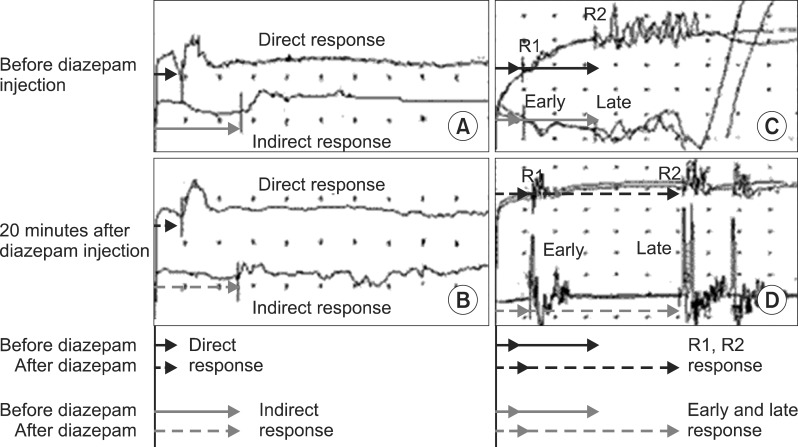
Methods: Six patients with HFS were recruited. Supraorbital nerve stimulation with orbicularis oris muscle recording and the lateral spread test were performed, followed by intravenous application of 10 mg diazepam to achieve facial motor neuron suppression. Subsequently, we repeated the two electrophysiological experiments mentioned above at 10 and 20 minutes after the patients had received the diazepam intravenously.
Results: Orbicularis oris muscle responses were observed in all patients after supraorbital nerve stimulation and lateral spread tests. After the diazepam injection, no orbicularis oris muscle response to supraorbital nerve stimulation was observed in one patient, and the latencies of this response were evident as a slowing tendency with time in the remaining five patients. However, the latencies of the orbicularis oris muscle responses were observed consistently in all patients in the lateral spread test.
Conclusion: Our results suggest that ectopic excitation/ephaptic transmission contributes to the pathophysiological mechanisms of HFS. This is because the latencies of the orbicularis oris muscle responses in the lateral spread test were observed consistently in the suppressed motor neuron in our patients.
Keywords: Blinking; Diazepam; Electromyography; Hemifacial spasm; Pathophysiology.
Conflict of interest statement
No potential conflicts of interest relation to this article was reported.
Figures
References
-
- Nielsen VK. Pathophysiology of hemifacial spasm: I. Ephaptic transmission and ectopic excitation. Neurology. 1984;34:418–426. - PubMed
-
- Auger RG. Hemifacial spasm: clinical and electrophysiologic observations. Neurology. 1979;29(9 Pt 1):1261–1272. - PubMed
-
- Maroon JC. Hemifacial spasm: a vascular cause. Arch Neurol. 1978;35:481–483. - PubMed
-
- Jannetta PJ, Abbasy M, Maroon JC, Ramos FM, Albin MS. Etiology and definitive microsurgical treatment of hemifacial spasm. Operative techniques and results in 47 patients. J Neurosurg. 1977;47:321–328. - PubMed
-
- Moller AR. Interaction between the blink reflex and the abnormal muscle response in patients with hemifacial spasm: results of intraoperative recordings. J Neurol Sci. 1991;101:114–123. - PubMed
LinkOut - more resources
Full Text Sources
Other Literature Sources