. 2014 May;171(9):2385-98.
doi: 10.1111/bph.12588.

Epac and the high affinity rolipram binding conformer of PDE4 modulate neurite outgrowth and myelination using an in vitro spinal cord injury model

Affiliations

Epac and the high affinity rolipram binding conformer of PDE4 modulate neurite outgrowth and myelination using an in vitro spinal cord injury model

S D Boomkamp et al. Br J Pharmacol. 2014 May.

Abstract

Background and purpose: cAMP and pharmacological inhibition of PDE4, which degrades it, are promising therapeutic targets for the treatment of spinal cord injury (SCI). Using our previously described in vitro SCI model, we studied the mechanisms by which cAMP modulators promote neurite outgrowth and myelination using enantiomers of the PDE4-specific inhibitor rolipram and other modulators of downstream signalling effectors.

Experimental approach: Rat mixed neural cell myelinating cultures were cut with a scalpel and treated with enantiomers of the PDE4-specific inhibitor rolipram, Epac agonists and PKA antagonists. Neurite outgrowth, density and myelination were assessed by immunocytochemistry and cytokine levels analysed by qPCR.

Key results: Inhibition of the high-affinity rolipram-binding state (HARBS), rather than the low-affinity rolipram binding state (LARBS) PDE4 conformer promoted neurite outgrowth and myelination. These effects were mediated through the activation of Epac and not through PKA. Expression of the chemokine CXCL10, known to inhibit myelination, was markedly elevated in astrocytes after Rho inhibition and this was blocked by inhibition of Rho kinase or PDE4.

Conclusions and implications: PDE4 inhibitors targeted at the HARBS conformer or Epac agonists may provide promising novel targets for the treatment of SCI. Our study demonstrates the differential mechanisms of action of these compounds, as well as the benefit of a combined pharmacological approach and highlighting potential promising targets for the treatment of SCI. These findings need to be confirmed in vivo.

Keywords: Epac; PDE4; cAMP; myelination; neurite outgrowth; spinal cord injury.


Figures

Figure 1
Figure 1
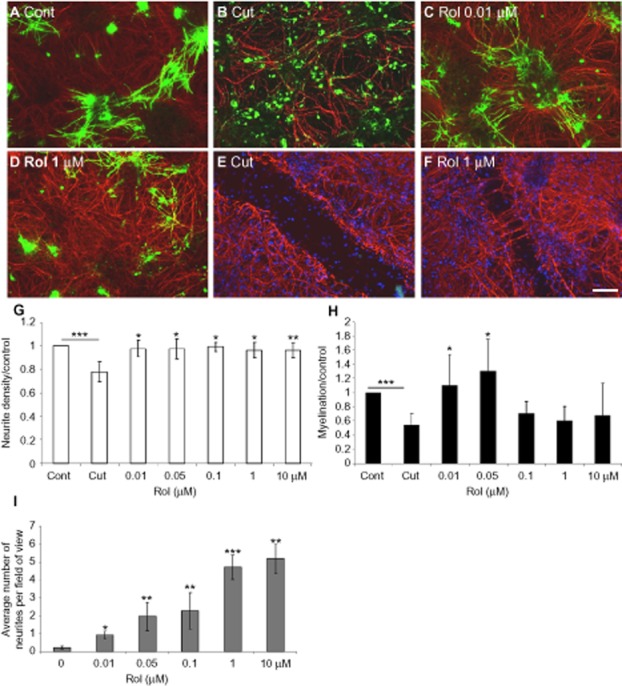
Rolipram induces myelination and neurite outgrowth. Immunolabelling of control, (A), cut (B: adjacent to the lesion, E: lesion site), and cut cultures treated with 10 nM (C) or 1 μM (D: adjacent to the lesion, F: lesion site) rolipram (Rol) with SMI-31 (red) and anti-PLP/DM20 (green) antibody. Cultures were cut at day 24, and treated with varying concentrations of rolipram (μM) 1 day after cutting. The cultures were treated for 6 days prior to immunocytochemistry and quantification of neurite density (G) and myelination (H) surrounding the lesion, as well as neurite outgrowth into the lesion (I). Scale bar 100 μm. *P < 0.05, **P < 0.01, ***P < 0.001, significant differences between control and cut, and treatments and cut.
Figure 2
Figure 2
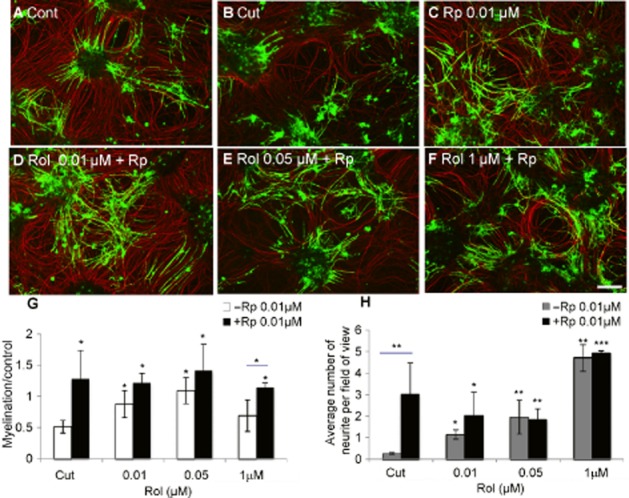
At high concentrations, rolipram inhibits myelination through PKA. Cultures were cut (B) and treated with varying concentrations of rolipram (Rol, 10 nM: D, 50 nM: E, 1 μM: F) in the presence (D–F) or absence of 10 nM Rp-cAMPS (Rp) (C). The cultures were treated for 6 days prior to immunocytochemistry using SMI-31 (red) and anti-PLP (green) and quantification of neurite density (data not shown) and myelination (G) surrounding the lesion, as well as neurite outgrowth into the lesion (H). Scale bar 100 μm. *P < 0.05, **P < 0.01, ***P < 0.001; significant differences between cut with/without Rp-cAMPS and rolipram-treated cut cultures with/without Rp-cAMPS.
Figure 3
Figure 3
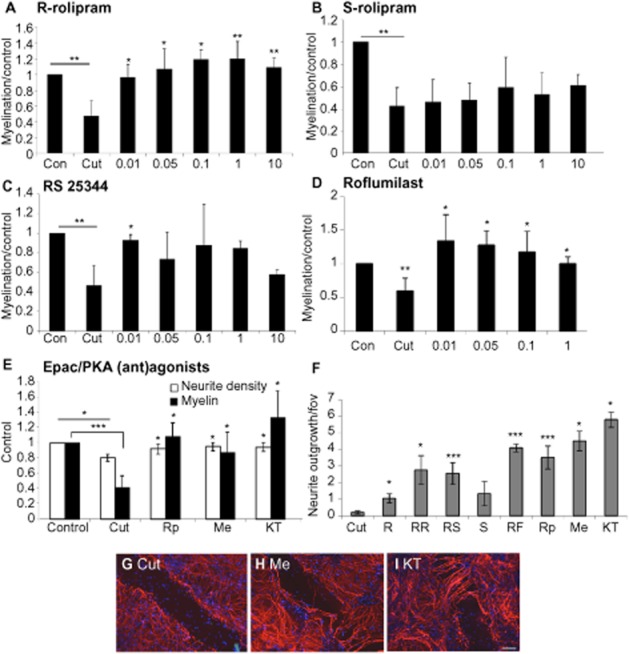
Myelination is primarily mediated via HARBS and Epac. Cut myelinating cultures were treated with varying concentrations (in μM) of R-rolipram (RR; A), S-rolipram (S; B), RS25344 (RS; C),roflumilast (RF; D), Epac/PKA (ant)agonists RpcAMPS (Rp), Me-cAMP (Me), KT5720 (KT; E), and the change in myelination surrounding the lesion, normalized to control, quantified. Neurite density surrounding the lesion was restored to control levels by all drugs tested (data not shown). In addition, the extent of neurite outgrowth into the lesion is shown in F (all at 10 nM), and representative images of the lesion site are shown of untreated cut cultures (G), cultures treated with Me-cAMP (Me; H) and KT5720 (KT; I). Scale bar 100 μm. *P < 0.05, **P < 0.01, ***P < 0.001; significant differences between control and cut, and treatments and cut.
Figure 4
Figure 4
Rolipram inhibits Rho activation. Cultures were cut and treated with 50 nM rolipram for 6 days prior to immunolabelling with phalloidin (green) and anti-phosphomyosin (red; A–C). Quantification was performed by measuring the intensities of each antibody staining, normalized to the number of DAPI-nuclei, and compared with the effects of Rho/ROCK inhibitors C3 (1 μg mL−1) and Y27632 (1 μM; D). Scale bar 25 μm. *P < 0.05, **P < 0.01, ***P < 0.001; significant differences between control and cut, and treatments and cut. Western blotting for activated RhoA using beads and total Rho was performed on these cell lysates (E). The blots shown are representative of experiments performed three times.
Figure 5
Figure 5
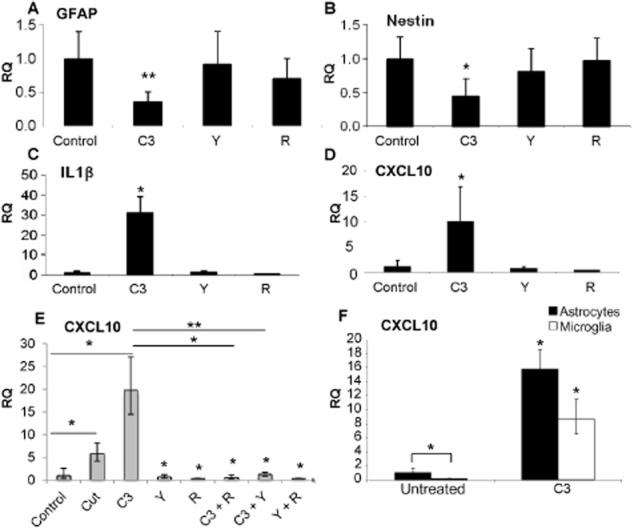
C3 Rho inhibitor enhances expression of mRNA for CXCL10 and IL-1β. qRT-PCR was performed on neurosphere-derived astrocytes (A–D) treated with 1 μg mL−1 C3, 1 μM Y27632 or 10 nM rolipram for 1 day, and levels of GFAP (A), nestin (B), IL-1β (C), CXCL10 (D) assessed. Changes in the RNA levels of CXCL10 were also elucidated in the cut myelinating cultures after treatment with these inhibitors, individually and combined (E) and purified microglia (F). The asterisks indicate changes. *P < 0.05, **P < 0.01; significant differences between control and treatments (A–D, F) and in (E), control and cut, and cut and treatment.
Figure 6
Figure 6
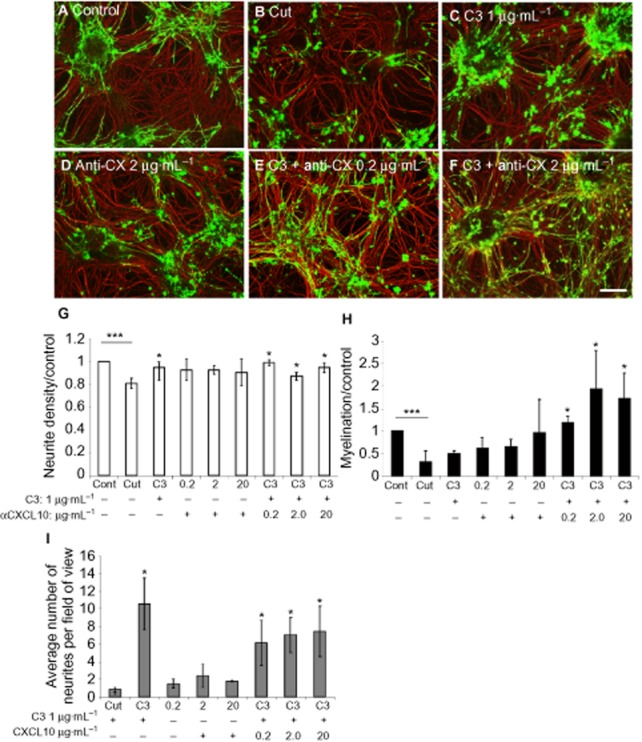
Treatment with C3 and anti-CXCL10 induces neurite outgrowth and myelination. Cut cultures (B) were immunolabelled with SMI-31 (red) and anti-PLP antibody (green) upon treatment with C3 1 μg mL−1 (C), anti-CXCL10 2 μg mL−1 (D), C3 and anti-CXCL10 0.2 μg mL−1 (E) and C3 and anti-CXCL10 2 μg mL−1 (F). The average neurite density (G) and myelination surrounding the lesion (H), normalized to control, and neurite outgrowth across the lesion (I) are shown. Scale bar 100 μm. *P < 0.05, **P < 0.001; significant differences between control and cut, and treatments and cut.
Figure 7
Figure 7
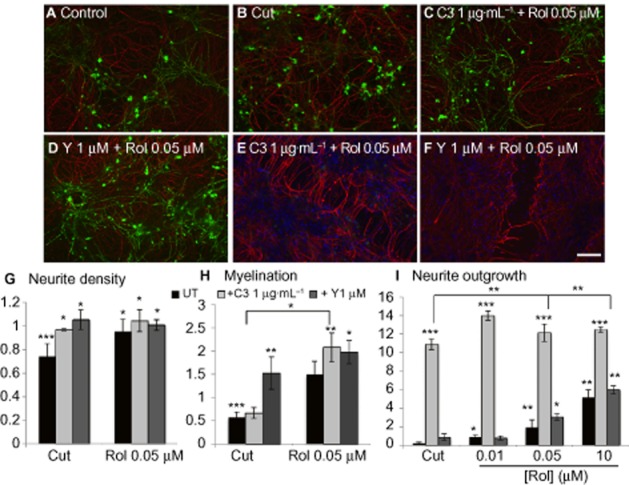
Rho/ROCK and PDE4 inhibition produces additive effects. Cultures were cut (B) and treated with C3 1 μg mL−1 and rolipram (C, E) or Y27632 and rolipram (D, F) for 6 days prior to immunocytochemistry with SMI-31 (red) and anti-PLP (green) labelling. Neurite density (G) and myelination (H) surrounding the lesion, normalized to control and neurite outgrowth (I) were calculated. Scale bar 100 μm. The asterisks indicate changes between control and cut, and treatments and cut. *P < 0.05, **P < 0.01, **P < 0.001; significant differences between control and cut, and treatments and cut. UT, untreated.
Figure 8
Figure 8
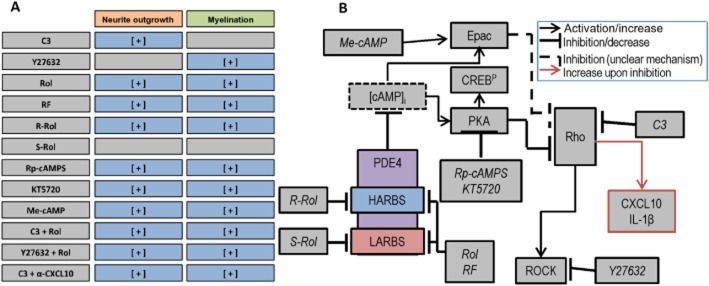
Proposed mechanisms of action of cAMP and Rho/ROCK modulators of neurite outgrowth and myelination. (A) Summary of the effects of the tested compounds (Rol, rolipram; RF, roflumilast; α-CXCL10, antibody to CXCL10) on neurite outgrowth and myelination. (B) Proposed mechanisms and targets of the compounds. cAMP (degraded by PDE4) can activate signalling molecules PKA and Epac. In turn, these effectors can inhibit downstream effector molecules Rho and ROCK. Targets of the inhibitors are indicated.

References

    1. Alexander SPH, Benson HE, Faccenda E, Pawson AJ, Sharman JL, Spedding M, et al. The Concise Guide to PHARMACOLOGY 2013/14: Enzymes. British Journal of Pharmacology. 2013;170:1797–1867. - PMC - PubMed
    1. Beaumont E, Whitaker CM, Burke DA, Hetman M, Onifer SM. Effects of rolipram on adult rat oligodendrocytes and functional recovery after contusive cervical spinal cord injury. Neuroscience. 2009;163:985–990. - PMC - PubMed
    1. Boomkamp SD, Riehle MO, Wood J, Olson M, Barnett SC. The development of a rat in vitro model of spinal cord injury demonstrating the additive effects of Rho and ROCK inhibitors on neurite outgrowth and myelination. Glia. 2012;3:441–456. - PubMed
    1. Burgin AB, Magnusson OT, Singh J, Witte P, Staker BL, Bjornsson JM, et al. Design of phosphodiesterase 4D (PDE4D) allosteric modulators for enhancing cognition with improved safety. Nat Biotechnol. 2010;28:63–70. - PubMed
    1. Cai D, Shen Y, De Bellard M, Tang S, Filbin MT. Prior exposure to neurotrophins blocks inhibition of axonal regeneration by MAG and myelin via a cAMP-dependent mechanism. Neuron. 1999;22:89–101. - PubMed

Publication types

MeSH terms