


A novel recurrent mutation in ATP1A3 causes CAPOS syndrome
- PMID: 24468074
- PMCID: PMC3937150
- DOI: 10.1186/1750-1172-9-15
A novel recurrent mutation in ATP1A3 causes CAPOS syndrome
Abstract
Background: We undertook genetic analysis of three affected families to identify the cause of dominantly-inherited CAPOS (cerebellar ataxia, areflexia, pes cavus, optic atrophy and sensorineural hearing loss) syndrome.
Methods: We used whole-exome sequencing to analyze two families affected with CAPOS syndrome, including the original family reported in 1996, and Sanger sequencing to assess familial segregation of rare variants identified in the probands and in a third, apparently unrelated family with CAPOS syndrome.
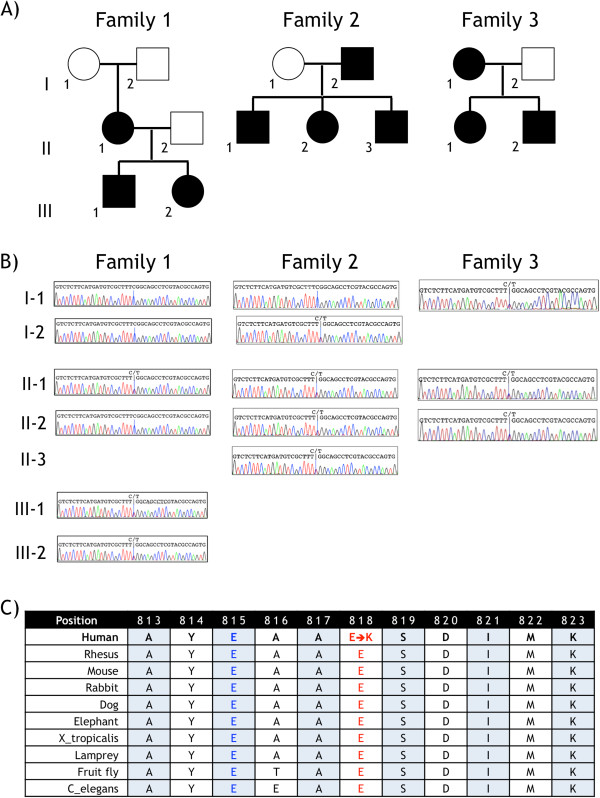
Results: We found an identical heterozygous missense mutation, c.2452G > A (p.(Glu818Lys)), in the Na⁺/K⁺ ATPase α₃(ATP1A3) gene in the proband and his affected sister and mother, but not in either unaffected maternal grandparent, in the first family. The same mutation was also identified in the proband and three other affected members of the second family and in all three affected members of the third family. This mutation was not found in more than 3600 chromosomes from unaffected individuals.
Conclusion: Other mutations in ATP1A3 have previously been demonstrated to cause rapid-onset dystonia-parkinsonism (also called dystonia-12) or alternating hemiplegia of childhood. This study shows that an allelic mutation in ATP1A3 produces CAPOS syndrome.
Figures
References
-
- Gibson WT, Hood RL, Zhan SH, Bulman DE, Fejes AP, Moore R, Mungall AJ, Eydoux P, Babul-Hirji R, An J, Marra MA, Canada Consortium FORGE, Chitayat D, Boycott KM, Weaver DD, Jones SJ. Mutations in EZH2 cause weaver syndrome. Am J Hum Genet. 2012;90:110–118. doi: 10.1016/j.ajhg.2011.11.018. - DOI - PMC - PubMed
-
- Burrows-wheeler aligner. [ http://bio-bwa.sourceforge.net/]
-
- SAMtools. [ http://samtools.sourceforge.net/]
-
- dbSNP. [ http://www.ncbi.nlm.nih.gov/SNP/]
Publication types
MeSH terms
Substances
Supplementary concepts
Grants and funding
LinkOut - more resources
Full Text Sources
Other Literature Sources
Molecular Biology Databases
