


Class D β-lactamases: are they all carbapenemases?
- PMID: 24468778
- PMCID: PMC4023754
- DOI: 10.1128/AAC.02522-13
Class D β-lactamases: are they all carbapenemases?
Abstract
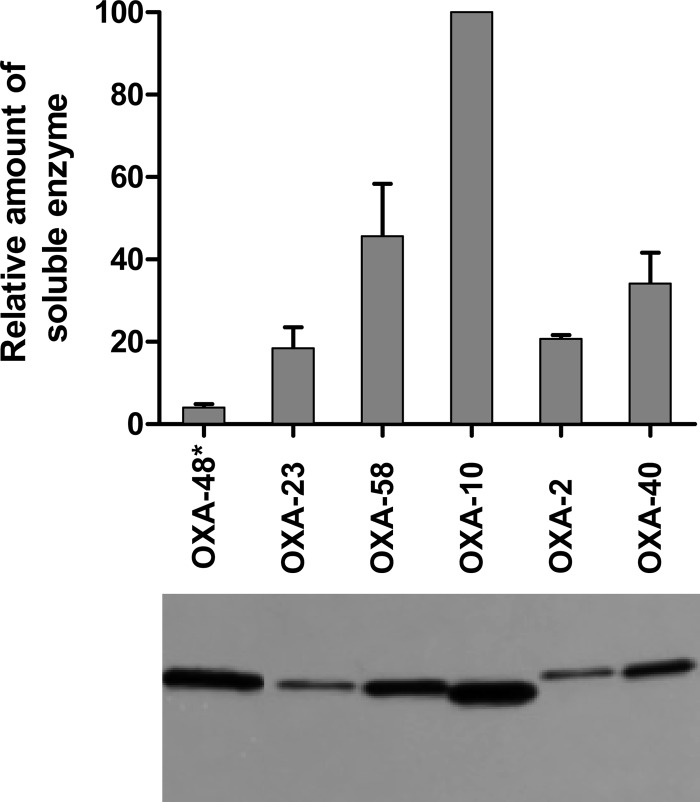
Carbapenem-hydrolyzing class D β-lactamases (CHDLs) are enzymes of the utmost clinical importance due to their ability to produce resistance to carbapenems, the antibiotics of last resort for the treatment of various life-threatening infections. The vast majority of these enzymes have been identified in Acinetobacter spp., notably in Acinetobacter baumannii. The OXA-2 and OXA-10 enzymes predominantly occur in Pseudomonas aeruginosa and are currently classified as narrow-spectrum class D β-lactamases. Here we demonstrate that when OXA-2 and OXA-10 are expressed in Escherichia coli strain JM83, they produce a narrow-spectrum antibiotic resistance pattern. When the enzymes are expressed in A. baumannii ATCC 17978, however, they behave as extended-spectrum β-lactamases and confer resistance to carbapenem antibiotics. Kinetic studies of OXA-2 and OXA-10 with four carbapenems have demonstrated that their catalytic efficiencies with these antibiotics are in the same range as those of some recognized class D carbapenemases. These results are in disagreement with the classification of the OXA-2 and OXA-10 enzymes as narrow-spectrum β-lactamases, and they suggest that other class D enzymes that are currently regarded as noncarbapenemases may in fact be CHDLs.
Figures
References
MeSH terms
Substances
Grants and funding
LinkOut - more resources
Full Text Sources
Other Literature Sources
Molecular Biology Databases
Miscellaneous
