


Trajectories of posttraumatic stress among urban residents
- PMID: 24469249
- PMCID: PMC3991929
- DOI: 10.1007/s10464-014-9634-6
Trajectories of posttraumatic stress among urban residents
Abstract
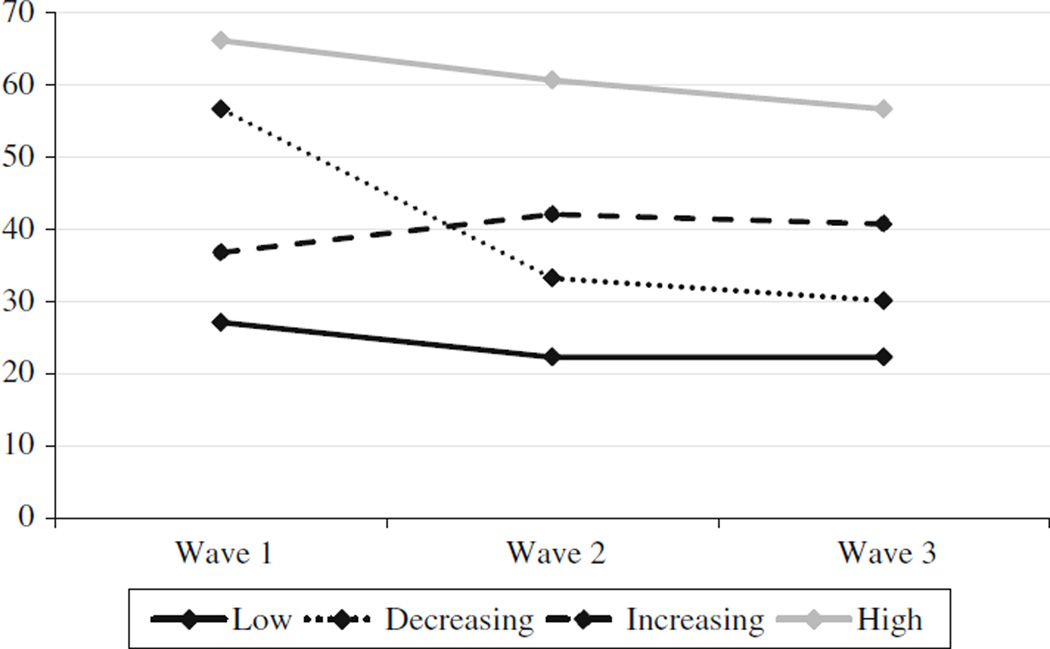
Urban residents experience a wide range of traumatic events and are at increased risk of assaultive violence. Although previous research has examined trajectories of posttraumatic stress (PTS) through latent class growth analysis (LCGA) among persons exposed to the same index events (e.g., a natural disaster), PTS trajectories have not been documented among urban residents. The aims of this study were to conduct LGCA with a sample of trauma survivors from Detroit, Michigan (N = 981), and to explore predictors of trajectory membership. Participants completed three annual telephone surveys, each of which included the posttraumatic stress disorder (PTSD) Checklist-Civilian Version. Four PTS trajectories were detected. Although the majority evidenced a trajectory of consistently few symptoms (Low: 72.5%), 4.6% were in a trajectory of chronic severe PTSD (High), and the remainder were in trajectories of consistently elevated, but generally subclinical, levels of PTS (Decreasing: 12.3%; Increasing: 10.6%). Socioeconomic disadvantage (e.g., lower income), more extensive trauma history (e.g., childhood abuse), and fewer social resources (e.g., lower social support) were associated with membership in higher PTS trajectories, relative to the Low trajectory. The results suggest that efforts to reduce PTS in urban areas need to attend to socioeconomic vulnerabilities in addition to trauma history and risk for ongoing trauma exposure.
Figures
References
-
- American Psychological Association. Diagnostic and statistical manual of mental disorders. 4th ed. Washington, DC: Author; 1994.
-
- Andruff H, Carraro N, Thompson A, Gandreau P, Louvet B. Latent class growth modeling: A tutorial. Tutorials in Quantitative Methods for Psychology. 2009;5:11–24. Retrieved from http://www.tqmp.org.
-
- Asparouhov T, Múthen B. Auxiliary variables in mixture modeling: 3-step approaches using Mplus. 2013 Retrieved from www.statmodel.com.
-
- Bernstein DP, Fink L, Handelsman L, Foote J, Lovejoy M, Wenzel K, et al. Initial reliability and validity of a new retrospective measure of child abuse and neglect. American Journal of Psychiatry. 1994;15:1132–1136. Retrieved from http://ajp.psychiatryonline.org/ - PubMed
Publication types
MeSH terms
Grants and funding
LinkOut - more resources
Full Text Sources
Other Literature Sources
Medical
