


Effects of carvedilol on cardiac autonomic nerve activities during sinus rhythm and atrial fibrillation in ambulatory dogs
- PMID: 24469435
- PMCID: PMC4081622
- DOI: 10.1093/europace/eut364
Effects of carvedilol on cardiac autonomic nerve activities during sinus rhythm and atrial fibrillation in ambulatory dogs
Abstract
Aims: We hypothesized that carvedilol can effectively suppress autonomic nerve activity (ANA) in ambulatory dogs during sinus rhythm and atrial fibrillation (AF), and that carvedilol withdrawal can lead to rebound elevation of ANA. Carvedilol is known to block pre-junctional β2-adrenoceptor responsible for norepinephrine release.
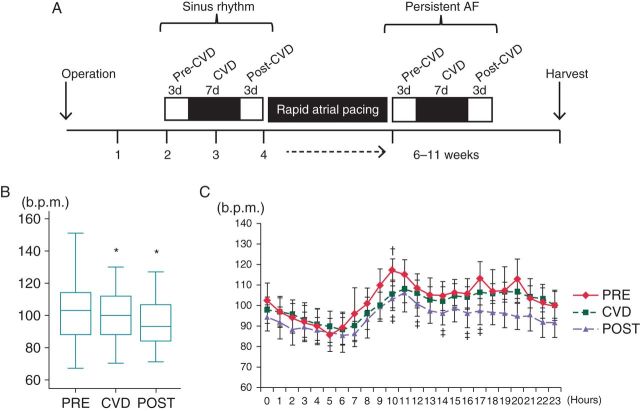
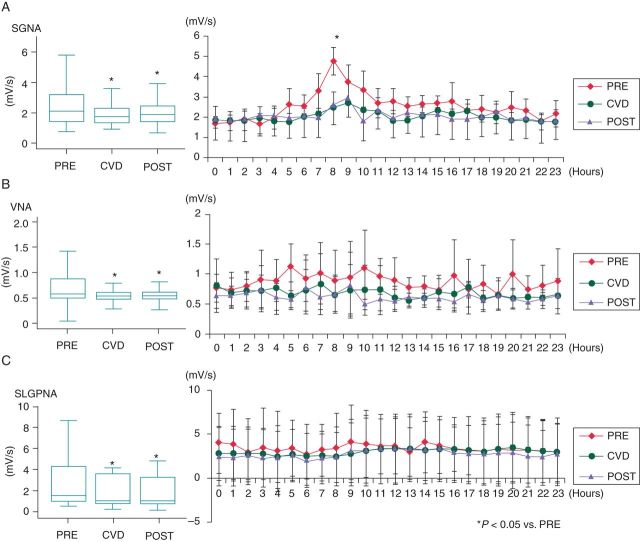
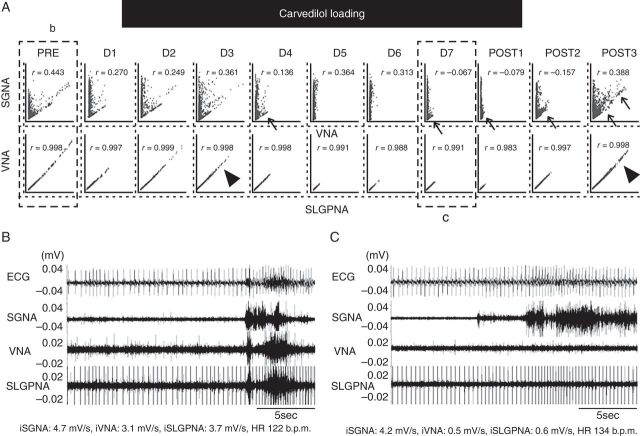
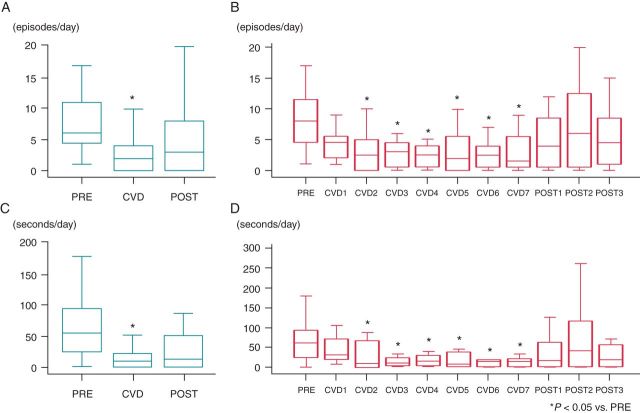
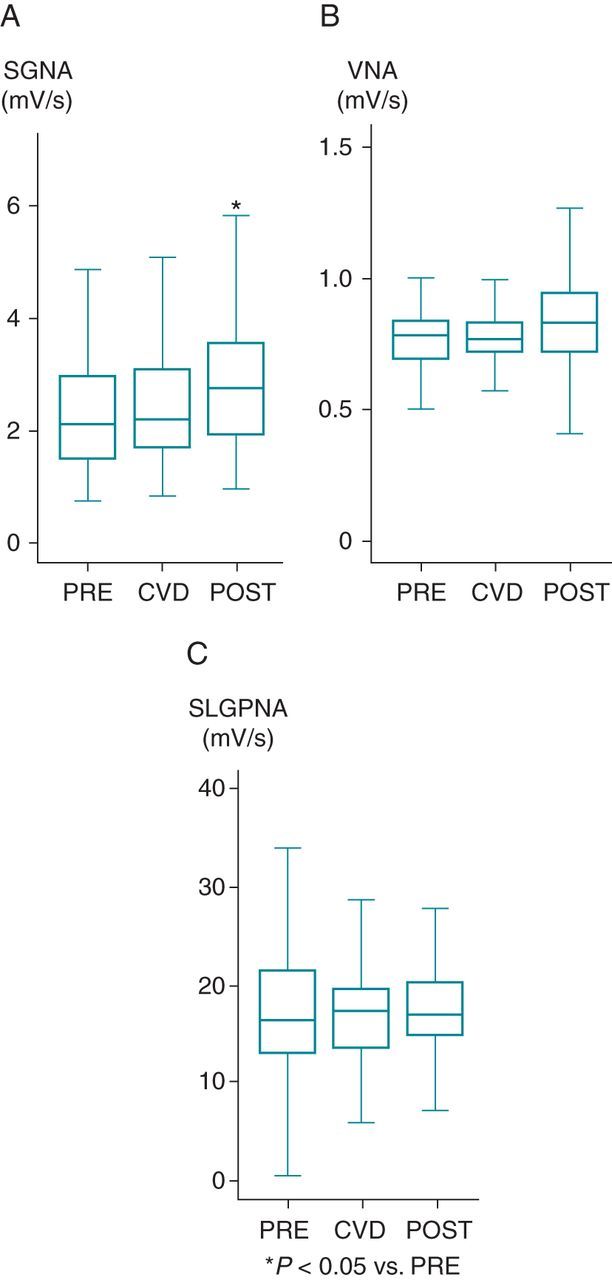
Methods and results: We implanted radiotransmitters to record stellate ganglion nerve activity (SGNA), vagal nerve activity (VNA), and superior left ganglionated plexi nerve activity (SLGPNA) in 12 ambulatory dogs. Carvedilol (12.5 mg orally twice a day) was given for 7 days during sinus rhythm (n = 8). Four of the eight dogs and an additional four dogs were paced into persistent AF. Carvedilol reduced heart rate [from 103 b.p.m. (95% confidence interval (CI), 100-105) to 100 b.p.m. (95% CI, 98-102), P = 0.044], suppressed integrated nerve activities (Int-NAs, SGNA by 17%, VNA by 19%, and SLGPNA by 12%; all P < 0.05 vs. the baseline), and significantly reduced the incidence (from 8 ± 6 to 3 ± 3 episodes/day, P < 0.05) and total duration (from 68 ± 64 to 16 ± 21 s/day, P < 0.05) of paroxysmal atrial tachycardia (PAT). Following the development of persistent AF, carvedilol loading was associated with AF termination in three dogs. In the remaining five dogs, Int-NAs were not significantly suppressed by carvedilol, but SGNA significantly increased by 16% after carvedilol withdrawal (P < 0.001).
Conclusion: Carvedilol suppresses ANA and PAT in ambulatory dogs during sinus rhythm.
Keywords: Arrhythmia; Atrial fibrillation; Atrium; Autonomic nervous system; Carvedilol.
Published on behalf of the European Society of Cardiology. All rights reserved. © The Author 2014. For permissions please email: journals.permissions@oup.com.
Figures
References
-
- Packer M, Bristow MR, Cohn JN, Colucci WS, Fowler MB, Gilbert EM, et al. The effect of carvedilol on morbidity and mortality in patients with chronic heart failure. U.S. Carvedilol Heart Failure Study Group. N Engl J Med. 1996;334:1349–55. - PubMed
-
- Merit-HF Study Group. Effect of metoprolol CR/XL in chronic heart failure: Metoprolol CR/XL Randomised Intervention Trial in Congestive Heart Failure (MERIT-HF) Lancet. 1999;353:2001–7. - PubMed
-
- Poole-Wilson PA, Swedberg K, Cleland JG, Di LA, Hanrath P, Komajda M, et al. Comparison of carvedilol and metoprolol on clinical outcomes in patients with chronic heart failure in the Carvedilol Or Metoprolol European Trial (COMET): randomised controlled trial. Lancet. 2003;362:7–13. - PubMed
-
- McMurray J, Kober L, Robertson M, Dargie H, Colucci W, Lopez-Sendon J, et al. Antiarrhythmic effect of carvedilol after acute myocardial infarction: results of the Carvedilol Post-Infarct Survival Control in Left Ventricular Dysfunction (CAPRICORN) trial. J Am Coll Cardiol. 2005;45:525–30. - PubMed
-
- Bristow MR, Feldman AM, Adams KF, Jr, Goldstein S. Selective versus nonselective beta-blockade for heart failure therapy: are there lessons to be learned from the COMET trial? J Card Fail. 2003;9:444–53. - PubMed
Publication types
MeSH terms
Substances
Grants and funding
LinkOut - more resources
Full Text Sources
Other Literature Sources
Medical
