. 2014 Apr;90(4):597-604.
doi: 10.4269/ajtmh.13-0614. Epub 2014 Jan 27.

Reemergence of Anopheles funestus as a vector of Plasmodium falciparum in western Kenya after long-term implementation of insecticide-treated bed nets

Affiliations

Reemergence of Anopheles funestus as a vector of Plasmodium falciparum in western Kenya after long-term implementation of insecticide-treated bed nets

Robert S McCann et al. Am J Trop Med Hyg. 2014 Apr.

Abstract

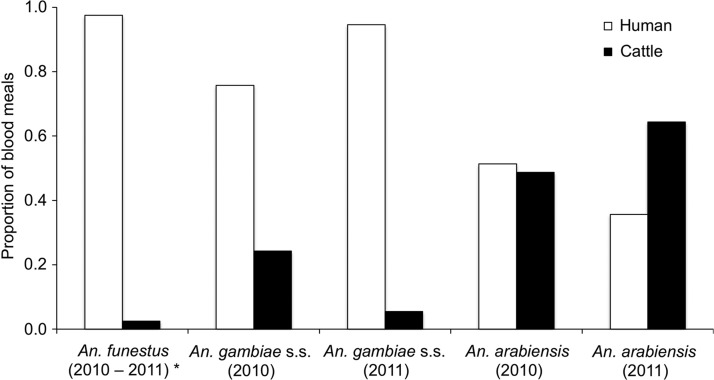
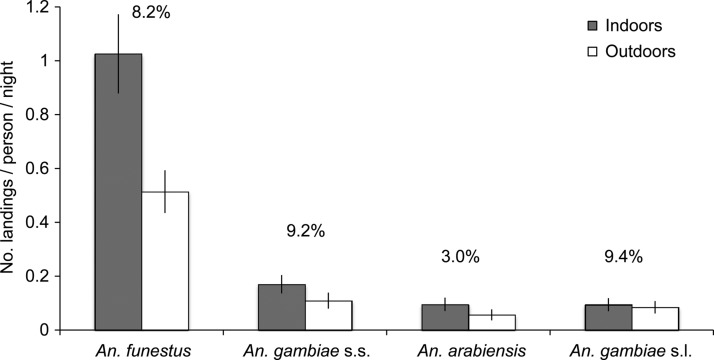
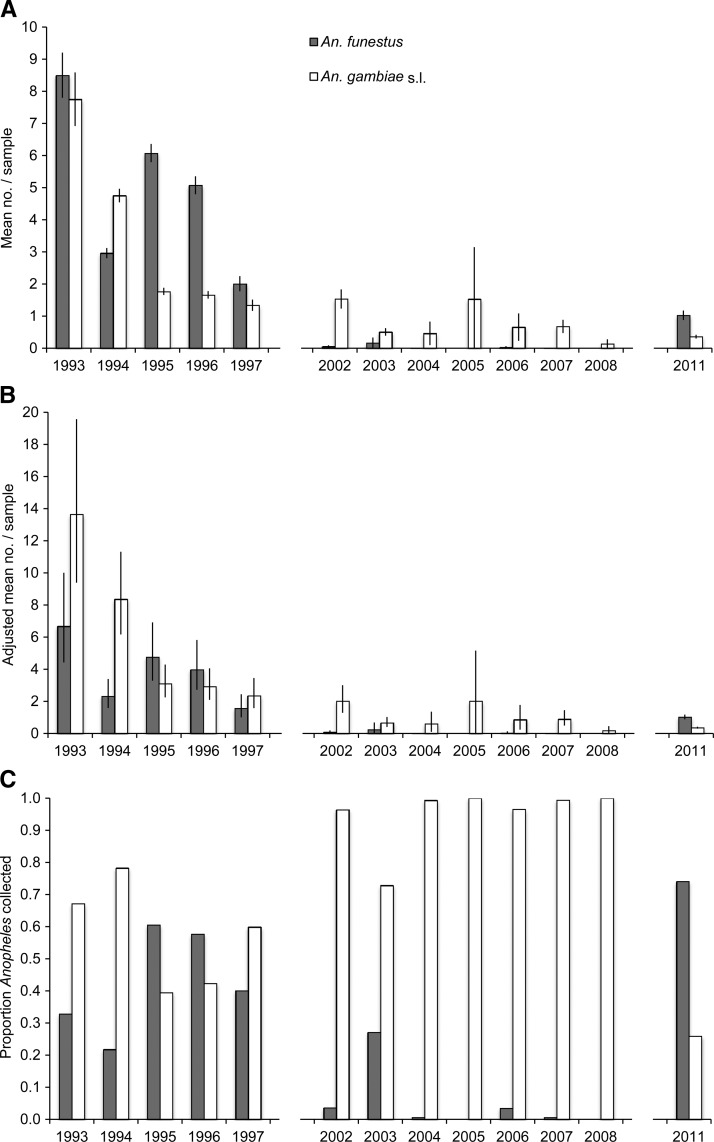
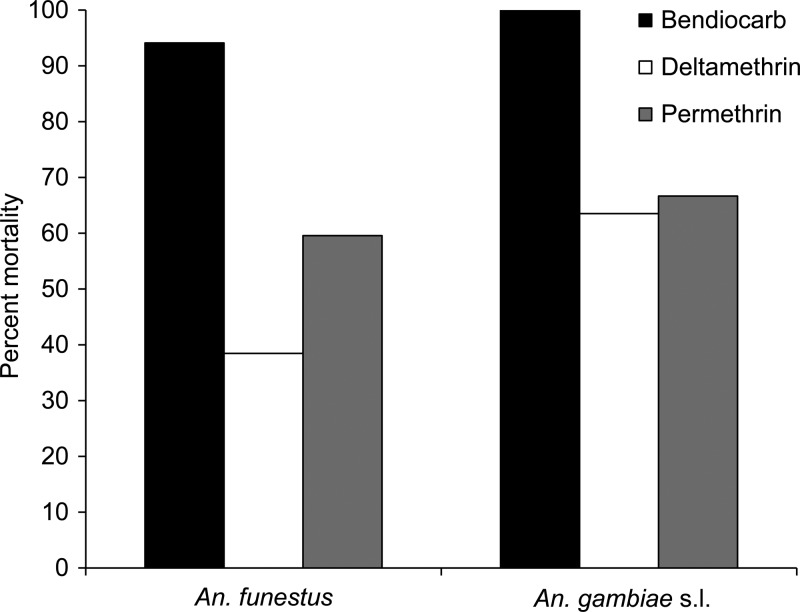
Historically, the malaria vectors in western Kenya have been Anopheles funestus, Anopheles gambiae s.s., and Anopheles arabiensis. Of these species, An. funestus populations declined the most after the introduction of insecticide-treated bed nets (ITNs) in the 1990s in Asembo, and collections of An. funestus in the region remained low until at least 2008. Contrary to findings during the early years of ITN use in Asembo, the majority of the Anopheles collected here in 2010 and 2011 were An. funestus. Female An. funestus had characteristically high Plasmodium falciparum sporozoite rates and showed nearly 100% anthropophily. Female An. funestus were found more often indoors than outdoors and had relatively low mortality rates during insecticide bioassays. Together, these results are of serious concern for public health in the region, indicating that An. funestus may once again be contributing significantly to the transmission of malaria in this region despite the widespread use of ITNs/long-lasting insecticidal nets (LLINs).


Figures
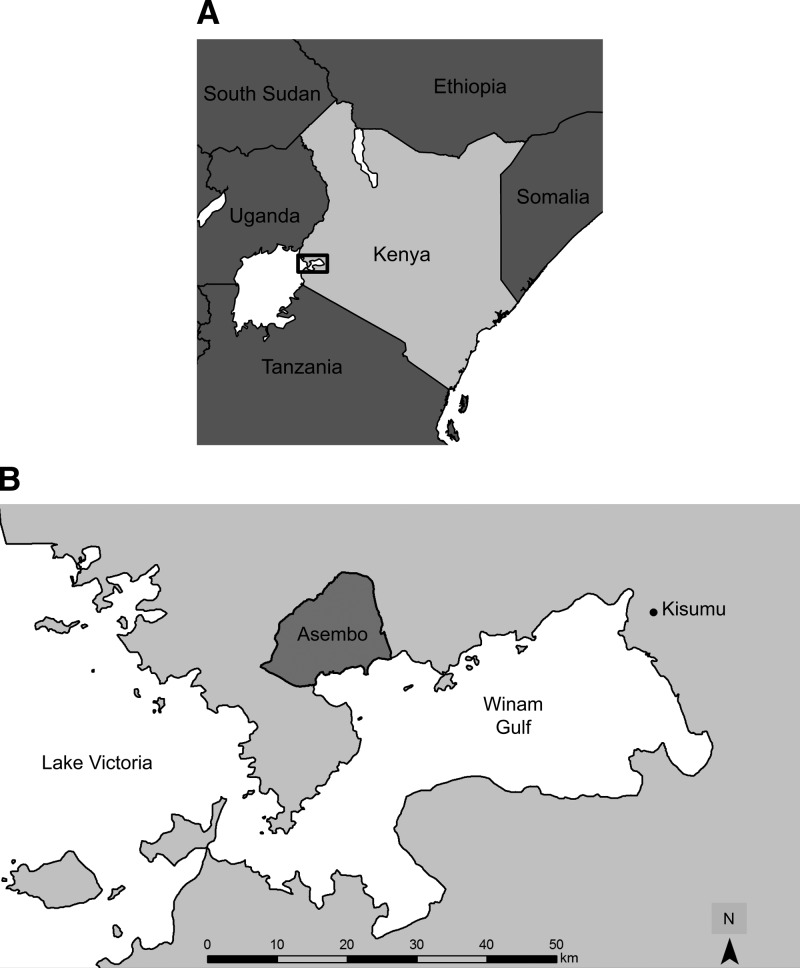
Figure 1.
Figure 1.
(A) Map of Kenya with box indicating location of the study region in Nyanza Province. (B) Map showing the location of Asembo on the shores of Lake Victoria, about 50 km west of the city of Kisumu.
Figure 2.
Figure 2.
Proportion of blood meals taken from humans and cattle by Anopheles species collected during pyrethrum spray catch in Asembo. Non-amplifiers to polymerase chain reaction for blood meal identification are not shown (29%). *Data pooled across years for Anopheles funestus because the proportions of blood meals from humans and cattle did not differ between years (Fisher's exact test, P = 1.00).
Figure 3.
Figure 3.
Number of Anopheles females collected per collector per night during human landing catch sampling shown by species and location (indoors/outdoors). Error bars are 95% confidence intervals. Plasmodium falciparum sporozoite rates as determined by enzyme-linked immunosorbent assays for specimens collected both indoors and outdoors are shown as percentages above each species. Anopheles gambiae s.l. specimens were identified as members of the An. gambiae species complex according to morphological methods but could not be further differentiated by polymerase chain reaction.
Figure 4.
Figure 4.
(A) Mean number of Anopheles females collected per sample in June through July from 1993 through 2011 using bed net traps (BNT; 1993–1997), light traps (LT; 2002–2008), and human landing catch (HLC; 2011). (B) Mean number of Anopheles females collected, adjusted for comparison to HLC sampling using the relative rates of BNT to HLC (1993–1997) and LT to HLC (2002–2008). (C) Proportion of total Anopheles females collected identified as either Anopheles funestus or Anopheles gambiae s.l. Error bars indicate 95% confidence intervals. Data were not available from 1998 to 2001, 2009, and 2010.
Figure 5.
Figure 5.
Percent mortality after 24 hours of wild-collected Anopheles funestus and Anopheles gambiae s.l. adults from Asembo when exposed to permethrin, deltamethrin, or bendiocarb in 1-hour World Health Organization tube bioassays.

References

    1. World Health Organization . World Malaria Report 2012. Geneva: World Health Organization; 2012. pp. 60–62.
    1. Feachem RG, Phillips AA, Hwang J, Cotter C, Wielgosz B, Greenwood BM, Sabot O, Rodríguez MH, Abeyasinghe RR, Ghebreyesus TA, Snow RW. Shrinking the malaria map: progress and prospects. Lancet. 2010;376:1566–1578. - PMC - PubMed
    1. Nájera JA, González-Silva M, Alonso PL. Some lessons for the future from the Global Malaria Eradication Programme (1955–1969) PLoS Med. 2011;8:e1000412. - PMC - PubMed
    1. Zhou G, Afrane YA, Vardo-Zalik AM, Atieli H, Zhong D, Wamae P, Himeidan YE, Minakawa N, Githeko AK, Yan G. Changing patterns of malaria epidemiology between 2002 and 2010 in western Kenya: the fall and rise of malaria. PLoS ONE. 2011;6:e20318. - PMC - PubMed
    1. Hamel MJ, Adazu K, Obor D, Sewe M, Vulule JM, Williamson JM, Slutsker L, Feikin DR, Laserson KF. A reversal in reductions of child mortality in western Kenya, 2003–2009. Am J Trop Med Hyg. 2011;85:597–605. - PMC - PubMed

Publication types

LinkOut - more resources