


Efficacy of face masks and respirators in preventing upper respiratory tract bacterial colonization and co-infection in hospital healthcare workers
- PMID: 24472436
- PMCID: PMC7172205
- DOI: 10.1016/j.ypmed.2014.01.015
Efficacy of face masks and respirators in preventing upper respiratory tract bacterial colonization and co-infection in hospital healthcare workers
Erratum in
- Prev Med. 2014 Dec;69:165
Abstract
Objective: We compared the efficacy of medical masks (MM) and N95 respirators (N95) in preventing bacterial colonization/infection in healthcare workers (HCWs).
Methods: A cluster randomized clinical trial (RCT) of 1441 hospital HCWs randomized to medical masks or N95 respirators, and compared to 481 control HCWs, was performed in Beijing, China, during the winter season of 2008-2009. Participants were followed for development of clinical respiratory illness (CRI). Symptomatic subjects were tested for Streptococcus pneumoniae, Bordetella pertussis, Chlamydia pneumoniae, Mycoplasma pneumoniae or Haemophilus influenza type B by multiplex polymerase chain reaction (PCR).
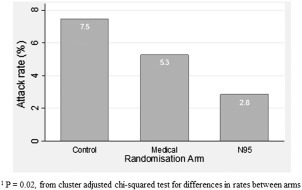
Results: The rate of bacterial colonization was 2.8% in the N95 group (p=0.02), 5.3% among medical mask users (p<0.01) and 7.5% among the controls (p=0.16). N95 respirators were significantly protective (adjusted RR 0.34, 95% CI: 0.21-0.56) against bacterial colonization. Co-infections of two bacteria or a virus and bacteria occurred in up to 3.7% of HCWs, and were significantly lower in the N95 arm.
Conclusions: N95 respirators were significantly protective against bacterial colonization, co-colonization and viral-bacterial co-infection. We showed that dual respiratory virus or bacterial-viral co-infections can be reduced by the use of N95 respirators. This study has occupational health and safety implications for health workers.
Keywords: Bacterial colonization; Healthcare workers; Hospitals; N95 respirators and medical masks.
Copyright © 2014. Published by Elsevier Inc.
Figures

Comment in
-
Efficacy of face masks and respirators in preventing upper respiratory tract bacterial colonization and co-infection in hospital healthcare workers - comment on the article by MacIntyre et al.Prev Med. 2014 Aug;65:153. doi: 10.1016/j.ypmed.2014.04.020. Epub 2014 May 24. Prev Med. 2014. PMID: 24863729 No abstract available.
-
Efficacy of face masks and respirators in preventing upper respiratory tract bacterial colonization and co-infection in hospital healthcare workers - authors' reply.Prev Med. 2014 Aug;65:154. doi: 10.1016/j.ypmed.2014.05.024. Epub 2014 Jun 3. Prev Med. 2014. PMID: 24905863 No abstract available.
References
-
- Addiss D.G., Davis J.P., Meade B.D. A pertussis outbreak in a Wisconsin nursing home. J. Infect. Dis. 1991;164:704–710. - PubMed
-
- Austrian R. Some aspects of the pneumococcal carrier state. J. Antimicrob. Chemother. 1986;18:35–45. - PubMed
-
- Baba H., Iinuma Y., Imaizumi K. Transmission of bacterial infections to healthcare workers during intubation and respiratory care of patients with severe pneumonia. Infect. Control Hosp. Epidemiol. 2009;30:1019–1021. - PubMed
-
- Balazy A., Toivola M., Adhikari A., Sivasubramani S.K., Reponen T., Grinshpun S.A. Do N95 respirators provide 95% protection level against airborne viruses, and how adequate are surgical masks? Am. J. Infect. Control. 2006;34:51–57. - PubMed
Publication types
MeSH terms
LinkOut - more resources
Full Text Sources
Other Literature Sources
