. 2014 Jan 28;5(1):e00928-13.
doi: 10.1128/mBio.00928-13.

Programmable removal of bacterial strains by use of genome-targeting CRISPR-Cas systems

Programmable removal of bacterial strains by use of genome-targeting CRISPR-Cas systems

Ahmed A Gomaa et al. mBio. .

Abstract

CRISPR (clustered regularly interspaced short palindromic repeats)-Cas (CRISPR-associated) systems in bacteria and archaea employ CRISPR RNAs to specifically recognize the complementary DNA of foreign invaders, leading to sequence-specific cleavage or degradation of the target DNA. Recent work has shown that the accidental or intentional targeting of the bacterial genome is cytotoxic and can lead to cell death. Here, we have demonstrated that genome targeting with CRISPR-Cas systems can be employed for the sequence-specific and titratable removal of individual bacterial strains and species. Using the type I-E CRISPR-Cas system in Escherichia coli as a model, we found that this effect could be elicited using native or imported systems and was similarly potent regardless of the genomic location, strand, or transcriptional activity of the target sequence. Furthermore, the specificity of targeting with CRISPR RNAs could readily distinguish between even highly similar strains in pure or mixed cultures. Finally, varying the collection of delivered CRISPR RNAs could quantitatively control the relative number of individual strains within a mixed culture. Critically, the observed selectivity and programmability of bacterial removal would be virtually impossible with traditional antibiotics, bacteriophages, selectable markers, or tailored growth conditions. Once delivery challenges are addressed, we envision that this approach could offer a novel means to quantitatively control the composition of environmental and industrial microbial consortia and may open new avenues for the development of "smart" antibiotics that circumvent multidrug resistance and differentiate between pathogenic and beneficial microorganisms.

Importance: Controlling the composition of microbial populations is a critical aspect in medicine, biotechnology, and environmental cycles. While different antimicrobial strategies, such as antibiotics, antimicrobial peptides, and lytic bacteriophages, offer partial solutions, what remains elusive is a generalized and programmable strategy that can distinguish between even closely related microorganisms and that allows for fine control over the composition of a microbial population. This study demonstrates that RNA-directed immune systems in bacteria and archaea called CRISPR-Cas systems can provide such a strategy. These systems can be employed to selectively and quantitatively remove individual bacterial strains based purely on sequence information, creating opportunities in the treatment of multidrug-resistant infections, the control of industrial fermentations, and the study of microbial consortia.


Figures

FIG 1
FIG 1
Selective removal of individual bacterial strains. Approaches are needed that can selectively remove individual constituents (green) but not others within a diverse microbial population.
FIG 2
FIG 2
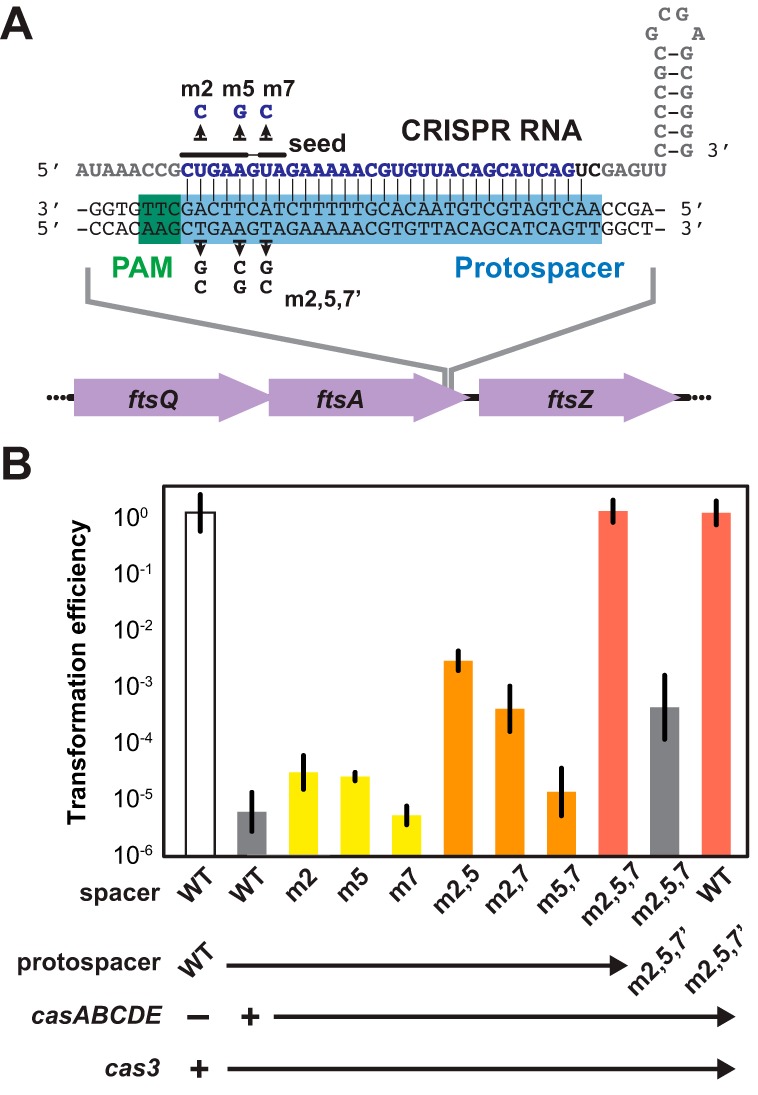
Potent and sequence-specific removal through genome targeting with CRISPR-Cas systems. (A) Design of a CRISPR RNA targeting the ftsA gene in E. coli K-12. The 32-nt spacer sequence is in blue, and the repeat sequence is in gray. The last two nucleotides of the spacer (in black) are fixed to introduce restriction sites used for cloning additional repeat-spacer pairs. Flanking the protospacer (highlighted in blue) is the protospacer-adjacent motif (PAM) (highlighted in green) required for DNA targeting. Point mutations within the established seed region of the spacer (9) and the protospacer tested in panel B are shown. (B) Transformation efficiencies of α-ftsA plasmids containing different mutations in the seed region of the spacer. Single, double, and triple mutations of the spacer sequence are shown in yellow, orange, and red, respectively. The transformations were carried out in BW25113-T7 (wild type [WT]) or BW25113-T7m257′ (m2,5,7′), each harboring two plasmids: pCas3 (+ cas3) and either pCasA-E (+ casABCDE) or pCasA-E′ (− casABCDE). Figure S1 in the supplemental material illustrates the general transformation procedure. Transformation efficiency was calculated as the number of transformants for each tested plasmid divided by the number of transformants for the original pCRISPR plasmid for the same culture. Values represent the geometric means and SEM of data from three independent experiments.
FIG 3
FIG 3
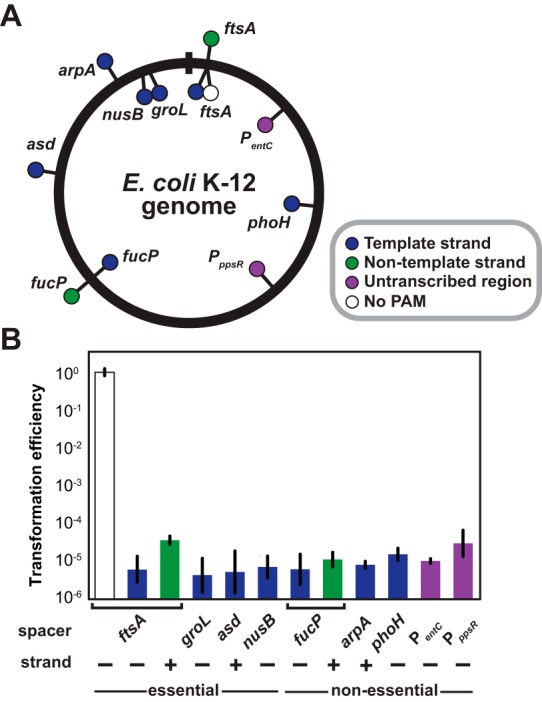
Similar efficiencies when targeting diverse locations throughout the genome. (A) Protospacer locations in the E. coli K-12 genome. Dots inside and outside the circle reflect spacers designed to base pair with the negative (−) or positive (+) strand of the chromosome, respectively. Dots also reflect protospacers flanked by a non-PAM (white), on the template strand (blue), or on the nontemplate strand (green) of coding regions or in nontranscribed regions (purple). (B) Transformation efficiencies for pCRISPR plasmids encoding spacers targeting the sites shown in panel A in BW25113-T7 harboring pCas3 and pCasA-E. See the legend for Fig. 2B for an explanation of the transformation efficiency. Values represent the geometric means and SEM of data from three independent experiments.
FIG 4
FIG 4
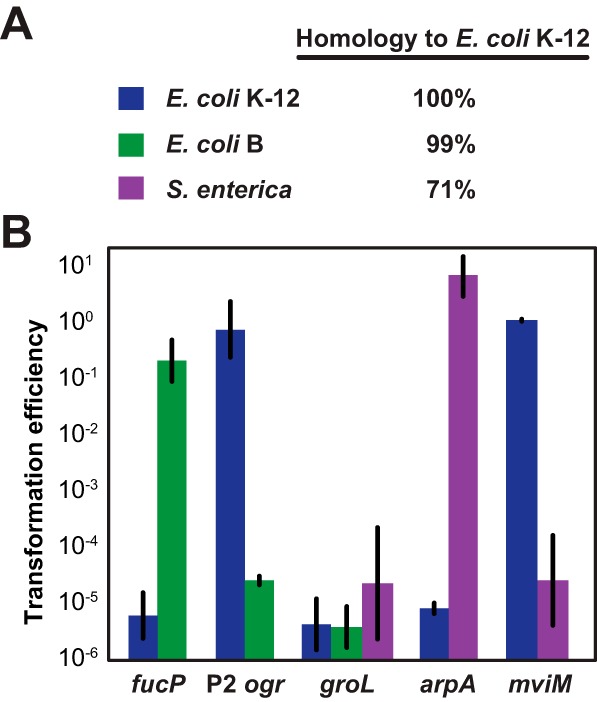
Sequence-specific removal of individual bacterial strains in pure cultures. (A) Estimated homologies between the genomes of E. coli K-12 BW25113-T7 (blue), E. coli B BL21(DE3) (green), and S. enterica SB300A#1 (purple), a derivative of strain LT2 (58). The reported homologies are based on prior comparisons between E. coli K-12 and E. coli B (30) and between E. coli K-12 and S. enterica LT2 (31). (B) Transformation efficiencies for pCRISPR plasmids encoding spacers targeting a PAM-flanking protospacer within the specified gene. The assay was conducted following the scheme depicted in Fig. S1 in the supplemental material for all three strains. See panel A for an explanation of the coloring scheme depicting each transformed strain. See the legend for Fig. 2B for an explanation of the transformation efficiency. Values represent the geometric means and SEM of data from three independent experiments.
FIG 5
FIG 5
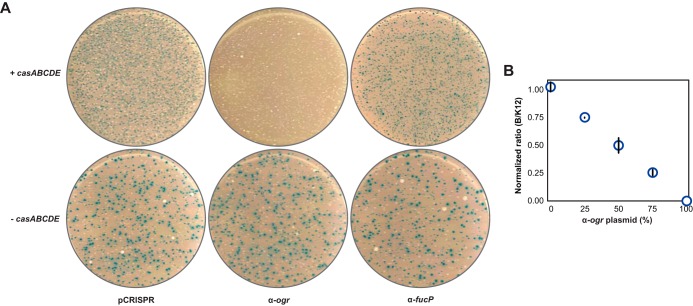
Selective and titratable removal of individual bacterial strains in mixed cultures. (A) Selective removal of BW25113-T7 and BL21(DE3) in mixed cultures. Equal numbers of BW25113-T7 and BL21(DE3) cells harboring pCas3 and either pCasA-E (+ casABCDE) or pCasA-E′ (− casABCDE) were mixed prior to preparation for electroporation. Mixed cultures electroporated with the indicated pCRISPR plasmid were plated on LB agar containing IPTG, X-Gal, l-arabinose, IPTG, and antibiotics. Only BL21(DE3) possesses the lacZ gene, which yields blue colonies (see Fig. S8 in the supplemental material). Plates are representative of three independent experiments. (B) Titratable removal of BL21(DE3) in mixed cultures. Transformations were conducted similarly to the method described for panel A except that cells were transformed with different ratios of the E. coli B-targeting plasmid (pCRISPR-ogr) and the nontargeting plasmid (pCRISPR) for a total of 100 ng. The ratio of blue to white colonies was normalized to the ratio of blue to white colonies for the same culture transformed with the pCRISPR plasmid. Values represent the geometric means and SEM of data from three independent experiments.

References

    1. Parisien A, Allain B, Zhang J, Mandeville R, Lan CQ. 2008. Novel alternatives to antibiotics: bacteriophages, bacterial cell wall hydrolases, and antimicrobial peptides. J. Appl. Microbiol. 104:1–13. 10.1111/j.1365-2672.2007.03498.x - DOI - PubMed
    1. Koskella B, Meaden S. 2013. Understanding bacteriophage specificity in natural microbial communities. Viruses 5:806–823. 10.3390/v5030806 - DOI - PMC - PubMed
    1. Sorek R, Lawrence CM, Wiedenheft B. 2013. CRISPR-mediated adaptive immune systems in bacteria and archaea. Annu. Rev. Biochem. 82:237–266. 10.1146/annurev-biochem-072911-172315 - DOI - PubMed
    1. Barrangou R, Fremaux C, Deveau H, Richards M, Boyaval P, Moineau S, Romero DA, Horvath P. 2007. CRISPR provides acquired resistance against viruses in prokaryotes. Science 315:1709–1712. 10.1126/science.1138140 - DOI - PubMed
    1. Garneau JE, Dupuis MÈ, Villion M, Romero DA, Barrangou R, Boyaval P, Fremaux C, Horvath P, Magadán AH, Moineau S. 2010. The CRISPR/Cas bacterial immune system cleaves bacteriophage and plasmid DNA. Nature 468:67–71. 10.1038/nature09523 - DOI - PubMed

Publication types