


Risk of long-term hot flashes after natural menopause: evidence from the Penn Ovarian Aging Study cohort
- PMID: 24473530
- PMCID: PMC4574289
- DOI: 10.1097/GME.0000000000000196
Risk of long-term hot flashes after natural menopause: evidence from the Penn Ovarian Aging Study cohort
Abstract
Objective: This study aims to estimate the risk of hot flashes relative to natural menopause and to evaluate the associations of hormone levels, behavioral variables, and demographic variables with the risk of hot flashes after menopause.
Methods: We performed annual assessment of 255 women who were premenopausal at baseline and reached natural menopause within 16 years of follow-up.
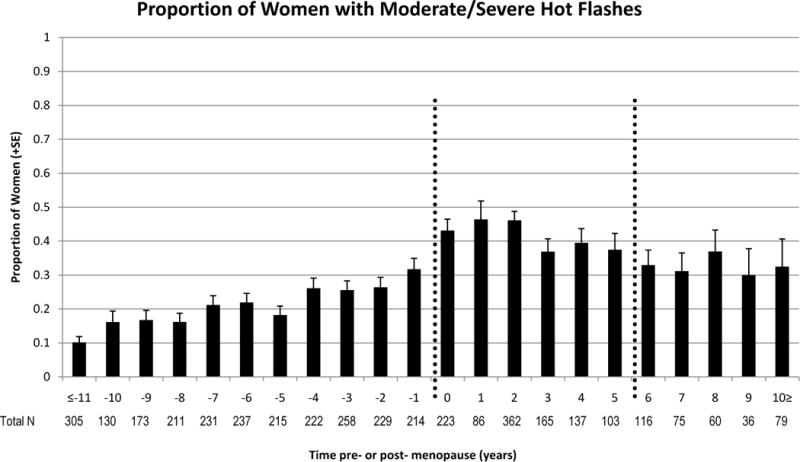
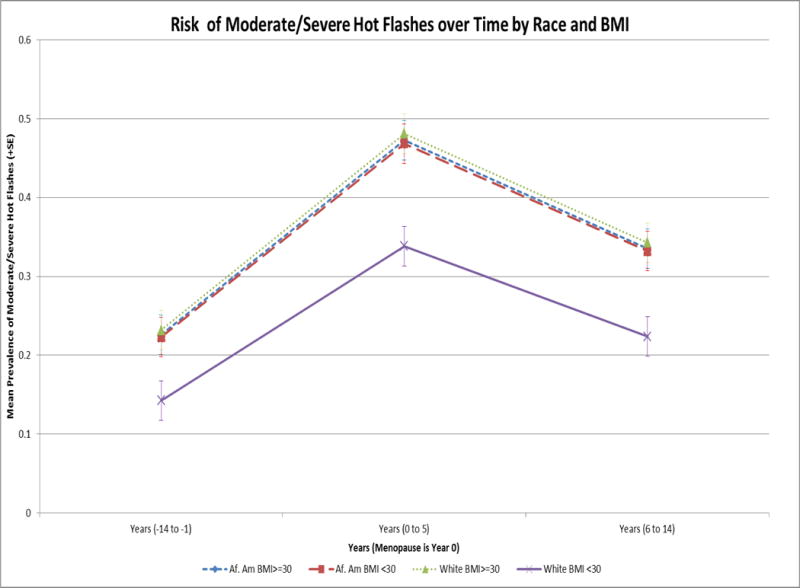
Results: The prevalence of moderate/severe hot flashes increased in each premenopausal year, reaching a peak of 46% in the first 2 years after the final menstrual period (FMP). Hot flashes decreased slowly after menopause and did not return to premenopausal levels until 9 years after the FMP. The mean (SD) duration of moderate/severe hot flashes after the FMP was 4.6 (2.9) years (for any hot flashes, 4.9 [3.1] y). One third of women at 10 years or more after menopause continued to experience moderate/severe hot flashes. African-American women (obese and nonobese) and obese white women had significantly greater risks of hot flashes compared with nonobese white women (interaction, P = 0.01). In multivariable analysis, increasing follicle-stimulating hormone levels before the FMP (P < 0.001), decreasing estradiol (odds ratio, 0.87; 95% CI, 0.78-0.96; P = 0.008), and increasing anxiety (odds ratio, 1.05; 95% CI, 1.03-1.06; P < 0.001) were significant risk factors for hot flashes, whereas higher education levels were protective (odds ratio, 0.66; 95% CI, 0.47-0.91; P = 0.011).
Conclusions: Moderate/severe hot flashes continue, on average, for nearly 5 years after menopause; more than one third of women observed for 10 years or more after menopause have moderate/severe hot flashes. Continuation of hot flashes for more than 5 years after menopause underscores the importance of determining individual risks/benefits when selecting hormone or nonhormone therapy for menopausal symptoms.
Conflict of interest statement
Conflict of interest: No conflicts/disclosures were declared by the other authors.
Figures

Comment in
-
For vasomotor symptoms, timing-and duration-may be everything.Menopause. 2014 Sep;21(9):917-9. doi: 10.1097/GME.0000000000000303. Menopause. 2014. PMID: 25051291 No abstract available.
References
-
- National Institutes of Health, State-of-the-Science Panel. National Institutes of Health State-of-the-Science Conference statement: management of menopause-related symptoms. Ann Intern Med. 2005;142:1003–1013. - PubMed
-
- Williams RE, Kalilani L, DiBenedetti DB, et al. Frequency and severity of vasomotor symptoms among peri- and postmenopausal women in the United States. Climacteric. 2008;11:32–43. - PubMed
Publication types
MeSH terms
Grants and funding
LinkOut - more resources
Full Text Sources
Other Literature Sources
Medical
