. 2014 Mar 14;289(11):7460-9.
doi: 10.1074/jbc.M113.518092. Epub 2014 Jan 28.

Signature motifs identify an Acinetobacter Cif virulence factor with epoxide hydrolase activity

Affiliations

Signature motifs identify an Acinetobacter Cif virulence factor with epoxide hydrolase activity

Christopher D Bahl et al. J Biol Chem. .

Abstract

Endocytic recycling of the cystic fibrosis transmembrane conductance regulator (CFTR) is blocked by the CFTR inhibitory factor (Cif). Originally discovered in Pseudomonas aeruginosa, Cif is a secreted epoxide hydrolase that is transcriptionally regulated by CifR, an epoxide-sensitive repressor. In this report, we investigate a homologous protein found in strains of the emerging nosocomial pathogens Acinetobacter nosocomialis and Acinetobacter baumannii ("aCif"). Like Cif, aCif is an epoxide hydrolase that carries an N-terminal secretion signal and can be purified from culture supernatants. When applied directly to polarized airway epithelial cells, mature aCif triggers a reduction in CFTR abundance at the apical membrane. Biochemical and crystallographic studies reveal a dimeric assembly with a stereochemically conserved active site, confirming our motif-based identification of candidate Cif-like pathogenic EH sequences. Furthermore, cif expression is transcriptionally repressed by a CifR homolog ("aCifR") and is induced in the presence of epoxides. Overall, this Acinetobacter protein recapitulates the essential attributes of the Pseudomonas Cif system and thus may facilitate airway colonization in nosocomial lung infections.

Keywords: Airway Infection; CFTR; Enzyme Catalysis; Epoxide Hydrolase; Gene Transcription; Mutagenesis Site Specific; Protein Conformation; Substrate Specificity; X-ray Crystallography.


Figures
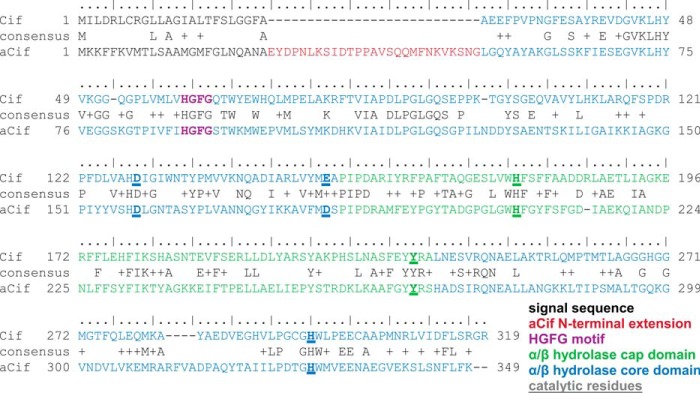
FIGURE 1.
FIGURE 1.
Comparison of the Cif protein sequence from P. aeruginosa and A. nosocomialis. An initial alignment was performed using ClustalW, which was then manually edited to account for biochemical data such as signal sequence cleavage.
FIGURE 2.
FIGURE 2.
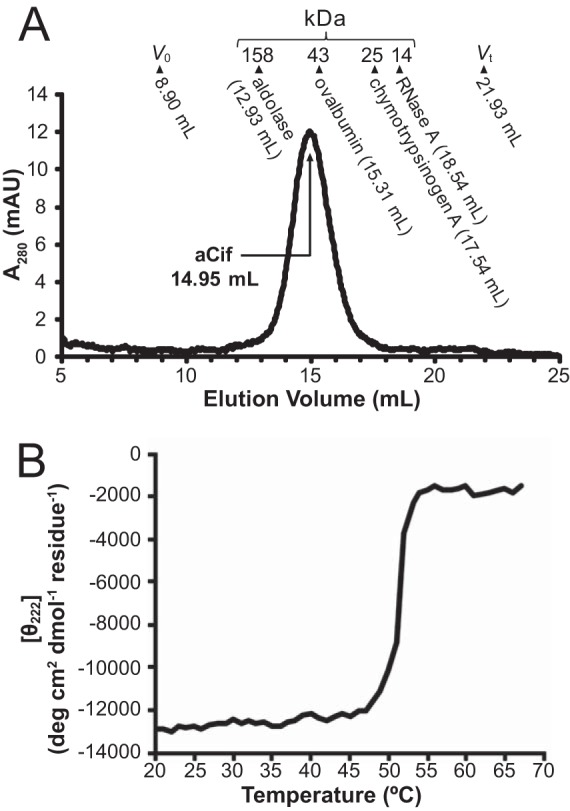
Biochemical characterization of aCif. A, analytical size-exclusion chromatography indicates that aCif forms a dimer in solution with an approximate molecular mass of 60 kDa, whereas the expected molecular mass of a monomer is around 37 kDa. B, circular dichroism spectroscopy indicates that aCif is stable at physiologically relevant temperatures, and exhibits cooperative unfolding at higher temperature.
FIGURE 3.
FIGURE 3.
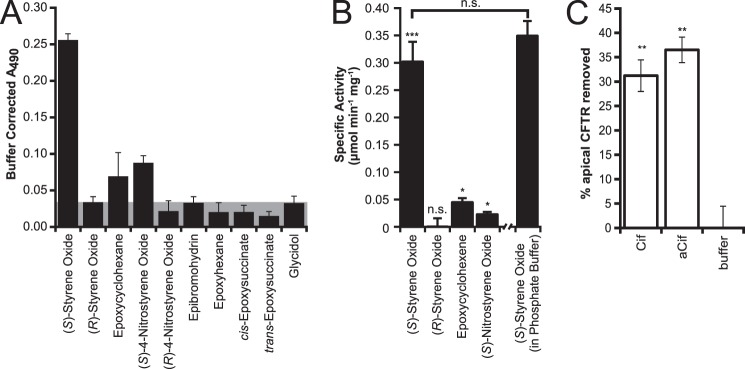
aCif is a Cif-like EH virulence factor. A, the epoxide hydrolysis ability of aCif was examined for a small panel of epoxide substrates; gray shading indicates the signal obtained with (R)-styrene oxide. B, the specific activity of hydrolysis of aCif was determined for four epoxides using a calibrated adrenochrome assay in MOPS buffer, or (at right) in sodium phosphate buffer at the same pH. C, 50 μg of Cif or aCif protein were applied apically to polarized human airway epithelial cells for 60 min at 37 °C, and cell-surface CFTR levels were determined by SDS-PAGE and immunoblot analysis of surface-biotinylated proteins. Values shown are mean ± S.D. (panel A) or mean ± S.E. (panels B and C) (*, p < 0.05; **, p < 0.01; ***, p < 0.001; n.s., not significant; n ≥ 3).
FIGURE 4.
FIGURE 4.
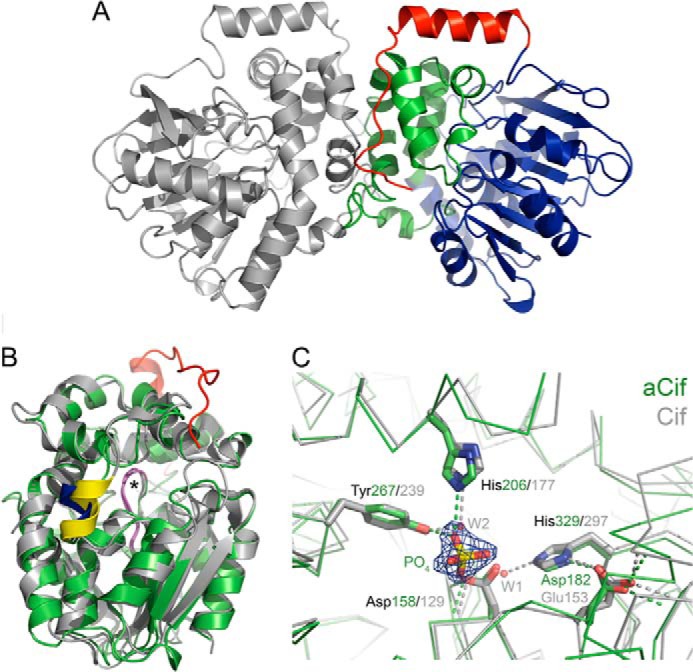
Structural analysis of aCif. A, the aCif dimer is shown using a schematic representation. One protomer is colored gray, whereas the other is shown with a blue α/β hydrolase core domain, a green cap domain, and a red N-terminal extension. B, a single protomer of the dimer for aCif (green) and Cif (gray) are aligned and shown as a schematic representation. These two models align with a Cα root mean square deviation of 1.0 Å. The α5 helix of aCif (blue) and Cif (yellow) is highlighted to show the conserved location. The HGFG motifs of aCif and Cif are shown in purple and indicated by an asterisk. The N-terminal extension of aCif is also shown in red. C, Cα traces for aCif (green) and Cif (gray) are shown, and the side chains of active-site residues are shown as sticks. aCif possesses active-site residues required for epoxide hydrolase activity in Cif: a nucleophile at Asp-158 (Asp-129 of Cif), a charge relay histidine-acid pair with His-329 and Asp-182 (His-297 and Glu-153 of Cif), and a ring-opening pair with Tyr-267 and His-206 (Tyr-239 and His-177 of Cif). A phosphate molecule is observed coordinated at the epoxide binding site in the active site of aCif (yellow), and an omit 2FoFc is shown as blue mesh, contoured to 1 σ. The phosphate presumably displaces the catalytically critical W1 water observed in the Cif active site, as well as the water found occupying the substrate binding site (W2).
FIGURE 5.
FIGURE 5.
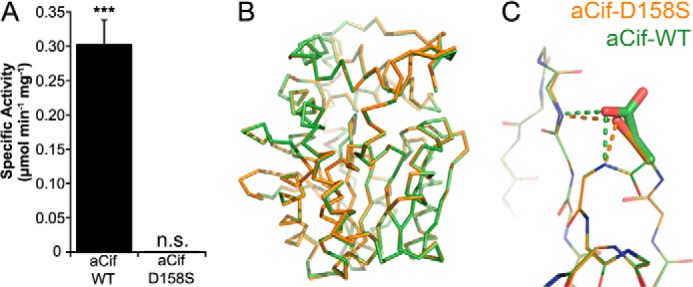
Enzymatic and structural characterization of aCif-D158S. A, WT aCif and aCif-D158S were assayed for the specific activity of hydrolysis of (S)-styrene oxide using a calibrated adrenochrome assay. Values shown are mean ± S.E. (***, p < 0.001; n.s., not significant; n ≥ 3). B, aCif (green) and aCif-D158S (orange) are shown as Cα traces following least-square superposition. C, the residue at nucleophile position 158 is shown for aCif (green) and aCif-D158S (orange) hydrogen bonding with Leu-159, as well as Phe-91 of the HGFG motif.
FIGURE 6.
FIGURE 6.
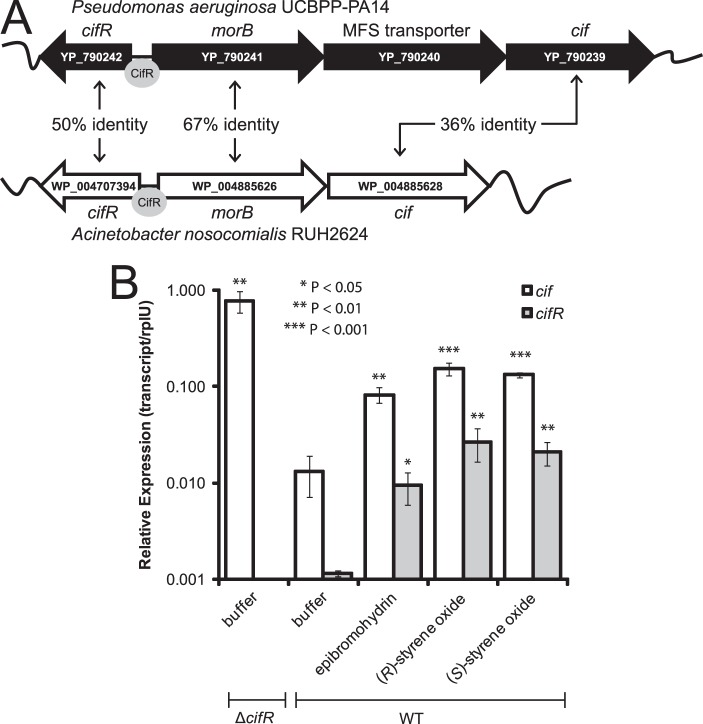
A, the cif operons of Pseudomonas and Acinetobacter are compared, with the genes and intergenic regions displayed to relative scale. The Acinetobacter operon does not possess a putative major facilitator superfamily (MFS) transporter gene that is found in the Pseudomonas operon. Sequence alignments were performed with ClustalW, and the percent identity was then calculated. B, qRT-PCR was performed on cultures of A. nosocomialis incubated with epoxide, or with a cifR gene deletion. Expression was not measured for cifR in the cifR deletion strain. Expression levels were compared with the values for the corresponding gene in the WT strain with buffer, using Student's unpaired t test (*, p < 0.05; **, p < 0.01; ***, p < 0.001; n = 3).

References

    1. Riordan J. R. (2008) CFTR function and prospects for therapy. Annu. Rev. Biochem. 77, 701–726 - PubMed
    1. Davies J. C., Bilton D. (2009) Bugs, biofilms, and resistance in cystic fibrosis. Respir. Care. 54, 628–640 - PubMed
    1. Cantin A. M., Hanrahan J. W., Bilodeau G., Ellis L., Dupuis A., Liao J., Zielenski J., Durie P. (2006) Cystic fibrosis transmembrane conductance regulator function is suppressed in cigarette smokers. Am. J. Respir. Crit. Care Med. 173, 1139–1144 - PubMed
    1. Clunes L. A., Davies C. M., Coakley R. D., Aleksandrov A. A., Henderson A. G., Zeman K. L., Worthington E. N., Gentzsch M., Kreda S. M., Cholon D., Bennett W. D., Riordan J. R., Boucher R. C., Tarran R. (2012) Cigarette smoke exposure induces CFTR internalization and insolubility, leading to airway surface liquid dehydration. FASEB J. 26, 533–545 - PMC - PubMed
    1. Kreindler J. L., Jackson A. D., Kemp P. A., Bridges R. J., Danahay H. (2005) Inhibition of chloride secretion in human bronchial epithelial cells by cigarette smoke extract. Am. J. Physiol. Lung Cell. Mol. Physiol. 288, L894–L902 - PubMed

Publication types

MeSH terms

Substances

LinkOut - more resources