Review
. 2014 Jan 16:4:415.
doi: 10.3389/fphys.2013.00415. eCollection 2013.

Risk factors for pancreatic cancer: underlying mechanisms and potential targets

Affiliations
Review

Risk factors for pancreatic cancer: underlying mechanisms and potential targets

Thomas Kolodecik et al. Front Physiol. .

Abstract

Purpose of the review: Pancreatic cancer is extremely aggressive, forming highly chemo-resistant tumors, and has one of the worst prognoses. The evolution of this cancer is multi-factorial. Repeated acute pancreatic injury and inflammation are important contributing factors in the development of pancreatic cancer. This article attempts to understand the common pathways linking pancreatitis to pancreatic cancer.

Recent findings: Intracellular activation of both pancreatic enzymes and the transcription factor NF-κB are important mechanisms that induce acute pancreatitis (AP). Recurrent pancreatic injury due to genetic susceptibility, environmental factors such as smoking, alcohol intake, and conditions such as obesity lead to increases in oxidative stress, impaired autophagy and constitutive activation of inflammatory pathways. These processes can stimulate pancreatic stellate cells, thereby increasing fibrosis and encouraging chronic disease development. Activation of oncogenic Kras mutations through inflammation, coupled with altered levels of tumor suppressor proteins (p53 and p16) can ultimately lead to development of pancreatic cancer.

Summary: Although our understanding of pancreatitis and pancreatic cancer has tremendously increased over many years, much remains to be elucidated in terms of common pathways linking these conditions.

Keywords: K-ras; autophagy; inflammation; pancreatic cancer; pancreatitis; stellate cells.


Figures
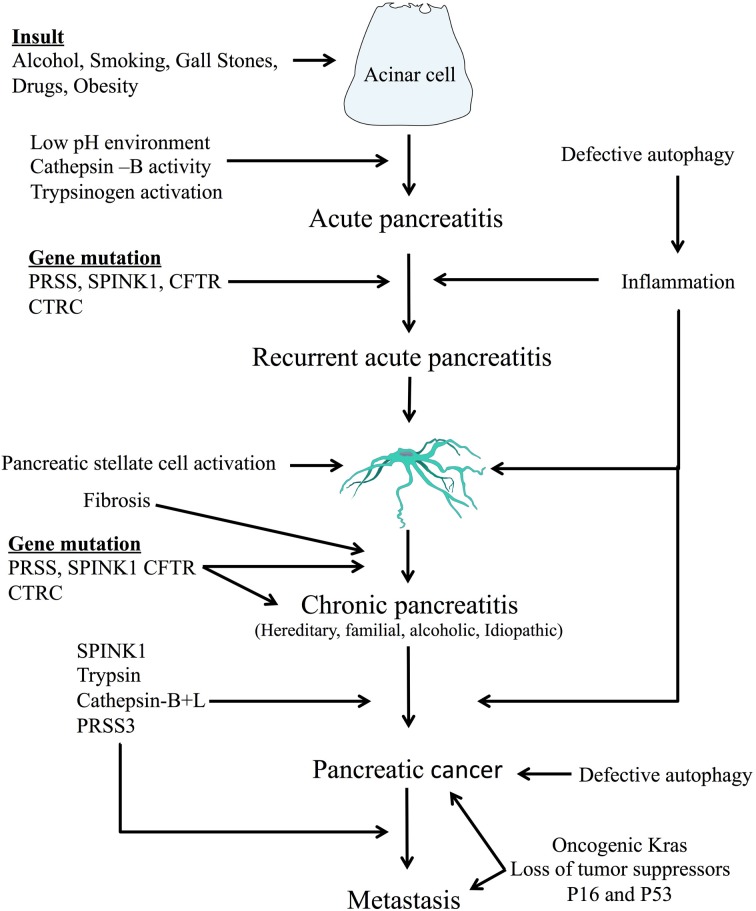
Figure 1
Figure 1
Common pathways associated with disease progression from acute to chronic pancreatitis and pancreatic cancer. Pancreatitis starts with an initiating insult followed by changes in the cellular environment and premature digestive enzyme activation. Mutations of genes associated with trypsinogen activation/inactivation predispose the pancreas to development of disease. As disease progresses defective autophagy, increased inflammation, pancreatic stellate cell activation, and fibrosis occur. Advancement toward pancreatic cancer and metastasis is also associated with defective autophagy, as well as extracellular matrix degradation, cell proliferation, expression of oncogenic Kras and loss of tumor suppressors (e.g., P16 and P53). Autophagy and inflammation are discussed further in Figures 2, 3.
Figure 2
Figure 2
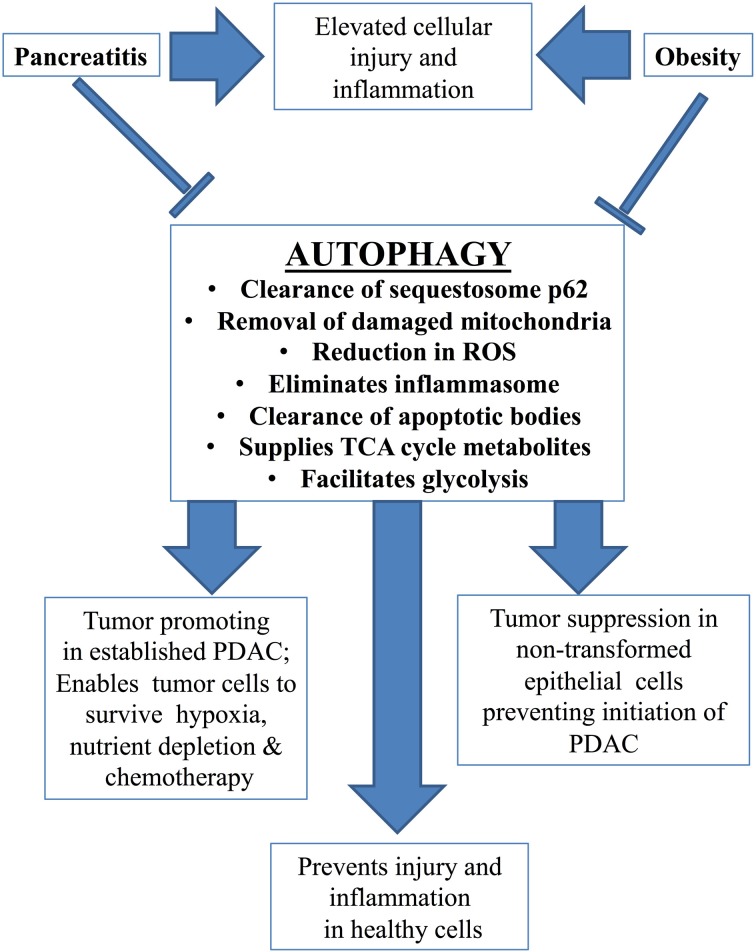
Autophagy and pancreatic disease. Autophagy is responsible for clearance of aggregates of the sequestosome p62, damaged mitochondria, apoptotic bodies, the inflammasome, and reduces levels of reactive oxygen species (ROS). This limits injury and inflammation in healthy cells and prevents neoplastic transformation and initiation of PDAC. Therefore the role of autophagy is normally beneficial. In tumor cells, however, autophagy promotes survival, enabling cancer to resist hypoxia, nutrient depletion, and chemotherapy. Pancreatitis and obesity lead to arrested autophagy resulting in elevated cellular injury and inflammation. This can predispose to chronic disease and even progression to PDAC.
Figure 3
Figure 3
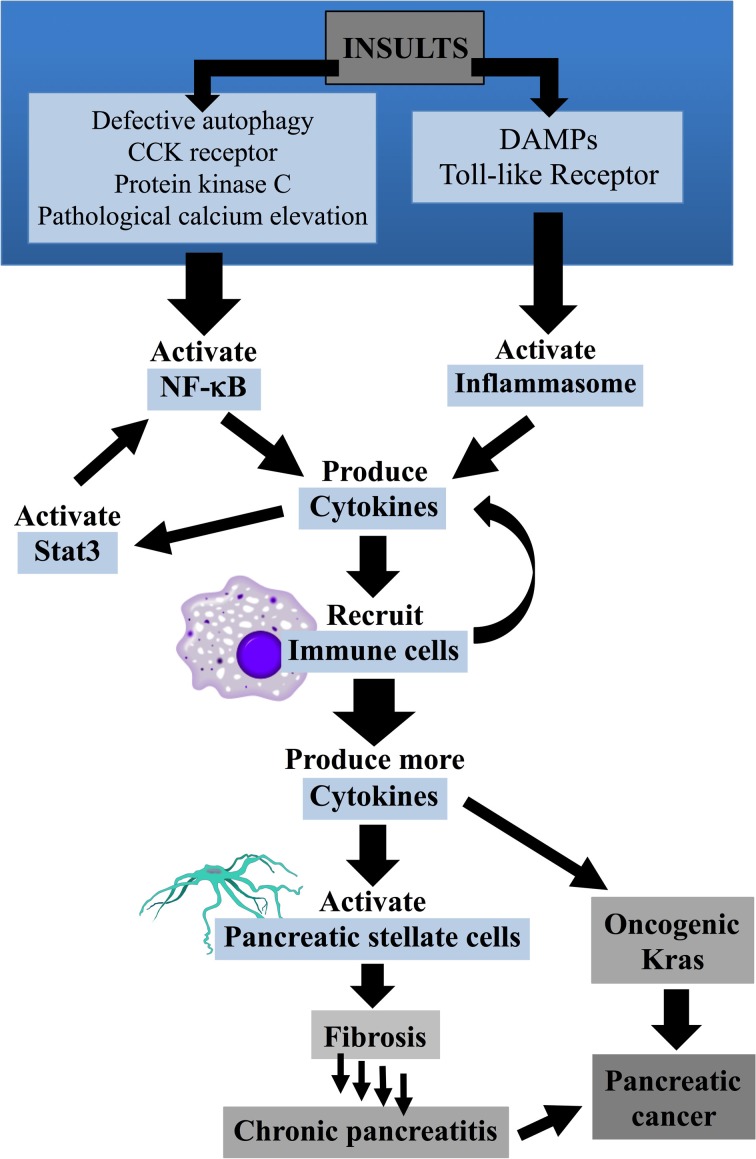
Inflammation and pancreatic disease. Insults lead to the activation of NF-κB and inflammasomes. NF-κB activation leads to the production of cytokines which, in turn, recruit immune cells and activate Stat3. Neutrophils, macrophages and other immune cells infiltrate the pancreas and produce more cytokines amplifying the inflammatory response. Cytokines can lead to the activation of pancreatic stellate cells which can, with repeated bouts of acute pancreatitis lead to fibrosis and the development of chronic pancreatitis. Cytokines can activate oncogenic Kras, a characteristic of nearly 90% of all pancreatic adenocarcinomas. Chronic pancreatitis can also lead to the development of pancreatic cancer.

References

    1. Aghajan M., Li N., Karin M. (2012). Obesity, autophagy and the pathogenesis of liver and pancreatic cancers. J. Gastroenterol. Hepatol. 27(Suppl. 2), 10–14 10.1111/j.1440-1746.2011.07008.x - DOI - PMC - PubMed
    1. Ahn D. W., Seo J. K., Lee S. H., Hwang J. H., Lee J. K., Ryu J. K., et al. (2012). Enhanced antitumor effect of combination therapy with gemcitabine and guggulsterone in pancreatic cancer. Pancreas 41, 1048–1057 10.1097/MPA.0b013e318249d62e - DOI - PubMed
    1. Algul H., Treiber M., Lesina M., Nakhai H., Saur D., Geisler F., et al. (2007). Pancreas-specific RelA/p65 truncation increases susceptibility of acini to inflammation-associated cell death following cerulein pancreatitis. J. Clin. Invest. 117, 1490–1501 10.1172/JCI29882 - DOI - PMC - PubMed
    1. Alirezaei M., Flynn C. T., Whitton J. L. (2012). Interactions between enteroviruses and autophagy in vivo. Autophagy 8, 973–975 10.4161/auto.20160 - DOI - PMC - PubMed
    1. Almoguera C., Shibata D., Forrester K., Martin J., Arnheim N., Perucho M. (1988). Most human carcinomas of the exocrine pancreas contain mutant c-K-ras genes. Cell 53, 549–554 10.1016/0092-8674(88)90571-5 - DOI - PubMed