. 2014 Jan 27;9(1):e85727.
doi: 10.1371/journal.pone.0085727. eCollection 2014.

Characterization of a ginsenoside-transforming β-glucosidase from Paenibacillus mucilaginosus and its application for enhanced production of minor ginsenoside F₂

Affiliations

Characterization of a ginsenoside-transforming β-glucosidase from Paenibacillus mucilaginosus and its application for enhanced production of minor ginsenoside F₂

Chang-Hao Cui et al. PLoS One. .

Abstract

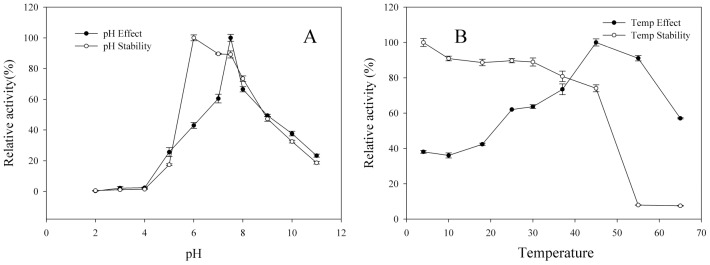
A novel β-glucosidase (BglPm) was identified from Paenibacillus mucilaginosus KCTC 3870(T) which has ginsenoside converting activity. The gene, termed bglPm, consists of 1,260 bp and belongs to glycoside hydrolase family 1 (GH1). After being overexpressed and purified from Escherichia coli, the enzymatic properties of BglPm were investigated. The enzyme exhibited an optimal activity at 45°C and pH 7.5 and showed high bioconversion ability for major ginsenoside Rb1 and Rd into ginsenoside F2. Thus, it was used for mass production of relatively high pure F2 from relatively abundant protopanaxadiol type ginsenosides mixture (PPDGM) with combined usage of ginsenoside Rc-hydrolyzing enzyme. Scale-up of production using 250 g of the PPDGM resulted in 152 g of F2 with 80.1% chromatography purity and 95.7% recovery. These results suggest that this enzyme would be useful in the preparation of pharmacologically active ginsenoside F2 in the functional food and pharmaceutical industries.


Conflict of interest statement

Competing Interests: The authors have declared that no competing interests exits.

Figures

Figure 1
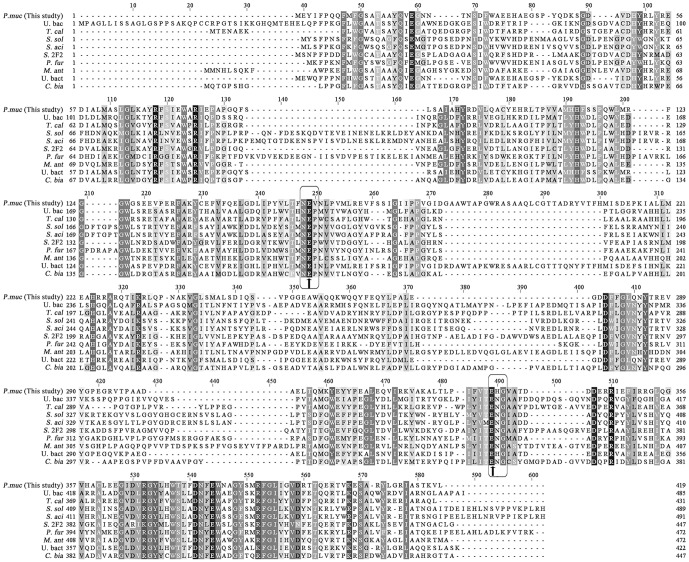
Figure 1. Sequence alignment of BglPm and related ginsenoside-transforming or characterized glycoside hydrolase family 1 enzymes.
The conserved regions for the catalytic central in glycoside hydrolase family 1 are boxed, and the conserved catalytic amino acids are marked with an asterisk. The two putative conserved motifs were shown in box, and the predicted GH1 active site residues (general acid/base and nucleophile residue) were marked by an arrowhead. Full species names and Genbank IDs of the glycoside hydrolases family 1 are as follows, Paenibacillus mucilaginosus KCTC 3870T β-glucosidase [P. muc (This study)], AEI42200; Uncultured bacteria β-glucosidase (U. bac), ABI18350; Thermus caldophilus β-glycosidase (T. cal), AAO15361; Sulfolobus solfataricus P2 β-glycosidase (S. sol), AAK43121; Sulfolobus acidocaldarius β-glycosidase (S. aci), WP_011278657; Sphingomonas sp. 2F2 β-glucosidase (S. 2F2), ADY18331; Pyrococcus furiosus β-glucosidase (P. fur), AAC25555; Micrococcus antarcticus β-glucosidase (M. ant), ACM66669; Uncultured bacterium β-glucosidase (U. bact), AFN70956; Cellulomonas biazotea cellobiase (C. bia), AEM45802.
Figure 2
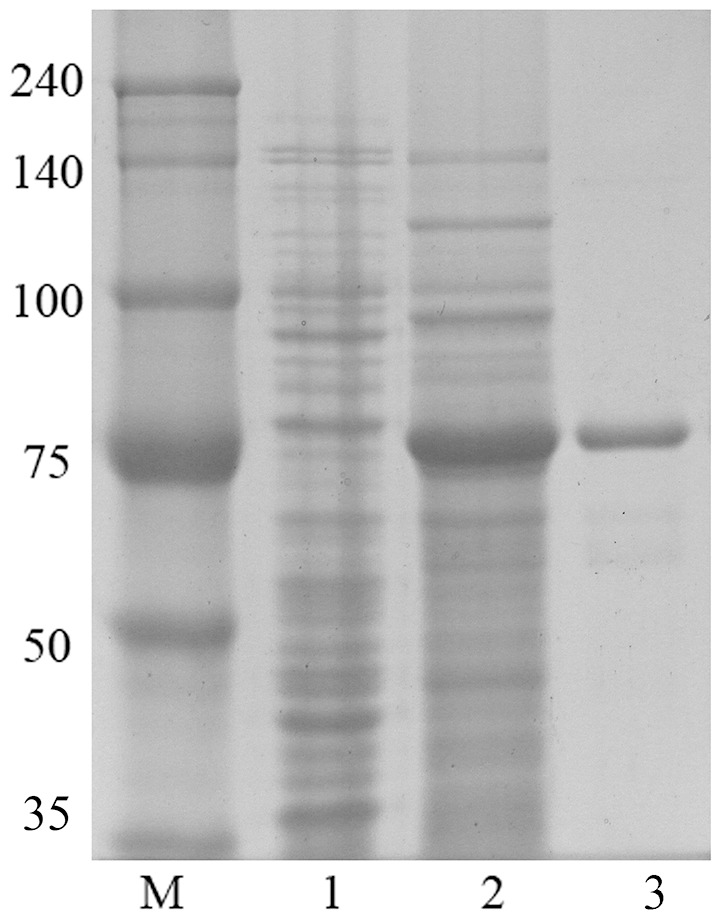
Figure 2. SDS-PAGE analysis of the recombinant BglPm after purification using the GST-bind agarose resin.
Lanes: M, molecular weight standard; 1, insoluble fraction of the crude extract of the induced recombinant BL 21 (DE3) cells; 2, soluble fraction of the crude extract of the induced recombinant BL 21 (DE3); 3, GST-BglPm after purification with the GST-bind agarose resin.
Figure 3
Figure 3. Effects of pH (A) and temperature (B) on the activity and stability of recombinant BglPm.
Figure 4
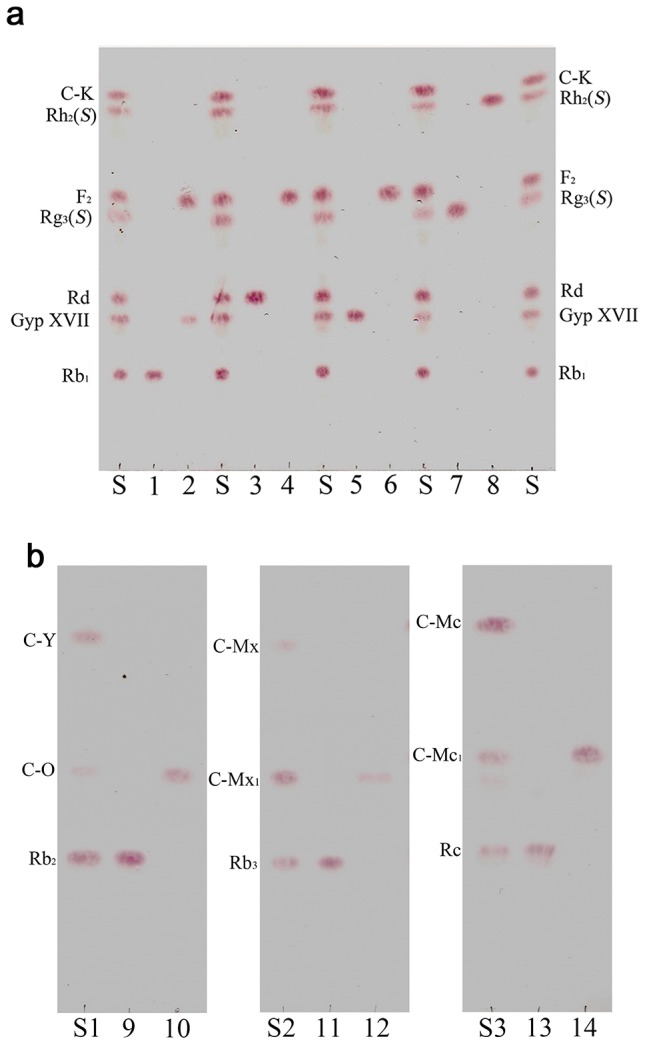
Figure 4. Thin layer chromatography (TLC) analyses of biotransformation of Rb1, Rd, Gyp XVII, Rg3(S) in (A) and Rb2, Rb3, Rc in (B) by recombinant BglPm.
The reaction time was 30: CHCl3-CH3OH-H2O (65∶35∶10, lower phase). (S, S1, S2, S3), ginsenoside standards (PPD type ginsenoside mixtures); Standards: 1, 3, 5, 7, 9, 11, 13; Reaction mixture: 2, 4, 6, 8, 10, 12, 14; 1, Rb1; 2, reaction mixture of Rb1; 3, Rd; 4, reaction mixture of Rd; 5, Gyp XVII; 6, reaction mixture of Gyp XVII; 7, Rg3(S); 8, reaction mixture of Rg3(S); 9, Rb2; 10, reaction mixture of Rb2; 11, Rb3; 12, reaction mixture of Rb3; 13, Rc; 14, reaction mixture of Rc. Abbreviations: C-K, compound K.
Figure 5
Figure 5. Biotransformation pathways of ginsenosides Rb1, Rd, Rb2, Rb3, and Rc by recombinant BglPm and incorporated pathways for F2 production by two glycoside hydrolases.
Figure 6
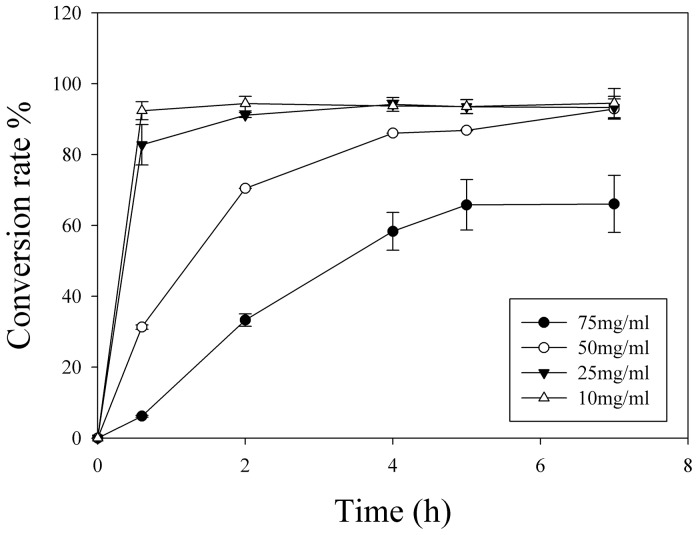
Figure 6. Effect of the concentration of PPDGM and crude BglPm on the production of ginsenoside F2.
Figure 7
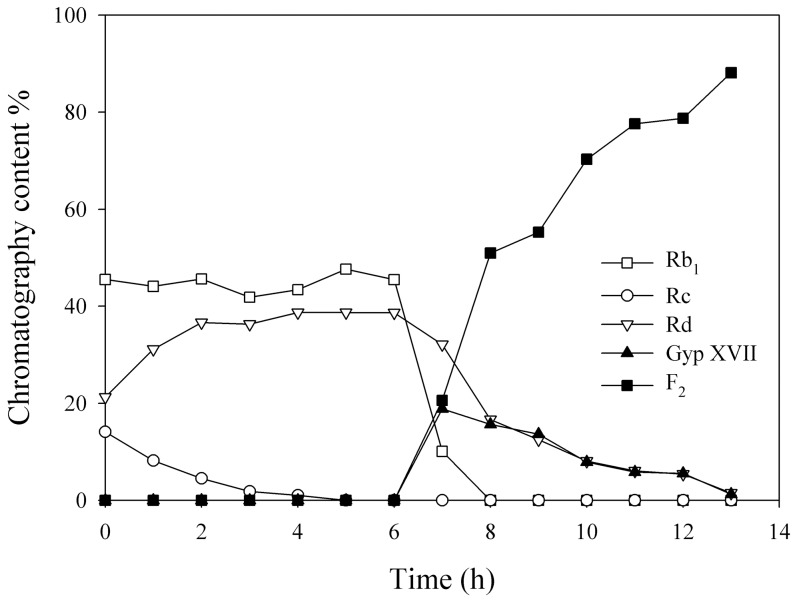
Figure 7. Relative abundance of ginsenosides Rb1, Rc, Rd, Gyp XVII and F2 in scaled-up production reactor in time course.
Figure 8
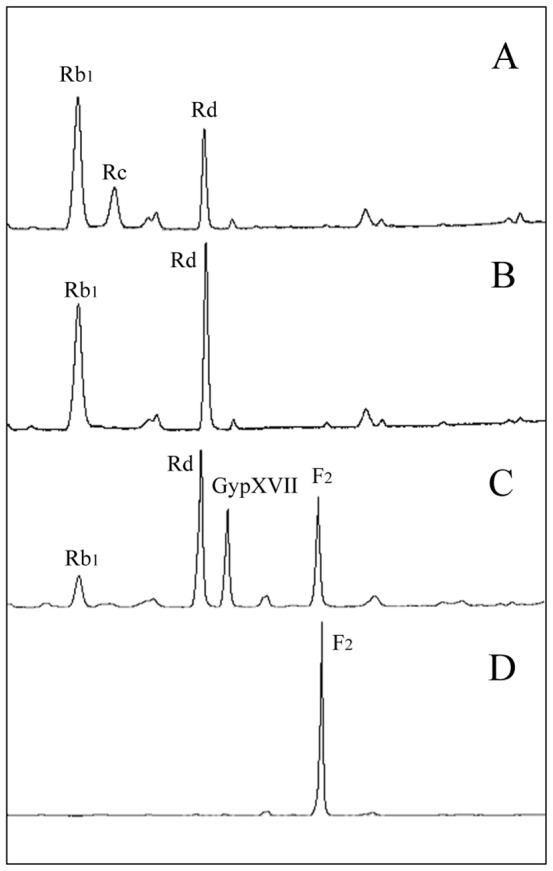
Figure 8. HPLC results of the transformation of PPDGM via Abf22-3 and followed by GST-BglPm; (a) ginsenoside peaks of PPDGM, (b) reaction mixture after 6 hour treatment with Abf-22-3, (c) reaction mixture after 1 hour treatment with GST-BglPm, (d) reaction mixture after 7 hour treatment with GST-BglPm.
Abbreviations: PPDGM, protopanaxadiol type ginsenoside mixture.

References

    1. Cho IH (2012) Effects of Panax ginseng in neurodegenerative diseases. J Ginseng Res 36: 342–353. - PMC - PubMed
    1. Kang S, Min H (2012) Ginseng, the ‘Immunity Boost’: the effects of Panax ginseng on immune system. J Ginseng Res 36: 354–368. - PMC - PubMed
    1. Park HJ, Kim DH, Park SJ, Kim JM, Ryu JH (2012) Ginseng in traditional herbal prescriptions. J Ginseng Res 36: 225–241. - PMC - PubMed
    1. Attele AS, Wu JA, Yuan CS (1999) Ginseng pharmacology: multiple constituents and multiple actions. Biochem Pharmacol 58: 1685–1693. - PubMed
    1. Christensen LP (2009) Ginsenosides chemistry, biosynthesis, analysis, and potential health effects. Adv Food Nutr Res 55: 1–99. - PubMed

Publication types