


Zinc mono-therapy in pre-symptomatic Chinese children with Wilson disease: a single center, retrospective study
- PMID: 24475083
- PMCID: PMC3901685
- DOI: 10.1371/journal.pone.0086168
Zinc mono-therapy in pre-symptomatic Chinese children with Wilson disease: a single center, retrospective study
Erratum in
- PLoS One. 2014;9(3):e92491
Abstract
Background: There is no official consensus regarding zinc therapy in pre-symptomatic children with Wilson Disease (WD); more data is needed.
Objective: To investigate the safety and efficacy of zinc gluconate therapy for Chinese children with pre-symptomatic WD.
Methods: We retrospectively analyzed pre-symptomatic children receiving zinc gluconate in a single Chinese center specialized in pediatric hepatology. Short-term follow-up data on safety and efficacy were presented, and effects of different zinc dosages were compared.
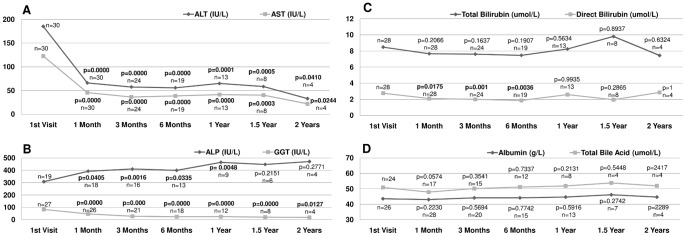
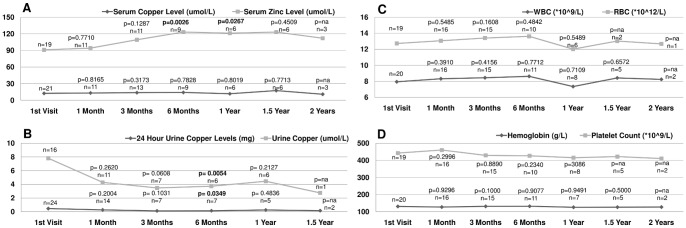
Results: 30 children (21 males) aged 2.7 to 16.8 years were followed for up to 4.4 years; 26 (87%) children had abnormal ALT at baseline. Most patients (73%) received higher than the currently recommended dose of elemental zinc. Zinc gluconate significantly reduced mean ALT (p<0.0001), AST (p<0.0001), GGT (p<0.0001) levels after 1 month, and urinary copper excretion after 6 months (p<0.0054). Mean direct bilirubin levels dropped significantly at 1 month (p = 0.0175), 3 months (p = 0.0010), and 6 months (p = 0.0036). Serum zinc levels gradually increased and reached a significantly higher level after 6 months (p<0.0026), reflecting good compliance with the therapy. Complete blood count parameters did not change throughout the analysis period. 8 children experienced mild and transient gastrointestinal side effects. The higher zinc dose did not affect treatment response and was not associated with different or increased side effects when compared to conventional zinc dose.
Conclusion: In our cohort, zinc gluconate therapy for Chinese children with pre-symptomatic WD was effective, and higher initial dose of elemental zinc had the same level of efficacy as the conventional dose.
Conflict of interest statement
Figures
References
-
- Brewer GJ, Yuzbasiyan-Gurkan V (1992) Wilson disease. Medicine 71: 139–164. - PubMed
-
- Bull PC, Thomas GR, Rommens JM, Forbes JR, Cox DW (1993) The Wilson disease gene is a putative copper transporting P-type ATPase similar to the Menkes gene. Nat Genet 5: 327–337. - PubMed
-
- Danks DM (1995) Disorders of copper transport. In: Scriver CR, Beaudet AL, Sly WS, et al.. eds. The Metabolic and Molecular Bases of Inherited Disease, 7th edition. New York: McGraw Hill: 2211–2235.
-
- Ferenci P, Caca K, Loudianos G, Mieli-Vergani G, Tanner S, et al. (2003) Diagnosis and phenotypic classification of Wilson disease. Liver Int 23: 139–142. - PubMed
-
- Koppikar S, Dhawan A (2005) Evaluation of the scoring system for the diagnosis of Wilson's disease in children. Liver Int 25: 680–681. - PubMed
Publication types
MeSH terms
Substances
LinkOut - more resources
Full Text Sources
Other Literature Sources
Medical
Miscellaneous
