. 2014 Jan 24;9(1):e86194.
doi: 10.1371/journal.pone.0086194. eCollection 2014.

Survival according to BRAF-V600 tumor mutations--an analysis of 437 patients with primary melanoma

Affiliations

Survival according to BRAF-V600 tumor mutations--an analysis of 437 patients with primary melanoma

Diana Meckbach et al. PLoS One. .

Abstract

The prognostic impact of BRAF-V600 tumor mutations in stage I/II melanoma patients has not yet been analyzed in detail. We investigated primary tumors of 437 patients diagnosed between 1989 and 2006 by Sanger sequencing. Mutations were detected in 38.7% of patients and were associated with age, histological subtype as well as mitotic rate. The mutational rate was 36.7% in patients with disease-free course and 51.7% in those with subsequent distant metastasis (p = 0.031). No difference in overall survival (p = 0.119) but a trend for worse distant-metastasis-free survival (p = 0.061) was observed in BRAF mutant compared to BRAF wild-type patients. Independent prognostic factors for overall survival were tumor thickness, mitotic rate and ulceration. An interesting significant prognostic impact was observed in patients with tumor thickness of 1 mm or less, with the mutation present in 6 of 7 patients dying from melanoma. In conclusion, no significant survival differences were found according to BRAF-V600 tumor mutations in patients with primary melanoma but an increasing impact of the mutational status was observed in the subgroup of patients with tumor thickness of 1 mm or less. A potential role of the mutational status as a prognostic factor especially in this subgroup needs to be investigated in larger studies.


Conflict of interest statement

Competing Interests: Benjamin Weide has read the journal's policy and declare the following: AD and DC applied for a patent on the diagnostic use of BRAF V600E mutant specific antibody VE1 VE1 (PCT International Application No. PCT/EP2011/067092, filed on September 30, 2011; U.S. Provisional Patent Application No. 61/503,950, filed on July 1, 2011; U.S. Provisional Patent Application No. 61/388,158, filed on September 30, 2010; U.S. Patent Application No. 13/877,035, filed on March 29, 2013). All terms are being managed by the German Cancer Research Center in accordance with its conflict of policies. This does not alter the authors adherence to all the PLOS ONE policies on sharing data and materials. There are no other relevant declarations relating to employment, consultancy, patents, products in development or marketed products etc. to be made by AD or DC. MH is associate partner of Dermatopathology Friedrichshaven a medical practice for histopathology. This does not alter the authors adherence to all the PLOS ONE policies on sharing data and materials. There are no other relevant declarations relating to employment, consultancy, patents, products in development or marketed products etc. to be made by MH. All other authors do not have any conflict of interest to declare. There are no relevant declarations relating to employment, consultancy, patents, products in development or marketed products etc. to be made by any other author.

Figures

Figure 1
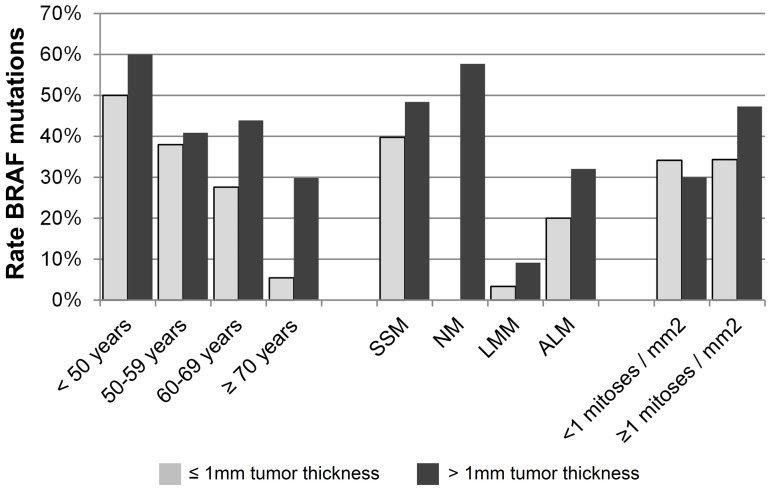
Figure 1. Rate of BRAF-V600 mutations in patients with tumor thickness of 1 mm or less (grey bars) or more than 1 mm (black bars) according to age (left), histological subtype (middle), and mitotic rate (right).
SSM – superficial spreading melanoma; NM – nodular melanoma; LMM – lentigo maligna melanoma; ALM – acral lentiginous melanoma.
Figure 2
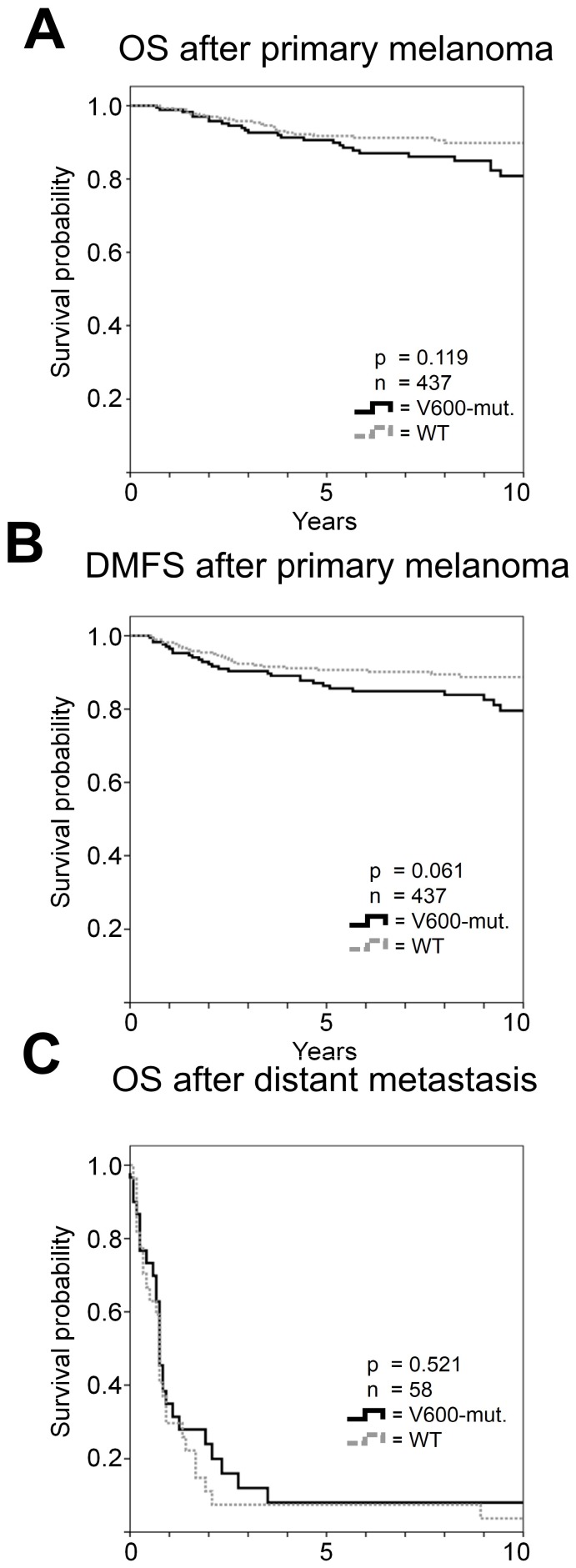
Figure 2. Univariate survival analysis according to BRAF-V600 mutational status.
No differences in overall survival (A) but a trend for unfavorable distant metastases-free survival (B) was observed in patients with tumor BRAF mutations. Survival after occurrence of distant metastasis was not different according to the tumor BRAF mutational status (C).
Figure 3
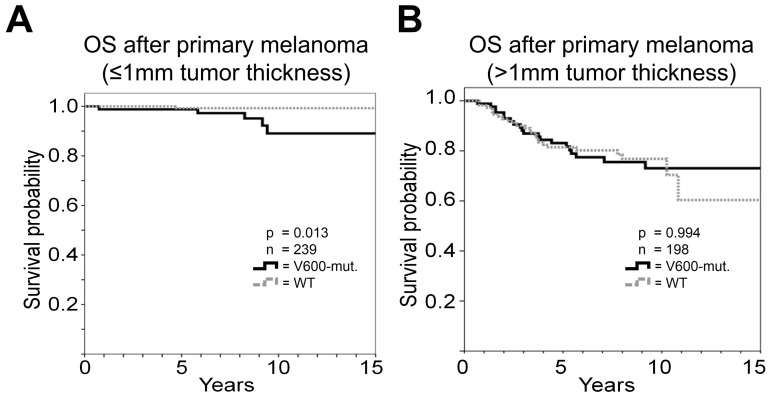
Figure 3. Kaplan-Meier analysis of overall survival (OS) of patients stratified according to tumor thickness for BRAF-V600 mutant (BRAF-mut.) vs. wild-type (WT) patients with tumor thickness ≤1 mm (A) or with tumor thickness >1 mm (B).
Figure 4
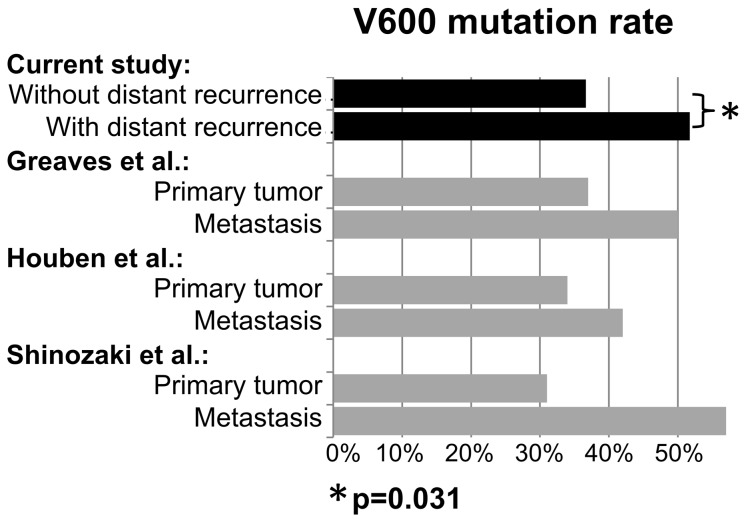
Figure 4. Rate of BRAF-V600 tumor mutations according to disease outcome.
A significantly lower rate of BRAF-V600 tumor mutations was observed in 382 patients who did not develop distant metastasis during follow-up (upper black solid bar - w/o distant metastasis) compared to 55 stage I/II patients who had distant recurrences in the further course of disease (black solid bar - with distant metastases) in our study (36.6% versus 52.7%; p = 0.026). A similar difference in mutational rate was reported in prior studies comparing the mutational rate in metastases of late-stage melanoma patients and primary tumors of stage I/II patients.

References

    1. Davies H, Bignell GR, Cox C, Stephens P, Edkins S, et al. (2002) Mutations of the BRAF gene in human cancer. Nature 417: 949–954. - PubMed
    1. Satyamoorthy K, Li G, Gerrero MR, Brose MS, Volpe P, et al. (2003) Constitutive mitogen-activated protein kinase activation in melanoma is mediated by both BRAF mutations and autocrine growth factor stimulation. Cancer Res 63: 756–759. - PubMed
    1. Flaherty KT, Robert C, Hersey P, Nathan P, Garbe C, et al. (2012) Improved survival with MEK inhibition in BRAF-mutated melanoma. N Engl J Med 367: 107–114. - PubMed
    1. Chapman PB, Hauschild A, Robert C, Haanen JB, Ascierto P, et al. (2011) Improved survival with vemurafenib in melanoma with BRAF V600E mutation. N Engl J Med 364: 2507–2516. - PMC - PubMed
    1. Flaherty KT, Puzanov I, Kim KB, Ribas A, McArthur GA, et al. (2010) Inhibition of mutated, activated BRAF in metastatic melanoma. N Engl J Med 363: 809–819. - PMC - PubMed

Publication types

Substances