


Pronounced inflammatory response to endotoxaemia during nighttime: a randomised cross-over trial
- PMID: 24475284
- PMCID: PMC3903723
- DOI: 10.1371/journal.pone.0087413
Pronounced inflammatory response to endotoxaemia during nighttime: a randomised cross-over trial
Abstract
Background: Circadian variation in bodily functions has been shown to impact health in acute and chronic medical conditions. Little is known about the relationship between circadian rhythm and sepsis in humans. We aimed to investigate circadian variations in the host response in a human endotoxaemia model.
Design and methods: A cross-over study, where 12 healthy young men received E. coli endotoxin (lipopolysaccharide, LPS) 0.3 ng/kg at 12 noon and, on another day, at 12 midnight. Blood samples were analysed for pro- and anti-inflammatory cytokines: tumour-necrosis factor (TNF)-alpha, soluble TNF receptors (sTNF-R)-1 and -2, interleukin (IL)-1beta, IL-1 receptor antagonist (IL-1Ra), IL-6, and IL-10 as well as YKL-40 and the oxidative stress markers malondialdehyde (MDA), ascorbic acid (AA) and dehydroascorbic acid (DHA) before and at 2, 4, 6 and 8 hours after LPS administration.
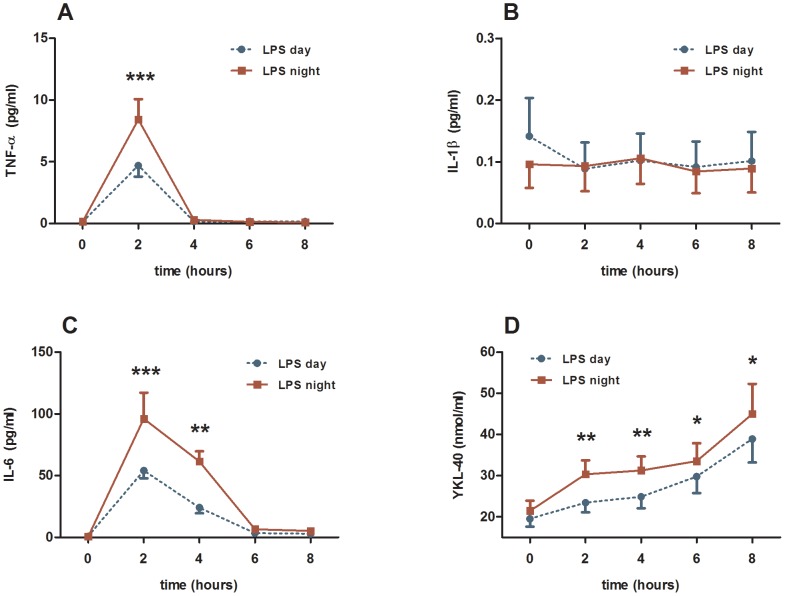
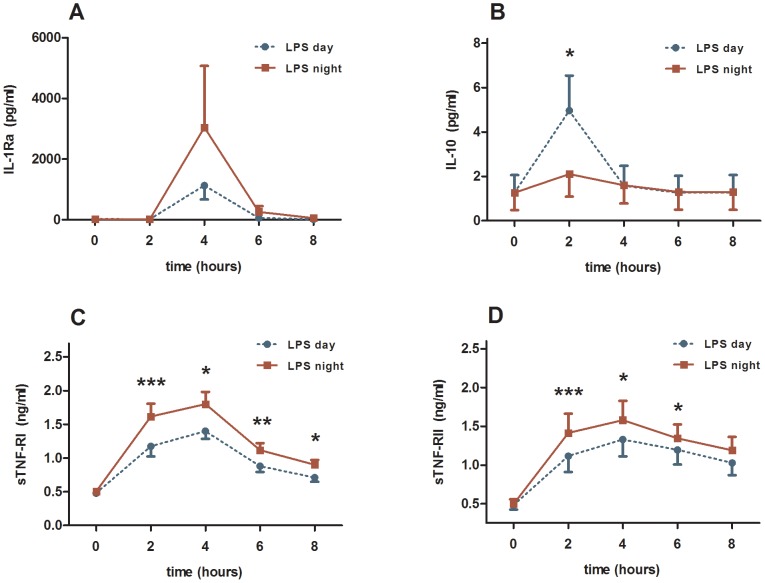
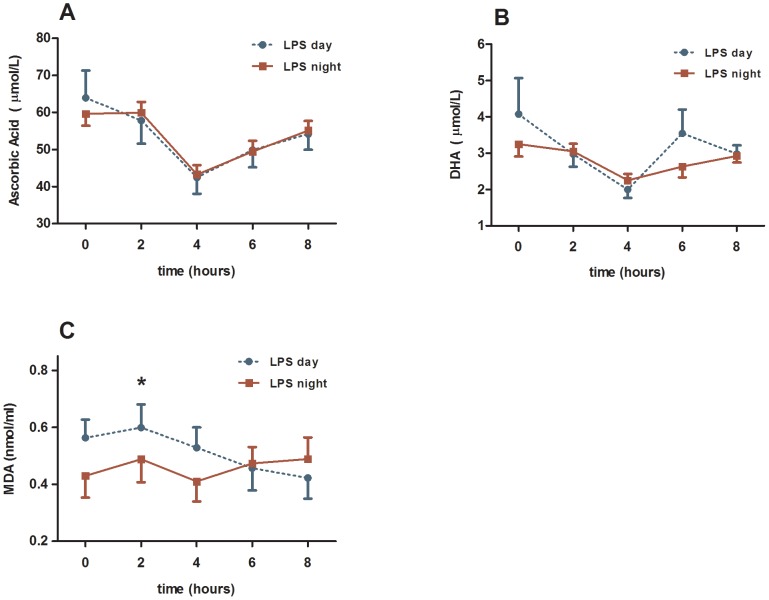
Results: The levels of MDA and IL-10 where significantly higher during the day time (P<0.05) whereas levels of TNF-alpha, sTNF-RI, sTNF-RII, IL-1Ra, IL-6, and YKL-40 were higher (P<0.01 for all comparisons) during the night time. No significant differences were seen in the levels of AA and DHA.
Conclusion: A day-night difference in the acute phase response to endotoxaemia exists in healthy volunteers with a more pronounced inflammatory response during the night time. This circadian difference in the response to endotoxaemia may play an important role in the clinical setting and should be investigated further.
Conflict of interest statement
Figures
References
-
- Habbal OA, Al-Jabri AA (2009) Circadian rhythm and the immune response: a review. Int Rev Immunol 28: 93–198. - PubMed
-
- Haus E, Lakatua DJ, Swoyer J, Sackett-Lundeen L (1983) Chronobiology in hematology and immunology. Am J Anat 168: 467–517. - PubMed
-
- Haus E, Smolensky MH (1999) Biologic rhythms in the immune system. Chronobiol Int 16: 581–622. - PubMed
-
- Kvaslerud T, Hansen MV, Rosenberg J, Gögenur I (2010) Circadian aspects of post-operative morbidity and mortality. Acta Anaesthesiol Scand 54: 1157–63. - PubMed
-
- Gögenur I (2010) Postoperative circadian disturbances. Dan Med Bull 57: B4205. - PubMed
Publication types
MeSH terms
Substances
LinkOut - more resources
Full Text Sources
Other Literature Sources
