


Candiduria in children and susceptibility patterns of recovered Candida species to antifungal drugs in Ahvaz
- PMID: 24475438
- PMCID: PMC3891146
- DOI: 10.12860/JNP.2013.20
Candiduria in children and susceptibility patterns of recovered Candida species to antifungal drugs in Ahvaz
Abstract
Background: Candiduria presents as an increasingly common nosocomial infection, which may involves urinary tract. Spectrum of disease is varying from asymptomatic candiduria to clinical sepsis. Disease is most commonly caused by Candida albicans.
Objectives: The aim of the present study was to determine the frequency of candiduria in children attending Abuzar Pediatrics Hospital.
Patients and methods: Urine samples were collected from 402 patients attending to the Abuzar Pediatrics Hospital, Ahvaz. 10µl of each urine sample was cultured on CHROMagar Candida plates and incubated at 37°C. Ketoconazole, amphotericine B, clotrimazole, fluconazole, miconazole and nystatin disks were used for determination of susceptibility.
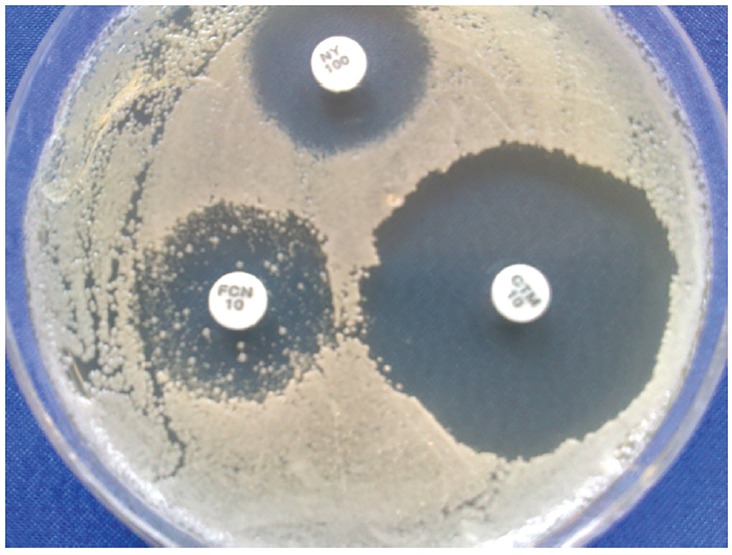
Results: In the present study, 402 patients with the age range <1-14 years were sampled (59.2% males and 40.8% females). Prevalence of Candida among enrolled patients was found to be 5.2% (71.4% males and 28.6% females). In our study C. albicans was identified in 19 cases as the most common yeast followed by nine C. glabrata and one C. krusei. Urine cultures were yielded more than 10000 CFU/ml in 14.3% of the cases followed by 600-10000 CFU/ml (28.5%) and 100-600 CFU/ml (57.2%). Antifungal susceptibility testing revealed that only one isolate of C. glabrata and seven isolates of C. albicans were resistant to nystatin and ketoconazole, respectively. However, all tested isolates were resistance to fluconazole.
Conclusion: Asymptomatic candiduria is relatively more prevalent among children in Ahvaz and the most common agent is C. albicans. In addition, isolated Candida species were sensitive to use antifungals, with exception to fluconazole.
Keywords: Candida albicans; Candiduria; Nosocomial infections; children.
References
-
- Laverdiere M, Labba AC, Restieri C, Rotstein C, Heyland D, Madger S. et al. Susceptibility patterns of Candida species recovered from Canadian intensive care units. J Crit Care. 2007;22(3):245–50. - PubMed
-
- Ozcelik B, Kaynak F, Cesur S, Sipahi B, Sultan N. In vitro activities of voriconazole as a triazole derivative and caspofungin as an echinocandin were compared with those of some antifungal agents against Candida species isolated from clinical specimens. J Infect Dis. 2007;60:302–4. - PubMed
-
- da Silva EH, da Silva Ruiz L, Matsumoto FE, Auler ME, Giudice MC, Moreira D. et al. Candiduria in a public hospital of São Paulo (1999-2004): characteristics of the yeast isolates. Rev Inst Med trop S Paulo. 2007;49(6):349–53. - PubMed
-
- Saha R, Das Das S, Kumar A, Kaur IR. Pattern of Candida isolates in hospitalized children. Indian J Pediatr. 2008;75:858–60. - PubMed
-
- NaymanAlpat S, Özguneş I, Ertem OT, Erben N, DoyukKartal E, Tözun M. et al. Evaluation of risk factors in patients with candiduria. Mikrobiyol Bul. 2011;45(2):318–24. - PubMed
LinkOut - more resources
Full Text Sources