


TERT promoter mutations are a major indicator of poor outcome in differentiated thyroid carcinomas
- PMID: 24476079
- PMCID: PMC4191548
- DOI: 10.1210/jc.2013-3734
TERT promoter mutations are a major indicator of poor outcome in differentiated thyroid carcinomas
Abstract
Context: Telomerase promoter mutations (TERT) were recently described in follicular cell-derived thyroid carcinomas (FCDTC) and seem to be more prevalent in aggressive cancers.
Objectives: We aimed to evaluate the frequency of TERT promoter mutations in thyroid lesions and to investigate the prognostic significance of such mutations in a large cohort of patients with differentiated thyroid carcinomas (DTCs).
Design: This was a retrospective observational study.
Setting and patients: We studied 647 tumors and tumor-like lesions. A total of 469 patients with FCDTC treated and followed in five university hospitals were included. Mean follow-up (±SD) was 7.8 ± 5.8 years.
Main outcome measures: Predictive value of TERT promoter mutations for distant metastasization, disease persistence at the end of follow-up, and disease-specific mortality.
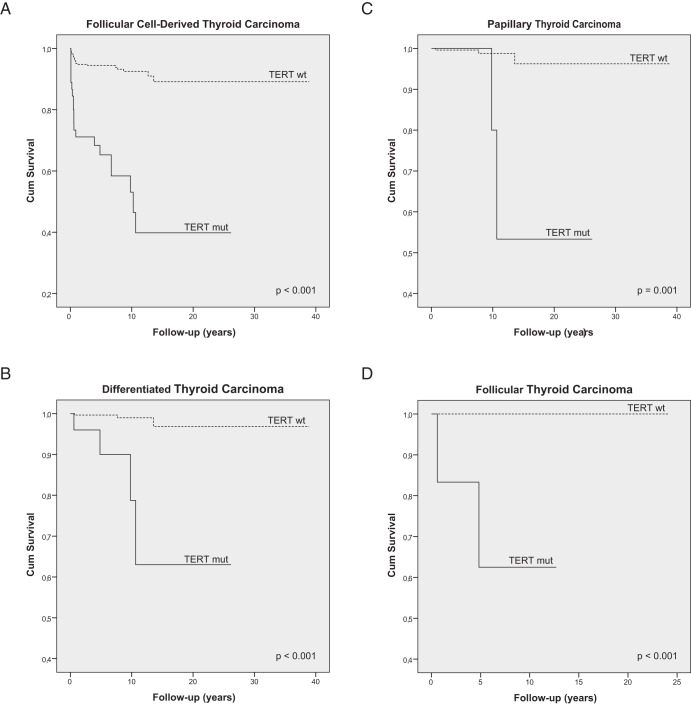
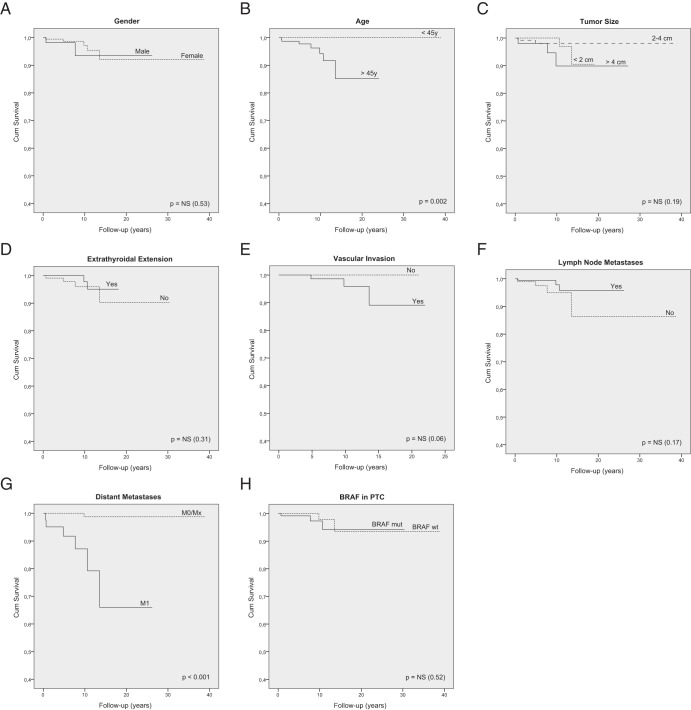
Results: TERT promoter mutations were found in 7.5% of papillary carcinomas (PTCs), 17.1% of follicular carcinomas, 29.0% of poorly differentiated carcinomas, and 33.3% of anaplastic thyroid carcinomas. Patients with TERT-mutated tumors were older (P < .001) and had larger tumors (P = .002). In DTCs, TERT promoter mutations were significantly associated with distant metastases (P < .001) and higher stage (P < .001). Patients with DTC harboring TERT promoter mutations were submitted to more radioiodine treatments (P = .009) with higher cumulative dose (P = .004) and to more treatment modalities (P = .001). At the end of follow-up, patients with TERT-mutated DTCs were more prone to have persistent disease (P = .001). TERT promoter mutations were significantly associated with disease-specific mortality [in the whole FCDTC (P < .001)] in DTCs (P < .001), PTCs (P = .001), and follicular carcinomas (P < .001). After adjusting for age at diagnosis and gender, the hazard ratio was 10.35 (95% confidence interval 2.01-53.24; P = .005) in DTC and 23.81 (95% confidence interval 1.36-415.76; P = .03) in PTCs.
Conclusions: TERT promoter mutations are an indicator of clinically aggressive tumors, being correlated with worse outcome and disease-specific mortality in DTC. TERT promoter mutations have an independent prognostic value in DTC and, notably, in PTC.
Figures
References
-
- Hanahan D, Weinberg RA. The hallmarks of cancer. Cell. 2000;100:57–70 - PubMed
-
- Kim NW, Piatyszek MA, Prowse KR, et al. Specific association of human telomerase activity with immortal cells and cancer. Science. 1994;266:2011–2015 - PubMed
-
- Shay JW, Bacchetti S. A survey of telomerase activity in human cancer. Eur J Cancer. 1997;33:787–791 - PubMed
-
- Bryan TM, Englezou A, Dalla-Pozza L, Dunham MA, Reddel RR. Evidence for an alternative mechanism for maintaining telomere length in human tumors and tumor-derived cell lines. Nat Med. 1997;3:1271–1274 - PubMed
Publication types
MeSH terms
Substances
LinkOut - more resources
Full Text Sources
Other Literature Sources
Medical
