


Induced pluripotent stem cell-derived cardiomyocytes for cardiovascular disease modeling and drug screening
- PMID: 24476344
- PMCID: PMC4056681
- DOI: 10.1186/scrt380
Induced pluripotent stem cell-derived cardiomyocytes for cardiovascular disease modeling and drug screening
Abstract
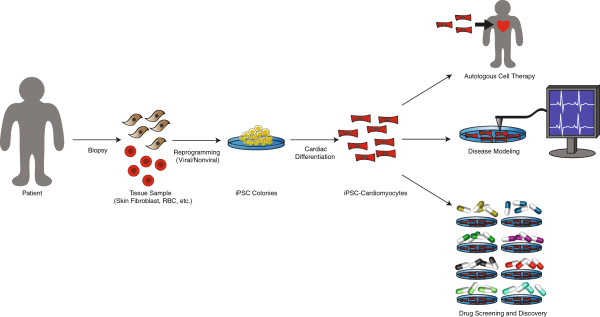
Human induced pluripotent stem cells (hiPSCs) have emerged as a novel tool for drug discovery and therapy in cardiovascular medicine. hiPSCs are functionally similar to human embryonic stem cells (hESCs) and can be derived autologously without the ethical challenges associated with hESCs. Given the limited regenerative capacity of the human heart following myocardial injury, cardiomyocytes derived from hiPSCs (hiPSC-CMs) have garnered significant attention from basic and translational scientists as a promising cell source for replacement therapy. However, ongoing issues such as cell immaturity, scale of production, inter-line variability, and cell purity will need to be resolved before human clinical trials can begin. Meanwhile, the use of hiPSCs to explore cellular mechanisms of cardiovascular diseases in vitro has proven to be extremely valuable. For example, hiPSC-CMs have been shown to recapitulate disease phenotypes from patients with monogenic cardiovascular disorders. Furthermore, patient-derived hiPSC-CMs are now providing new insights regarding drug efficacy and toxicity. This review will highlight recent advances in utilizing hiPSC-CMs for cardiac disease modeling in vitro and as a platform for drug validation. The advantages and disadvantages of using hiPSC-CMs for drug screening purposes will be explored as well.
Figures
References
-
- Takahashi K, Yamanaka S. Induction of pluripotent stem cells from mouse embryonic and adult fibroblast cultures by defined factors. Cell. 2006;4:663–676. - PubMed
-
- Zhou T, Benda C, Dunzinger S, Huang Y, Ho JC, Yang J, Wang Y, Zhang Y, Zhuang Q, Li Y, Bao X, Tse HF, Grillari J, Grillari-Voglauer R, Pei D, Esteban MA. Generation of human induced pluripotent stem cells from urine samples. Nat Protoc. 2012;4:2080–2089. - PubMed
-
- Novak A, Shtrichman R, Germanguz I, Segev H, Zeevi-Levin N, Fishman B, Mandel YE, Barad L, Domev H, Kotton D, Mostoslavsky G, Binah O, Itskovitz-Eldor J. Enhanced reprogramming and cardiac differentiation of human keratinocytes derived from plucked hair follicles, using a single excisable lentivirus. Cell Reprogram. 2010;4:665–678. - PubMed
Publication types
MeSH terms
Grants and funding
LinkOut - more resources
Full Text Sources
Other Literature Sources
