Incidence of childhood obesity in the United States
- PMID: 24476431
- PMCID: PMC4017620
- DOI: 10.1056/NEJMoa1309753
Incidence of childhood obesity in the United States
Abstract
Background: Although the increased prevalence of childhood obesity in the United States has been documented, little is known about its incidence. We report here on the national incidence of obesity among elementary-school children.
Methods: We evaluated data from the Early Childhood Longitudinal Study, Kindergarten Class of 1998-1999, a representative prospective cohort of 7738 participants who were in kindergarten in 1998 in the United States. Weight and height were measured seven times between 1998 and 2007. Of the 7738 participants, 6807 were not obese at baseline; these participants were followed for 50,396 person-years. We used standard thresholds from the Centers for Disease Control and Prevention to define "overweight" and "obese" categories. We estimated the annual incidence of obesity, the cumulative incidence over 9 years, and the incidence density (cases per person-years) overall and according to sex, socioeconomic status, race or ethnic group, birth weight, and kindergarten weight.
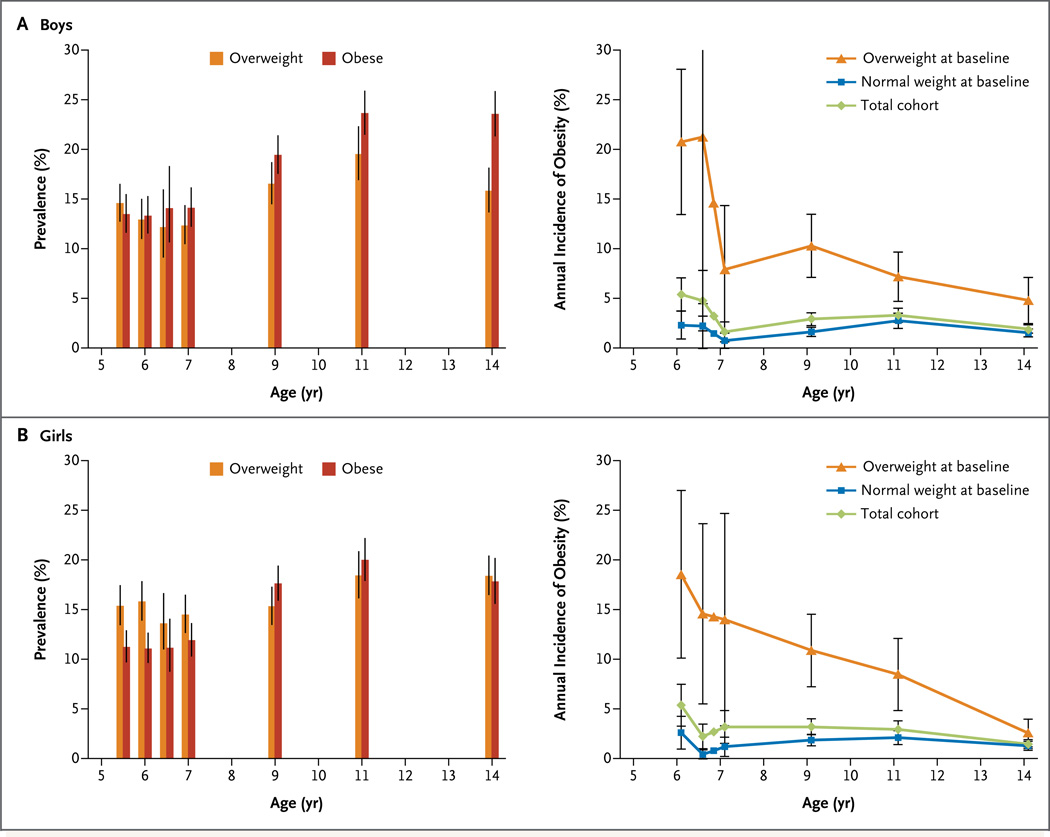
Results: When the children entered kindergarten (mean age, 5.6 years), 12.4% were obese and another 14.9% were overweight; in eighth grade (mean age, 14.1 years), 20.8% were obese and 17.0% were overweight. The annual incidence of obesity decreased from 5.4% during kindergarten to 1.7% between fifth and eighth grade. Overweight 5-year-olds were four times as likely as normal-weight children to become obese (9-year cumulative incidence, 31.8% vs. 7.9%), with rates of 91.5 versus 17.2 per 1000 person-years. Among children who became obese between the ages of 5 and 14 years, nearly half had been overweight and 75% had been above the 70th percentile for body-mass index at baseline.
Conclusions: Incident obesity between the ages of 5 and 14 years was more likely to have occurred at younger ages, primarily among children who had entered kindergarten overweight. (Funded by the Eunice Kennedy Shriver National Institute of Child Health and Human Development.).
Figures
Comment in
-
Who becomes obese during childhood--clues to prevention.N Engl J Med. 2014 Jan 30;370(5):475-6. doi: 10.1056/NEJMe1315169. N Engl J Med. 2014. PMID: 24476437 No abstract available.
-
Incidence of childhood obesity in the United States.N Engl J Med. 2014 Apr 24;370(17):1660-1. doi: 10.1056/NEJMc1402397. N Engl J Med. 2014. PMID: 24758623 Free PMC article. No abstract available.
-
Incidence of childhood obesity in the United States.N Engl J Med. 2014 Apr 24;370(17):1659. doi: 10.1056/NEJMc1402397. N Engl J Med. 2014. PMID: 24758624 No abstract available.
-
Incidence of childhood obesity in the United States.N Engl J Med. 2014 Apr 24;370(17):1659-60. doi: 10.1056/NEJMc1402397. N Engl J Med. 2014. PMID: 24758625 No abstract available.
-
[Obesity biography begins early].MMW Fortschr Med. 2014 Mar 6;156(4):31. MMW Fortschr Med. 2014. PMID: 24908766 German. No abstract available.
References
-
- Glickman D, Parker L, Sim LJ, Cook HDV, Miller EA, editors. Accelerating progress in obesity prevention: solving the weight of the nation. Washington, DC: National Academies Press; 2012. - PubMed
-
- Jolliffe D. Extent of overweight among US children and adolescents from 1971 to 2000. Int J Obes Relat Metab Disord. 2004;28:4–9. - PubMed
-
- Singh GK, Kogan MD, van Dyck PC. Changes in state-specific childhood obesity and overweight prevalence in the United States from 2003 to 2007. Arch Pediatr Adolesc Med. 2010;164:598–607. - PubMed
Publication types
MeSH terms
Grants and funding
LinkOut - more resources
Full Text Sources
Other Literature Sources
Medical