


Phosphorylation-regulated degradation of the tumor-suppressor form of PED by chaperone-mediated autophagy in lung cancer cells
- PMID: 24477641
- PMCID: PMC4310550
- DOI: 10.1002/jcp.24569
Phosphorylation-regulated degradation of the tumor-suppressor form of PED by chaperone-mediated autophagy in lung cancer cells
Abstract
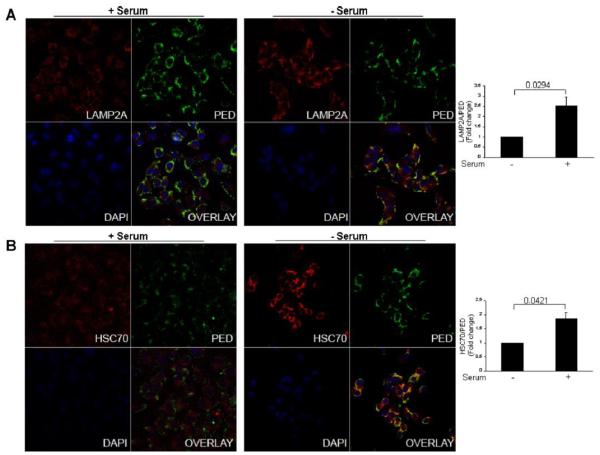
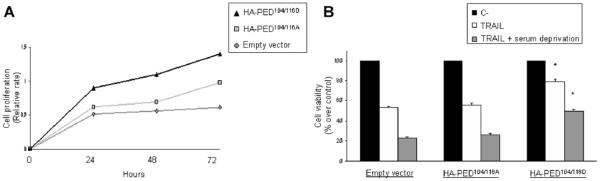
PED/PEA-15 is a death effector domain (DED) family member with a variety of effects on cell growth and metabolism. To get further insight into the role of PED in cancer, we aimed to find new PED interactors. Using tandem affinity purification, we identified HSC70 (Heat Shock Cognate Protein of 70 kDa)-which, among other processes, is involved in chaperone-mediated autophagy (CMA)-as a PED-interacting protein. We found that PED has two CMA-like motifs (i.e., KFERQ), one of which is located within a phosphorylation site, and demonstrate that PED is a bona fide CMA substrate and the first example in which phosphorylation modifies the ability of HSC70 to access KFERQ-like motifs and target the protein for lysosomal degradation. Phosphorylation of PED switches its function from tumor suppression to tumor promotion, and we show that HSC70 preferentially targets the unphosphorylated form of PED to CMA. Therefore, we propose that the up-regulated CMA activity characteristic of most types of cancer cell enhances oncogenesis by shifting the balance of PED function toward tumor promotion. This mechanism is consistent with the notion of a therapeutic potential for targeting CMA in cancer, as inhibition of this autophagic pathway may help restore a physiological ratio of PED forms.
© 2014 Wiley Periodicals, Inc.
Figures



References
-
- Condorelli G, Vigliotta G, Cafieri A, Trencia A, Andalo P, et al. PED/PEA-15: an anti-apoptotic molecule that regulates FAS/TNFR1-induced apoptosis. Oncogene. 1999;18:4409–4415. - PubMed
-
- Renault F, Formstecher E, Callebaut I, Junier MP, Chneiweiss H. The multifunctional protein PEA-15 is involved in the control of apoptosis and cell cycle in astrocytes. Biochem Pharmacol. 2003;66:1581–1588. - PubMed
-
- Incoronato M, Garofalo M, Urso L, Romano G, Quintavalle C, et al. miR-212 increases tumor necrosis factor-related apoptosis-inducing ligand sensitivity in non-small cell lung cancer by targeting the antiapoptotic protein PED. Cancer Res. 2010;70:3638–3646. - PubMed
-
- Stassi G, Garofalo M, Zerilli M, Ricci-Vitiani L, Zanca C, et al. PED mediates AKT-dependent chemoresistance in human breast cancer cells. Cancer Res. 2005;65:6668–6675. - PubMed
Publication types
MeSH terms
Substances
Grants and funding
LinkOut - more resources
Full Text Sources
Other Literature Sources
Medical
Miscellaneous
