Randomized Controlled Trial
. 2014 Apr;232(4):1219-31.
doi: 10.1007/s00221-014-3838-8. Epub 2014 Jan 31.

Factors affecting grip force: anatomy, mechanics, and referent configurations

Affiliations
Randomized Controlled Trial

Factors affecting grip force: anatomy, mechanics, and referent configurations

Satyajit Ambike et al. Exp Brain Res. 2014 Apr.

Abstract

The extrinsic digit muscles naturally couple wrist action and grip force in prehensile tasks. We explored the effects of wrist position on the steady-state grip force and grip-force change during imposed changes in the grip aperture [apparent stiffness (AS)]. Subjects held an instrumented handle steady using a prismatic five-digit grip. The grip aperture was changed slowly, while the subjects were instructed not to react voluntarily to these changes. An increase in the aperture resulted in an increase in grip force, and its contraction resulted in a proportional drop in grip force. The AS values (between 4 and 6 N/cm) were consistent across a wide range of wrist positions. These values were larger when the subjects performed the task with eyes open as compared to eyes-closed trials. They were also larger for trials that started from a larger initial aperture. After a sequence of aperture increase and decrease to the initial width, grip force dropped by about 25% without the subjects being aware of this. We interpret the findings within the referent configuration hypothesis of grip-force production. The results support the idea of back-coupling between the referent and actual digit coordinates. According to this idea, the central nervous system defines referent coordinates for the digit tips, and the difference between the referent and actual coordinates leads to force production. If actual coordinates are not allowed to move to referent ones, referent coordinates show a relatively slow drift toward the actual ones.


Figures
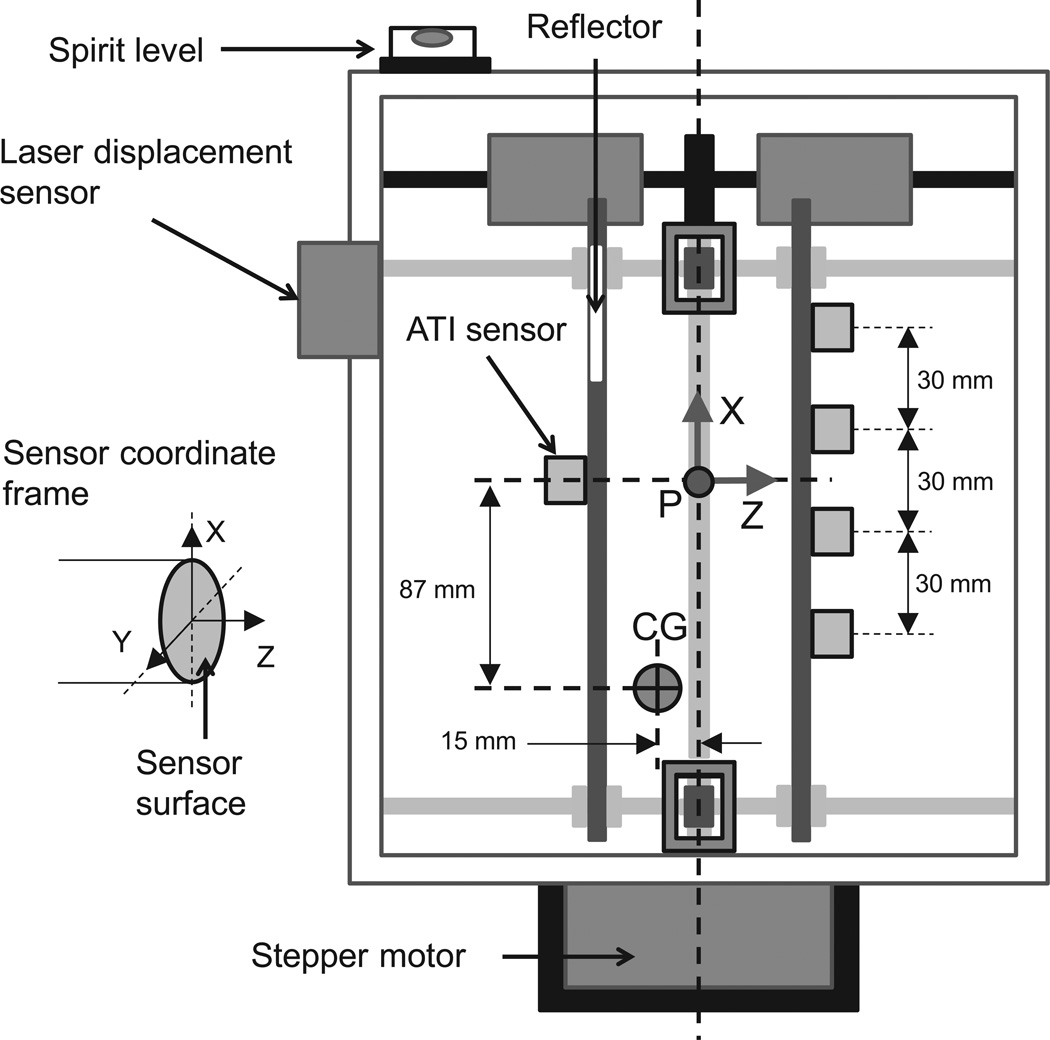
Figure 1
Figure 1
Schematic diagram of the expanding handle. The motor attached at the bottom changed the aperture width, i.e. the horizontal distance between the thumb and the finger sensor surfaces, symmetrically about the vertical axis. A handle-fixed coordinate frame is located at point P on the vertical symmetry axis of the handle and on a line passing through the center of the thumb sensor. The center of gravity (CG) of the assembly is towards the thumb sensor and displaced downward from point P. Each sensor measured digit forces and moments in a local coordinate frame shown.
Figure 2
Figure 2
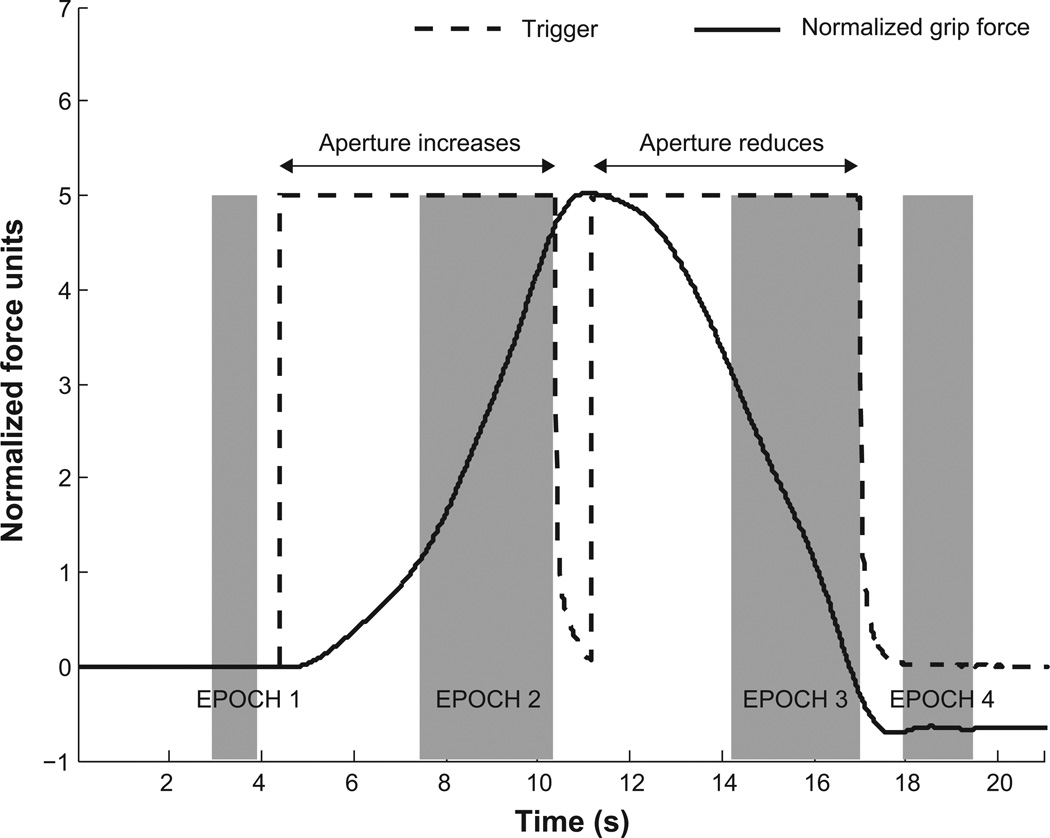
Typical subject response. The normalized grip force (thick black trace) and the trigger signal (dashed black trace) are plotted against time. The initial value of the normalized force at time 0 s is arbitrarily set to zero. Grip force increases as the aperture increases and decreases as the aperture reduces. The data is partitioned into four epochs associated with the initial steady state, aperture opening, aperture closing, and the final steady state. These are indicated as shaded bands.
Figure 3
Figure 3
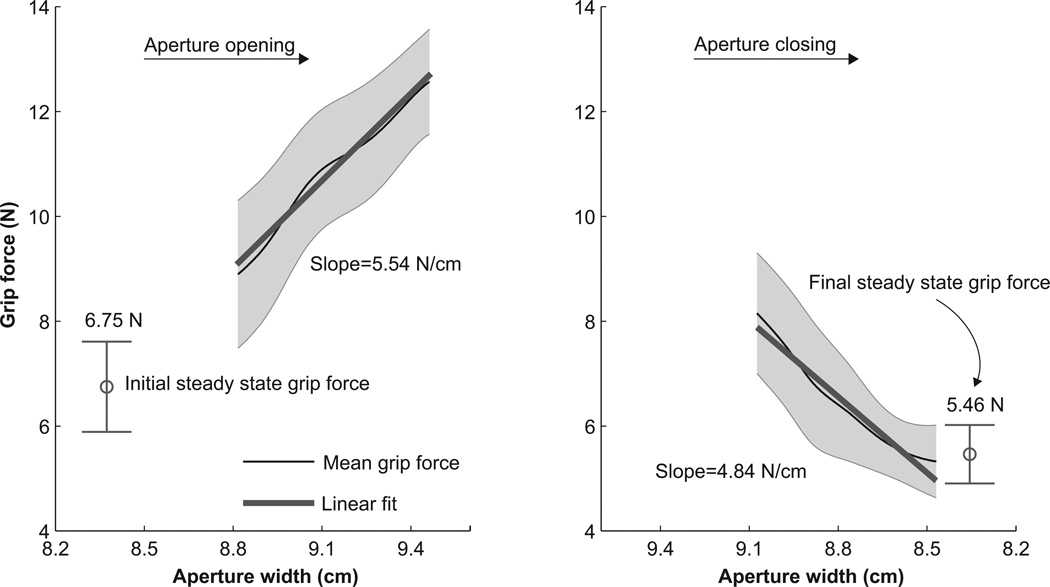
Computation of grip force and apparent stiffness (AS) for a representative subject. Data averages are across three repetitions for a particular wrist position, eye condition, and initial aperture size. Left panel shows the initial steady-state grip force (mean and SD) and the mean (black line) and SD (black band) of the grip force as the aperture increases from left to right. The right panel shows the mean (black line) and SD (black band) of the grip force as the aperture decreases from left to right and the final steady state grip force (mean and SD). The thick black line in each panel are the linear regression lines to the mean grip forces. The slopes of these linear fits are the AS.
Figure 4
Figure 4
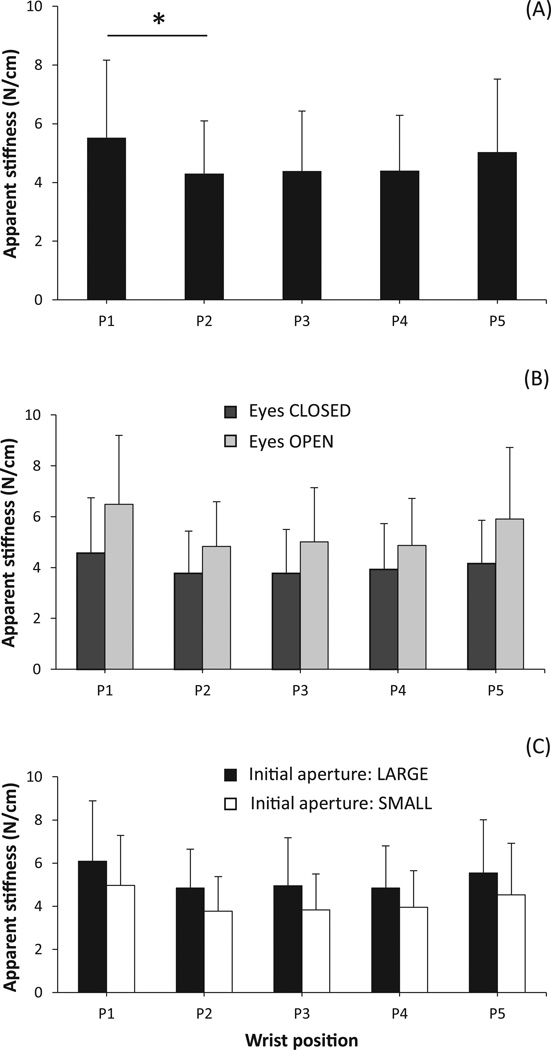
Apparent stiffness mean and SD across various conditions. Wrist positions are labeled from P1 to P5 ranging from flexion to extension in that order. Significant differences are indicated with a star (*).
Figure 5
Figure 5
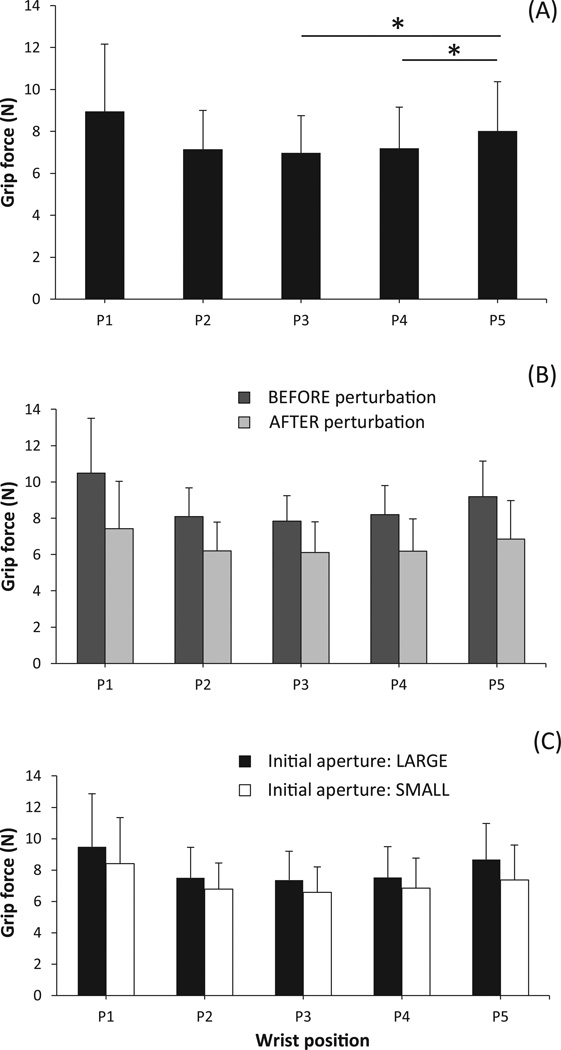
The steady state grip force mean and SD for various conditions. Wrist positions are labeled from P1 to P5 ranging from flexion to extension in that order. Significant differences are indicated with a star (*).
Figure 6
Figure 6
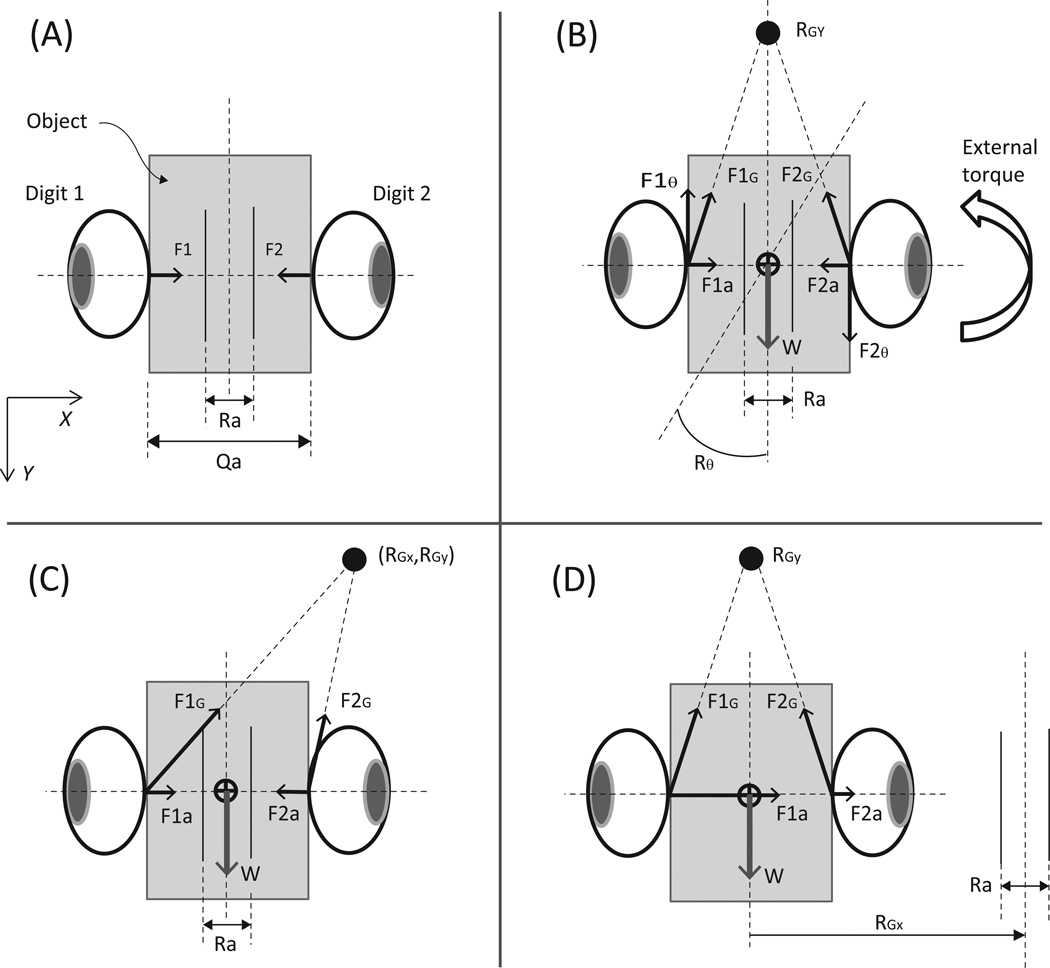
Referent apertures and the mechanism of grip force generation. Figure 6(A) depicts the simplest case wherein two digits statically balance the object without applying any moment. Figure 6(B) depicts a possible way in which the referent coordinates can be modulated to counter object weight w and external torque acting on the object. Figures (C) and (D) depict two possible ways in which changes in four referent coordinates can produce movement of the object to the right. In all cases, the forces measured at the digit-object interface are the vector sum of the digit forces resulting from the prescribed values for all four referent coordinates. Assume zero external torque for simplicity. So, Rθ = 0.
Figure 7
Figure 7
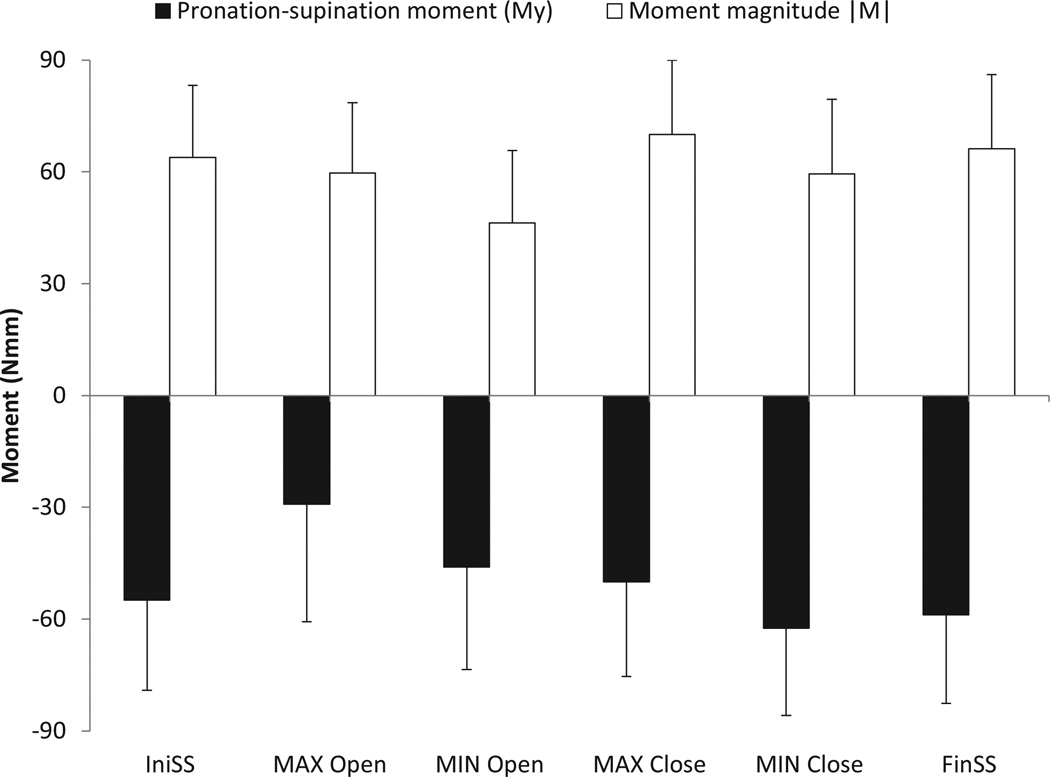
The mean and SD for the unbalanced moment about the handle-fixed Y axis MY (black bars) and the magnitude of the net unbalanced moment |M| (white bars) are shown. The following six moments are analyzed: (1) initial steady-state (IniSS), (2) the maximum during the aperture opening phase (Max Open), (3) the minimum during the aperture opening phase (Min Open), (4) the maximum during the aperture closing phase (Max Close), (5) the minimum during the aperture closing phase (Min Close), and (6) the final steady-state (FinSS).

References

    1. Ambike SS, Paclet F, Latash ML, Zatsiorsky VM. Grip-force modulation in multi-finger prehension during wrist flexion and extension. Exp Brain Res. 2013;227:509–522. - PMC - PubMed
    1. Aoki T, Latash ML, Zatsiorsky VM. Adjustments to local friction in multifinger prehension. J Mot Behav. 2007;39:276–290. - PMC - PubMed
    1. Baweja HS, Patel BK, Martinkewiz JD, Vu J, Christou EA. Removal of visual feedback alters muscle activity and reduces force variability during constant isometric contractions. Exp Brain Res. 2009;197:35–47. - PMC - PubMed
    1. Bernstein N. The co-ordination and regulation of movements. Oxford: Pergamon; 1967.
    1. Brand P, Hollister A. Clinical mechanics of the hand. St. Louis: Mosby Year Book; 1999.

Publication types

LinkOut - more resources