Naturalistic follow-up of youths treated for pediatric anxiety disorders
- PMID: 24477837
- PMCID: PMC3969570
- DOI: 10.1001/jamapsychiatry.2013.4186
Naturalistic follow-up of youths treated for pediatric anxiety disorders
Abstract
Importance: Pediatric anxiety disorders are highly prevalent and impairing and are considered gateway disorders in that they predict adult psychiatric problems. Although they can be effectively treated in the short term, data are limited on the long-term outcomes in treated children and adolescents, particularly those treated with medication.
Objective: To determine whether acute clinical improvement and treatment type (i.e., cognitive behavioral therapy, medication, or their combination) predicted remission of anxiety and improvement in global functioning at a mean of 6 years after randomization and to examine predictors of outcomes at follow-up.
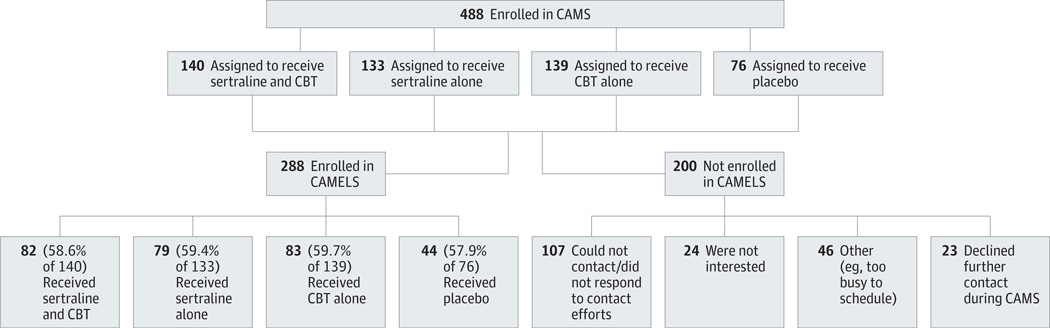
Design, setting, and participants: This naturalistic follow-up study, as part of the Child/Adolescent Anxiety Multimodal Extended Long-term Study (CAMELS), was conducted at 6 academic sites in the United States and included 288 youths (age range, 11-26 years; mean age, 17 years). Youths were randomized to 1 of 4 interventions (cognitive behavioral therapy, medication, combination, or pill placebo) in the Child/Adolescent Anxiety Multimodal Study (CAMS) and were evaluated a mean of 6 years after randomization. Participants in this study constituted 59.0% of the original CAMS sample.
Exposures: Participants were assessed by independent evaluators using a semistructured diagnostic interview to determine the presence of anxiety disorders, the severity of anxiety, and global functioning. Participants and their parents completed questionnaires about mental health symptoms, family functioning, life events, and mental health service use.
Main outcomes and measures: Remission, defined as the absence of all study entry anxiety disorders. RESULTS Almost half of the sample (46.5%) were in remission a mean of 6 years after randomization. Responders to acute treatment were significantly more likely to be in remission (odds ratio, 1.83; 95% CI, 1.08-3.09) and had less severe anxiety symptoms and higher functioning; the assigned treatment arm was unrelated to outcomes. Several predictors of remission and functioning were identified.
Conclusions and relevance: Youths rated as responders during the acute treatment phase of CAMS were more likely to be in remission a mean of 6 years after randomization, although the effect size was small. Relapse occurred in almost half (48%) of acute responders, suggesting the need for more intensive or continued treatment for a sizable proportion of youths with anxiety disorders. TRIAL REGISTRATION clinicaltrials.gov Identifier: NCT00052078.
Conflict of interest statement
Figures
References
-
- Kendall PC, Safford S, Flannery-Schroeder E, Webb A. Child anxiety treatment: outcomes in adolescence and impact on substance use and depression at 7.4-year follow-up. J Consult Clin Psychol. 2004;72(2):276–287. - PubMed
Publication types
MeSH terms
Substances
Associated data
Grants and funding
- R01 MH064092/MH/NIMH NIH HHS/United States
- U01 MH064003/MH/NIMH NIH HHS/United States
- U01 MH064107/MH/NIMH NIH HHS/United States
- R01 MH064003/MH/NIMH NIH HHS/United States
- R01 MH064088/MH/NIMH NIH HHS/United States
- R01 MH064107/MH/NIMH NIH HHS/United States
- MH64088/MH/NIMH NIH HHS/United States
- MH64092/MH/NIMH NIH HHS/United States
- U01 MH064088/MH/NIMH NIH HHS/United States
- U01 MH063747/MH/NIMH NIH HHS/United States
- MH64107/MH/NIMH NIH HHS/United States
- K24 MH096760/MH/NIMH NIH HHS/United States
- R01 MH063747/MH/NIMH NIH HHS/United States
- MH064089/MH/NIMH NIH HHS/United States
- U01 MH064089/MH/NIMH NIH HHS/United States
- R01 MH064089/MH/NIMH NIH HHS/United States
- MH063747/MH/NIMH NIH HHS/United States
LinkOut - more resources
Full Text Sources
Other Literature Sources
Medical