. 2014 Feb;52(2):407-18.
doi: 10.1128/JCM.02069-13. Epub 2013 Nov 13.

Characterization of Escherichia coli isolates from hospital inpatients or outpatients with urinary tract infection

Affiliations

Characterization of Escherichia coli isolates from hospital inpatients or outpatients with urinary tract infection

Francisco Toval et al. J Clin Microbiol. 2014 Feb.

Abstract

Uropathogenic Escherichia coli (UPEC) is the most common cause of community- and hospital-acquired urinary tract infections (UTIs). Isolates from uncomplicated community-acquired UTIs express a variety of virulence traits that promote the efficient colonization of the urinary tract. In contrast, nosocomial UTIs can be caused by E. coli strains that differ in their virulence traits from the community-acquired UTI isolates. UPEC virulence markers are used to distinguish these facultative extraintestinal pathogens, which belong to the intestinal flora of many healthy individuals, from intestinal pathogenic E. coli (IPEC). IPEC is a diarrheagenic pathogen with a characteristic virulence gene set that is absent in UPEC. Here, we characterized 265 isolates from patients with UTIs during inpatient or outpatient treatment at a hospital regarding their phylogenies and IPEC or UPEC virulence traits. Interestingly, 28 of these isolates (10.6%) carried typical IPEC virulence genes that are characteristic of enteroaggregative E. coli (EAEC), Shiga toxin-producing E. coli (STEC), and atypical enteropathogenic E. coli (aEPEC), although IPEC is not considered a uropathogen. Twenty-three isolates harbored the astA gene coding for the EAEC heat-stable enterotoxin 1 (EAST1), and most of them carried virulence genes that are characteristic of UPEC and/or EAEC. Our results indicate that UPEC isolates from hospital patients differ from archetypal community-acquired isolates from uncomplicated UTIs by their spectrum of virulence traits. They represent a diverse group, including EAEC, as well as other IPEC pathotypes, which in addition contain typical UPEC virulence genes. The combination of typical extraintestinal pathogenic E. coli (ExPEC) and IPEC virulence determinants in some isolates demonstrates the marked genome plasticity of E. coli and calls for a reevaluation of the strict pathotype classification of EAEC.


Figures
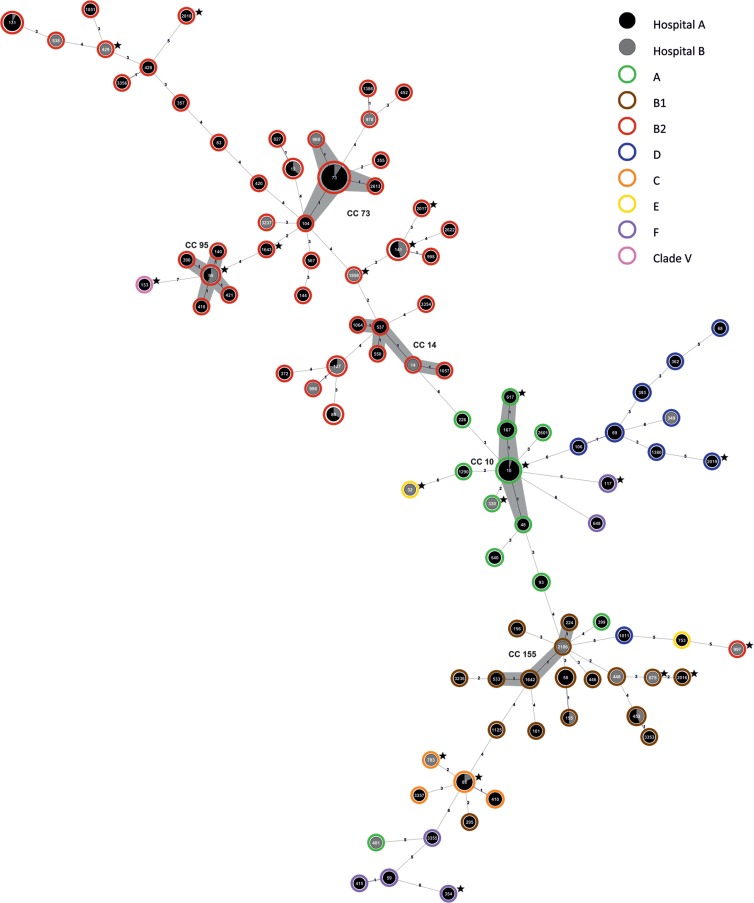
FIG 1
FIG 1
Phylogenetic background of E. coli isolates from hospital inpatients and outpatients with UTIs. The molecular phylogeny of the urine isolates from hospital A (black) or from hospital B (gray) as indicated by the pie charts is based on the MLST allelic profiles. The minimum spanning tree illustrating the clonal relationship of the isolates has been generated with SeqSphere (Ridom GmbH). The size of each pie chart mirrors the number of strains allocated to an individual ST. Phylogenetic groups (A, B1, B2, C, D, E, F, and clade V) as determined by an improved quadruplex phylotyping PCR approach (21) are indicated by the outermost colored rings on the tree. Sequence types marked with an asterisk comprise isolates with intestinal pathogenic E. coli (IPEC) virulence markers.
FIG 2
FIG 2
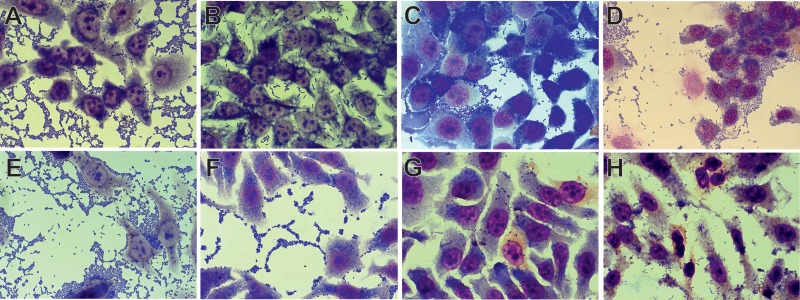
Adherence pattern of astA-positive atypical UPEC isolates from hospital inpatients and outpatients identified on HEp-2 cells. Shown are EAEC strain 042 (positive control) (A), E. coli K-12 strain C600 (negative control) (B), aUPEC 2383 (Ont:H-, ST141) (C), aUPEC 5226 (Ont:Hnt, ST782) (D), aUPEC UR3427 (Ont:H-, ST133) (E), aUPEC UR05826/201 (O8:H-, ST10) (F), aUPEC 1352 (O15:H-, ST10) (G), and aUPEC UR5889/201 (O2:H6, ST141) (H).
FIG 3
FIG 3
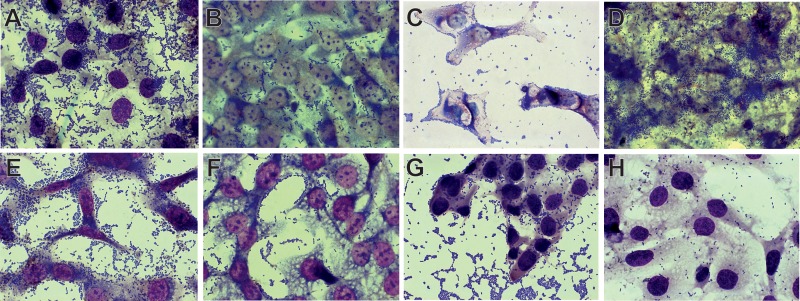
Adherence pattern of astA-positive atypical UPEC isolates from hospital inpatients and outpatients on T24 bladder epithelial cells. Shown are EAEC strain 042 (positive control) (A), E. coli K-12 strain C600 (negative control) (B), aUPEC 2383 (Ont:H-, ST141) (C), aUPEC 5226 (Ont:Hnt, ST782) (D), aUPEC UR3427 (Ont:H-, ST133) (E), aUPEC UR05826/201 (O8:H-, ST10) (F), aUPEC 1352 (O15:H-, ST10) (G), and aUPEC UR5889/201 (O2:H6, ST141) (H).
FIG 4
FIG 4
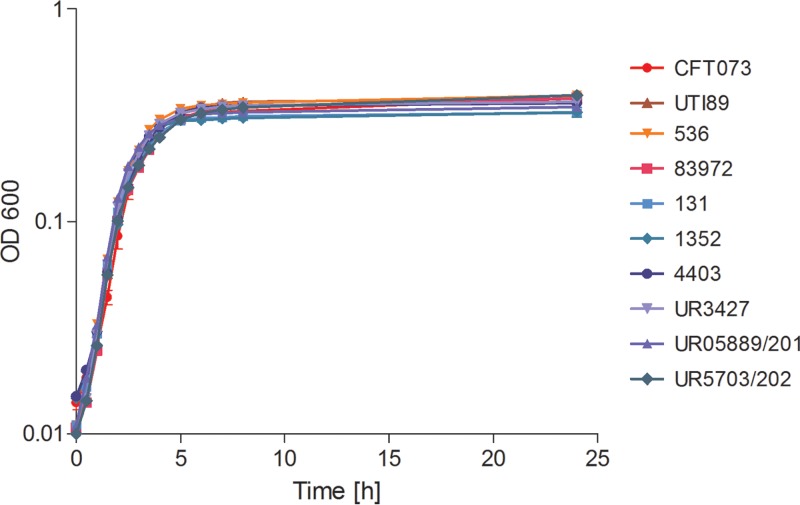
Growth characteristics of atypical UPEC isolates in pooled human urine samples. Error bars represent the standard deviations of the results from at least three independent experiments. The growth curves of typical UPEC and asymptomatic bacteriuria E. coli isolates at 37°C are indicated in red and orange, and growth curves of atypical UPEC isolates are colored in blue and violet.
FIG 5
FIG 5
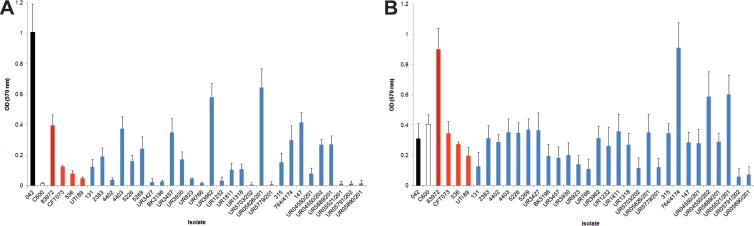
Biofilm formation of atypical UPEC isolates upon growth at 37°C in M9 minimal medium (A) and artificial urine medium (B). Error bars represent the standard deviations of the results from at least three independent experiments.

References

    1. Kaper JB, Nataro JP, Mobley HL. 2004. Pathogenic Escherichia coli. Nat. Rev. Microbiol. 2:123–140. 10.1038/nrmicro818 - DOI - PubMed
    1. Kucheria R, Dasgupta P, Sacks SH, Khan MS, Sheerin NS. 2005. Urinary tract infections: new insights into a common problem. Postgrad. Med. J. 81:83–86. 10.1136/pgmj.2004.023036 - DOI - PMC - PubMed
    1. Dwyer LL, Harris-Kojetin LD, Valverde RH, Frazier JM, Simon AE, Stone ND, Thompson ND. 2013. Infections in long-term care populations in the United States. J. Am. Geriatr. Soc. 61:342–349. 10.1111/jgs.12153 - DOI - PubMed
    1. Jacobsen SM, Stickler DJ, Mobley HL, Shirtliff ME. 2008. Complicated catheter-associated urinary tract infections due to Escherichia coli and Proteus mirabilis. Clin. Microbiol. Rev. 21:26–59. 10.1128/CMR.00019-07 - DOI - PMC - PubMed
    1. Simonetti A, Ottaiano E, Diana MV, Onza C, Triassi M. 2013. Epidemiology of hospital-acquired infections in an adult intensive care unit: results of a prospective cohort study. Ann. Ig. 25:281–289 (In Italian.) - PubMed

Publication types

MeSH terms

Substances

LinkOut - more resources