Review
. 2014 Jan 17:4:413.
doi: 10.3389/fphys.2013.00413. eCollection 2013.

Role of AE2 for pHi regulation in biliary epithelial cells

Affiliations
Review

Role of AE2 for pHi regulation in biliary epithelial cells

Axel R Concepcion et al. Front Physiol. .

Abstract

The Cl(-)/HCO(-) 3anion exchanger 2 (AE2) is known to be involved in intracellular pH (pHi) regulation and transepithelial acid-base transport. Early studies showed that AE2 gene expression is reduced in liver biopsies and blood mononuclear cells from patients with primary biliary cirrhosis (PBC), a disease characterized by chronic non-suppurative cholangitis associated with antimitochondrial antibodies (AMA) and other autoimmune phenomena. Microfluorimetric analysis of the Cl(-)/HCO(-) 3 anion exchange (AE) in isolated cholangiocytes showed that the cAMP-stimulated AE activity is diminished in PBC compared to both healthy and diseased controls. More recently, it was found that miR-506 is upregulated in cholangiocytes of PBC patients and that AE2 may be a target of miR-506. Additional evidence for a pathogenic role of AE2 dysregulation in PBC was obtained with Ae2 (-/-) a,b mice, which develop biochemical, histological, and immunologic alterations that resemble PBC (including development of serum AMA). Analysis of HCO(-) 3 transport systems and pHi regulation in cholangiocytes from normal and Ae2 (-/-) a,b mice confirmed that AE2 is the transporter responsible for the Cl(-)/HCO(-) 3exchange in these cells. On the other hand, both Ae2 (+/+) a,b and Ae2 (-/-) a,b mouse cholangiocytes exhibited a Cl(-)-independent bicarbonate transport system, essentially a Na(+)-bicarbonate cotransport (NBC) system, which could contribute to pHi regulation in the absence of AE2.

Keywords: Cl−/HCO−3 anion exchange; bile flow; biliary HCO−3 secretion; cholangiocytes; primary biliary cirrhosis.


Figures
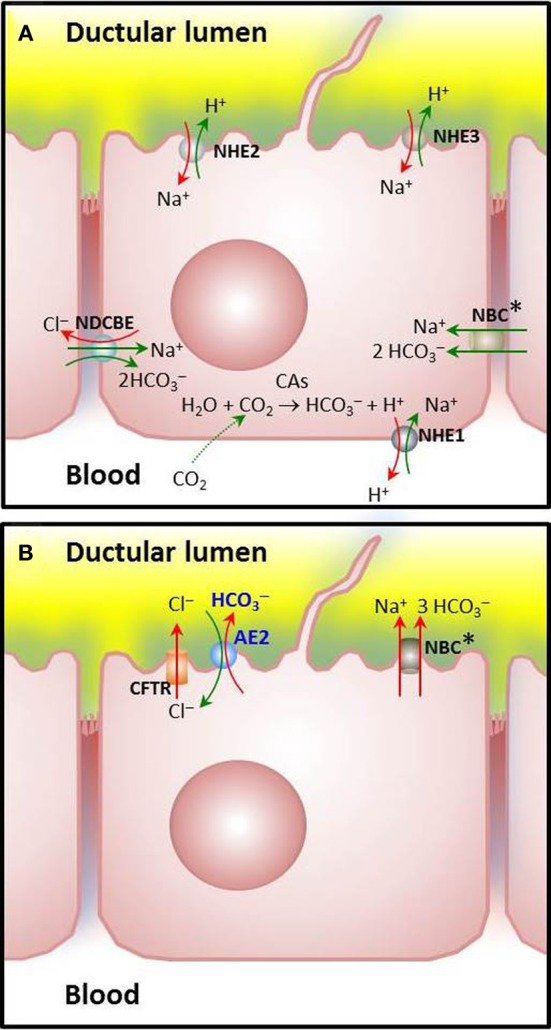
Figure 1
Figure 1
Major ion carriers involved in pHi regulation in cholangiocytes. (A) Acid extruders or HCO3 loaders: Cells are loaded with HCO3 via CO2 hydration catalyzed by carbonic anhydrases [CO2(g)+H2O(l) ↔ HCO3−(aq) + H+(aq)] and subsequent H+ extrusion through Na+/H+ exchange, mainly mediated by the basolateral amiloride-sensitive NHE1, that is recognized as a potent acid extruder. Amiloride-insensitive NHE2 and amiloride-sensitive NHE3 may also participate, though these apical exchangers seems to play a major role for NaCl and fluid absorption from the bile duct lumen (Strazzabosco, ; Spirlì et al., ; Mennone et al., 2001). Additionally, Na+: HCO3 cotransporters (NBC) with a stoichiometry of 1:2 or a Na+-dependent Cl/HCO3 exchanger (NDCBE) may load HCO3 (in rodent or human cholangiocytes, respectively). (B) Acid loaders: The Na+-independent Cl/HCO3 exchanger AE2 is the major acid loader in cholangiocytes. Physiologically, it extrudes HCO3 in exchange with Cl once a high outside to inside gradient has been established following stimulation of a variety of apical Cl channels (the cAMP-activated CFTR and the Ca2+-dependent TMEM16A—illustrated in Figure 2—among other channels pending a complete characterization). Characteristically, mouse cholangiocytes possess an additional capability for acid loading through Na+: HCO3 cotransport (putatively with a stoichiometry of 1:3) (Uriarte et al., 2010). The biliary epithelial cells have other ion carriers like those for Cl, Na+, and K+ (not shown) which may contribute, at least indirectly, to pHi regulation and/or HCO3 secretion. Asterisks are used to indicate that locations for NBC(s) remain to be definitely determined.
Figure 2
Figure 2
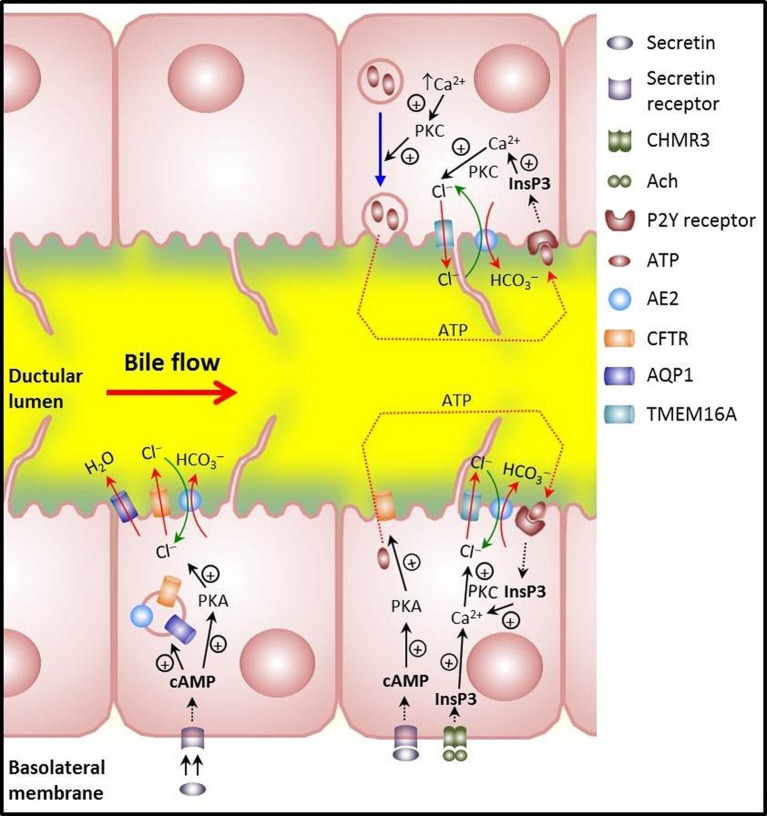
Main mechanisms involved in biliary HCO3 secretion in cholangiocytes. Lower left: illustrates that the hormone secretin induces trafficking of vesicles with the chloride channel CFTR, the anion exchanger AE2/SLC4A2, and the water channel AQP1. Vesicle exocytosis at the apical membrane allows for bicarbonate-rich hydrocholeresis. Lower right: cholinergic stimulation of basolateral M3 muscarinic receptors increases InsP3 and leads to Ca2+ release. Activation of the apical Ca2+-dependent Cl channel TMEM16A results in efflux of Cl which is then exchanged with HCO3 via AE2. Moreover, CFTR activation that follows secretin stimulation may induce apical release of ATP with further stimulation of apical P2Y receptors, increases in InsP3 and Ca2+, activation of apical Ca2+-dependent Cl channel TMEM16A, Cl efflux and final AE2-mediated Cl/HCO3 exchanger for apical HCO3 secretion. Upper right: release of ATP that follows PKC-dependent exocytosis of ATP-enriched intracellular vesicles upon increases in cell volume. Further stimulation of apical P2Y receptors may end up with apical HCO3 secretion as described for the CFTR-dependent release of ATP.

References

    1. Abuladze N., Pushkin A., Tatishchev S., Newman D., Sassani P., Kurtz I. (2004). Expression and localization of rat NBC4c in liver and renal uroepithelium. Am. J. Physiol. Cell Physiol. 287, C781–C789 10.1152/ajpcell.00590.2003 - DOI - PubMed
    1. Afroze S., Meng F., Jensen K., McDaniel K., Rahal K., Onori P., et al. (2013). The physiological roles of secretin and its receptor. Ann. Transl. Med. 1, 29 10.3978/j.issn.2305-5839.2012.12.01 - DOI - PMC - PubMed
    1. Alper S. L. (2009). Molecular physiology and genetics of Na+-independent SLC4 anion exchangers. J. Exp. Biol. 212, 1672–1683 10.1242/jeb.029454 - DOI - PMC - PubMed
    1. Alterio V., di Fiore A., D'Ambrosio K., Supuran C. T., de Simone G. (2012). Multiple binding modes of inhibitors to carbonic anhydrases: how to design specific drugs targeting 15 different isoforms? Chem. Rev. 112, 4421–4468 10.1021/cr200176r - DOI - PubMed
    1. Alvaro D., Alpini G., Jezequel A. M., Bassotti C., Francia C., Fraioli F., et al. (1997a). Role and mechanisms of action of acetylcholine in the regulation of rat cholangiocyte secretory functions. J. Clin. Invest. 100, 1349–1362 10.1172/JCI119655 - DOI - PMC - PubMed

LinkOut - more resources