


The influence of two different invitation letters on Chlamydia testing participation: randomized controlled trial
- PMID: 24480721
- PMCID: PMC3936267
- DOI: 10.2196/jmir.2907
The influence of two different invitation letters on Chlamydia testing participation: randomized controlled trial
Abstract
Background: In The Netherlands, screening for chlamydia (the most prevalent sexually transmitted infection worldwide) is a relatively simple and free procedure. Via an invitation letter sent by the public health services (PHS), people are asked to visit a website to request a test kit. They can then do a chlamydia test at home, send it anonymously to a laboratory, and, within two weeks, they can review their test results online and be treated by their general practitioner or the PHS. Unfortunately, the participation rates are low and the process is believed to be not (cost-) effective.
Objective: The objective of this study was to assess whether the low participation rate of screening for chlamydia at home, via an invitation letter asking to visit a website and request a test kit, could be improved by optimizing the invitation letter through systematically applied behavior change theories and evidence.
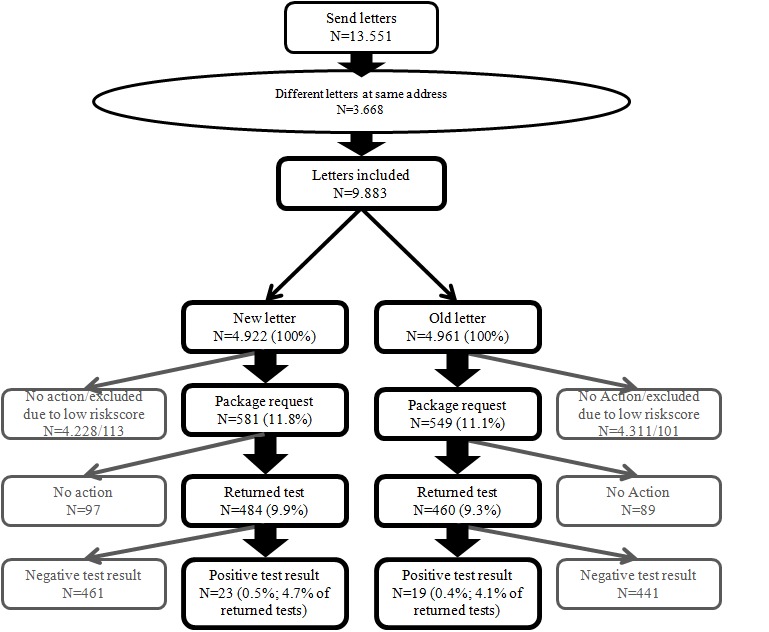
Methods: The original letter and a revised letter were randomly sent out to 13,551 citizens, 16 to 29 years old, in a Dutch municipality. Using behavior change theories, the revised letter sought to increase motivation to conduct chlamydia screening tests. The revised letter was tailored to beliefs that were found in earlier studies: risk perception, advantages and disadvantages (attitude), moral norm, social influence, and response- and self-efficacy. Revisions to the new letter also sought to avoid possible unwanted resistance caused when people feel pressured, and included prompts to trigger the desired behavior.
Results: No significant differences in test package requests were found between the two letters. There were also no differences between the original and revised letters in the rates of returned tests (11.80%, 581/4922 vs. 11.07%, 549/4961) or positive test results (4.8%, 23/484 vs. 4.1%, 19/460). It is evident that the new letter did not improve participation compared to the original letter.
Conclusions: It is clear that the approach of inviting the target population through a letter does not lead to higher participation rates for chlamydia screening. Other approaches have to be developed and pilot tested.
Keywords: behavior change theories; chlamydia; invitation letter; screening; testing.
Conflict of interest statement
Conflicts of Interest: None declared.
Figures
References
-
- Chlamydia Screening Website. [2014-01-07]. http://www.chlamydiatest.nl.
-
- van den Broek IV, van Bergen JE, Brouwers EE, Fennema JS, Götz HM, Hoebe CJ, Koekenbier RH, Kretzschmar M, Over EA, Schmid BV, Pars LL, van Ravesteijn SM, van der Sande MA, de Wit GA, Low N, Op de Coul EL. Effectiveness of yearly, register based screening for chlamydia in the Netherlands: controlled trial with randomised stepped wedge implementation. BMJ. 2012;345:e4316. http://www.bmj.com/cgi/pmidlookup?view=long&pmid=22767614 - PMC - PubMed
-
- Schmid BV, Over EAB, van den Broek IVF, Op de Coul ELM, van Bergen JEAM, Fennema JSA, Götz HM, Hoebe CJPA, de Wit GA, van der Sande MAB, Kretzschmar MEE. Effects of population based screening for Chlamydia infections in the Netherlands limited by declining participation rates. PLoS One. 2013;8(3):e58674. doi: 10.1371/journal.pone.0058674. http://dx.plos.org/10.1371/journal.pone.0058674 - DOI - PMC - PubMed
-
- Bartholomew LK, Parcel GS, Kok G, Gottlieb NH, Fernández ME. Planning Health Promotion Programs: An Intervention Mapping Approach, 3rd Edition. San Francisco, CA: Jossey-Bass; 2011.
-
- Ten Hoor GA, Ruiter RA, van Bergen JE, Hoebe CJ, Houben K, Kok G. Non-participation in chlamydia screening in the Netherlands: determinants associated with young people's intention to participate in chlamydia screening. BMC Public Health. 2013;13:1091. doi: 10.1186/1471-2458-13-1091. http://www.biomedcentral.com/1471-2458/13/1091 - DOI - PMC - PubMed
Publication types
MeSH terms
Substances
LinkOut - more resources
Full Text Sources
Other Literature Sources
Medical
