Bioactive versus bare platinum coils in the treatment of intracranial aneurysms: the MAPS (Matrix and Platinum Science) trial
- PMID: 24481333
- PMCID: PMC7964535
- DOI: 10.3174/ajnr.A3857
Bioactive versus bare platinum coils in the treatment of intracranial aneurysms: the MAPS (Matrix and Platinum Science) trial
Abstract
Background and purpose: The ability of polymer-modified coils to promote stable aneurysm occlusion after endovascular treatment is not well-documented. Angiographic aneurysm recurrence is widely used as a surrogate for treatment failure, but studies documenting the correlation of angiographic recurrence with clinical failure are limited. This trial compares the effectiveness of Matrix(2) polyglycolic/polylactic acid biopolymer-modified coils with bare metal coils and correlates the angiographic findings with clinical failure (ie, target aneurysm recurrence), a composite end point that includes any incident of posttreatment aneurysm rupture, retreatment, or unexplained death.
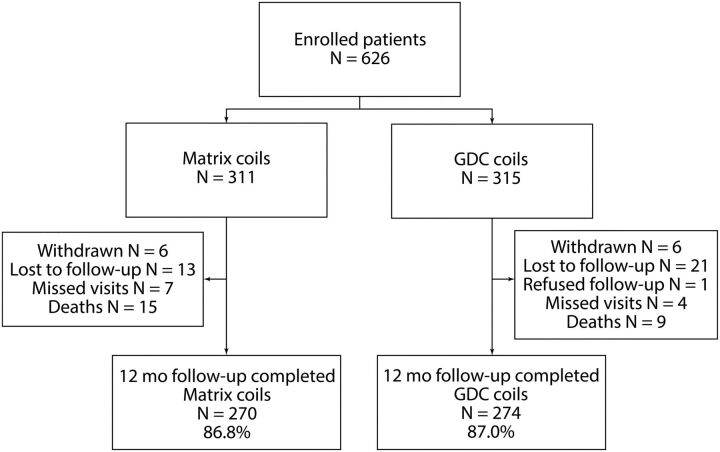
Materials and methods: This was a multicenter randomized noninferiority trial with blinded end point adjudication. We enrolled 626 patients, divided between Matrix(2) and bare metal coil groups. The primary outcome was target aneurysm recurrence at 12 ± 3 months.
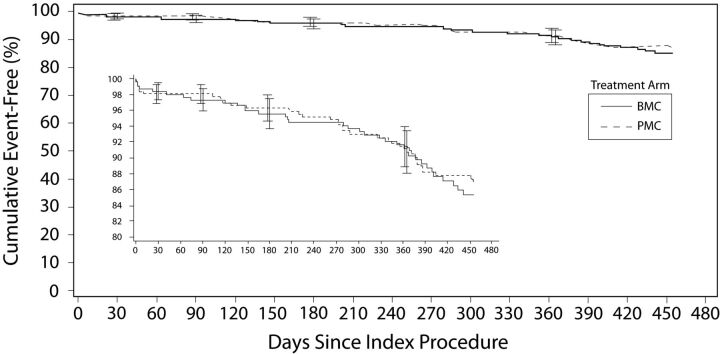
Results: At 455 days, at least 1 target aneurysm recurrence event had occurred in 14.6% of patients treated with bare metal coils and 13.3% of Matrix(2) (P = .76, log-rank test) patients; 92.8% of target aneurysm recurrence events were re-interventions for aneurysms that had not bled after treatment, and 5.8% of target aneurysm recurrence events resulted from hemorrhage or rehemorrhage, with or without retreatment. Symptomatic re-intervention occurred in only 4 (0.6%) patients. At 455 days, 95.8% of patients with unruptured aneurysms and 90.4% of those with ruptured aneurysms were independent (mRS ≤ 2). Target aneurysm recurrence was associated with incomplete initial angiographic aneurysm obliteration, presentation with rupture, and a larger aneurysmal dome and neck size.
Conclusions: Tested Matrix(2) coils were not inferior to bare metal coils. Endovascular coiling of intracranial aneurysms was safe, and the rate of technical success was high. Target aneurysm recurrence is a promising clinical outcome measure that correlates well with established angiographic measurements.
Trial registration: ClinicalTrials.gov NCT00396981.
© 2014 by American Journal of Neuroradiology.
Figures
References
-
- Molyneux AJ, Kerr RS, Yu LM, et al. International subarachnoid aneurysm trial (ISAT) of neurosurgical clipping versus endovascular coiling in 2143 patients with ruptured intracranial aneurysms: a randomised comparison of effects on survival, dependency, seizures, rebleeding, subgroups, and aneurysm occlusion. Lancet 2005;366:809–17 - PubMed
-
- McDougall CG, Spetzler RF, Zabramski JM, et al. The Barrow Ruptured Aneurysm Trial. J Neurosurg 2012;116:135–44 - PubMed
-
- Molyneux AJ, Kerr RS, Birks J, et al. Risk of recurrent subarachnoid haemorrhage, death, or dependence and standardised mortality ratios after clipping or coiling of an intracranial aneurysm in the International Subarachnoid Aneurysm Trial (ISAT): long-term follow-up. Lancet Neurol 2009;8:427–33 - PMC - PubMed
-
- Taschner CA, Leclerc X, Rachdi H, et al. Matrix detachable coils for the endovascular treatment of intracranial aneurysms: analysis of early angiographic and clinical outcomes. Stroke 2005;36:2176–80 - PubMed
Publication types
MeSH terms
Substances
Associated data
LinkOut - more resources
Full Text Sources
Other Literature Sources
Medical