


Moderating influences of baseline activity levels in school physical activity programming for children: the Ready for Recess project
- PMID: 24484545
- PMCID: PMC3943446
- DOI: 10.1186/1471-2458-14-103
Moderating influences of baseline activity levels in school physical activity programming for children: the Ready for Recess project
Abstract
Background: A limitation of traditional outcome studies from behavioral interventions is the lack of attention given to evaluating the influence of moderating variables. This study examined possible moderation effect of baseline activity levels on physical activity change as a result of the Ready for Recess intervention.
Methods: Ready for Recess (August 2009-September 2010) was a controlled trial with twelve schools randomly assigned to one of four conditions: control group, staff supervision, equipment availability, and the combination of staff supervision and equipment availability. A total of 393 children (181 boys and 212 girls) from grades 3 through 6 (8-11 years old) were asked to wear an Actigraph monitor during school time on 4-5 days of the week. Assessments were conducted at baseline (before intervention) and post intervention (after intervention).
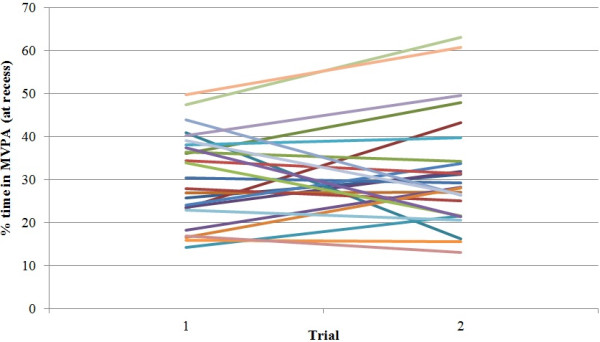
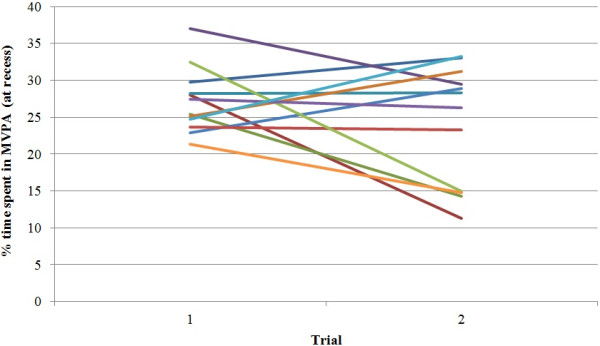
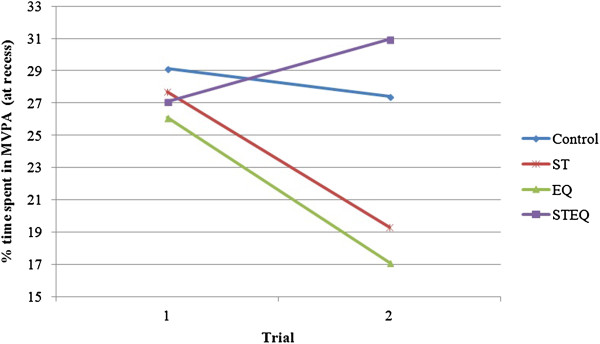
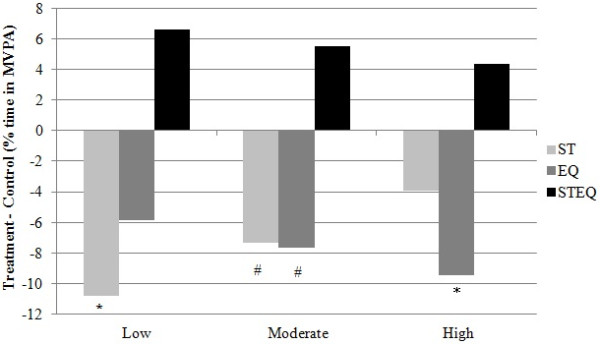
Results: Initial MVPA moderated the effect of Staff supervision (β = -0.47%; p < .05), but not Equipment alone and Staff + Equipment (p > .05). Participants in the Staff condition that were 1 standard deviation (SD) below the mean for baseline MVPA (classified as "low active") had lower MVPA levels at post-intervention when compared with their low active peers in the control condition (Mean diff = -10.8 ± 2.9%; p = .005). High active individuals (+1SD above the mean) in the Equipment treatment also had lower MVPA values at post-intervention when compared with their highly active peers in the control group (Mean diff = -9.5 ± 2.9%; p = .009).
Conclusions: These results indicate that changes in MVPA levels at post-intervention were reduced in highly active participants when recess staff supervision was provided. In this study, initial MVPA moderated the effect of Staff supervision on children's MVPA after 6 months of intervention. Staff training should include how to work with inactive youth but also how to assure that active children remain active.
Figures
References
-
- Centers for Disease Control and Prevention. School health guidelines to promote healthy eating and physical activity. MMRW, Volume 60 (RR- 5) 2011. pp. 1–76. - PubMed
-
- Kriemler S, Meyer U, Martin E, van Sluijs EM, Andersen LB, Martin BW. Effect of school-based interventions on physical activity and fitness in children and adolescents: a review of reviews and systematic update. Br J Sports Med. 2011;45:923–930. doi: 10.1136/bjsports-2011-090186. - DOI - PMC - PubMed
-
- Huberty JL, Beets MW, Beighle A, Saint-Maurice PF, Welk G. Effects of ready for recess, an environmental intervention, on physical activity in 3rd - 6th grade children. J Phys Act Health. 2013. in press. - PubMed
Publication types
MeSH terms
LinkOut - more resources
Full Text Sources
Other Literature Sources
Medical
