. 2014 Jan 31:14:52.
doi: 10.1186/1471-2407-14-52.

Metformin anti-tumor effect via disruption of the MID1 translational regulator complex and AR downregulation in prostate cancer cells

Affiliations

Metformin anti-tumor effect via disruption of the MID1 translational regulator complex and AR downregulation in prostate cancer cells

Ummuhan Demir et al. BMC Cancer. .

Abstract

Background: Metformin is an approved drug prescribed for diabetes. Its role as an anti-cancer agent has drawn significant attention because of its minimal side effects and low cost. However, its mechanism of anti-tumour action has not yet been fully clarified.

Methods: The effect on cell growth was assessed by cell counting. Western blot was used for analysis of protein levels, Boyden chamber assays for analyses of cell migration and co-immunoprecipitation (CoIP) followed by western blot, PCR or qPCR for analysis of protein-protein and protein-mRNA interactions.

Results: Metformin showed an anti-proliferative effect on a wide range of prostate cancer cells. It disrupted the AR translational MID1 regulator complex leading to release of the associated AR mRNA and subsequently to downregulation of AR protein in AR positive cell lines. Inhibition of AR positive and negative prostate cancer cells by metformin suggests involvement of additional targets. The inhibitory effect of metformin was mimicked by disruption of the MID1-α4/PP2A protein complex by siRNA knockdown of MID1 or α4 whereas AMPK activation was not required.

Conclusions: Findings reported herein uncover a mechanism for the anti-tumor activity of metformin in prostate cancer, which is independent of its anti-diabetic effects. These data provide a rationale for the use of metformin in the treatment of hormone naïve and castration-resistant prostate cancer and suggest AR is an important indirect target of metformin.


Figures
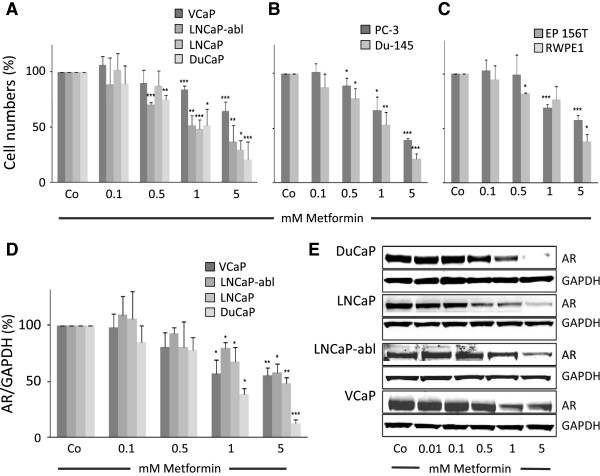
Figure 1
Figure 1
The anti-diabetic drug metformin inhibits prostate cancer cell growth and reduces AR protein levels. Prostate cancer and immortalized benign prostate epithelial cells were treated with increasing concentrations of metformin. After 96 h cell numbers were counted and AR levels determined by western blot. (A), AR-positive cell lines, (B), AR negative cell lines, and (C), immortalized benign prostate epithelial cell lines. (D, E), AR protein levels determined by quantification of western blot bands in AR positive cell lines. Each experiment was repeated at least 3 times. Representative western blot flouroscan images are shown in (E). Statistical significant differences are indicated as *, p < 0.05; **, p <0.01 and ***, p < 0.001.
Figure 2
Figure 2
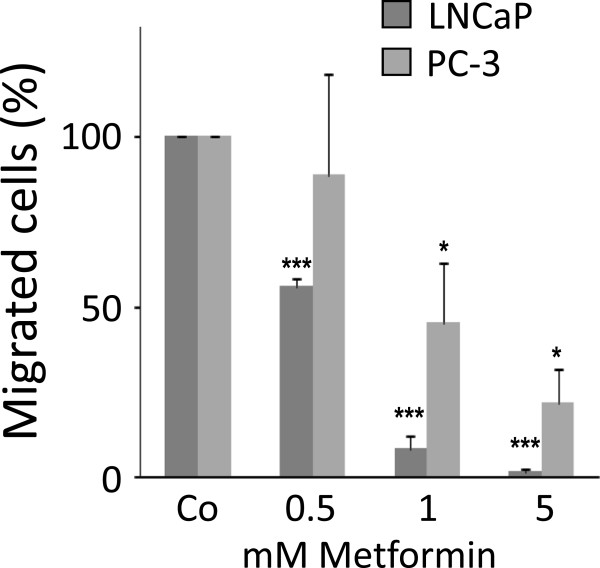
Metformin inhibits cell migration. After 72 hours of treatment with metformin, LNCaP and PC3 cells were seeded in Boyden chambers and the number of migrated cells was quantified 48 hours later. Each experiment was repeated at least 3 times. Statistical significant differences are indicated as *, p < 0.05; **, p <0.01 and ***, p < 0.001.
Figure 3
Figure 3
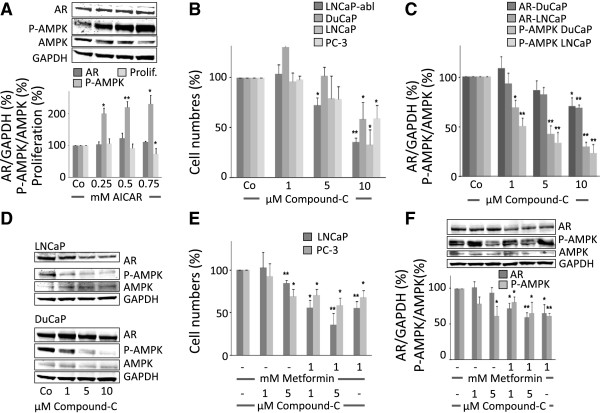
AMPK activation is not required for metformin inhibition of prostate cancer cells. Prostate cancer cells were treated with increasing concentrations of AICAR, an AMPK activator, Compound C, an AMPK inhibitor or a combination of AMPK inhibitor and metformin, respectively. LNCaP cells were treated with the AMPK activator AICAR. After 96 h AR levels were quantified by western blot and normalized to GAPDH. Activation of AMPK was verified by detection of phosphorylated AMPK by western blot (P-AMPK/AMPK ratio) (A). Prostate cancer cells were treated with increasing concentrations of the AMPK inhibitor compound-C (0–10 μM) and cell numbers (B) and AR protein levels (C) in LNCaP and DuCaP cells were determined after 96 h. Inhibition of AMPK was verified by detection of phosporylated AMPK (P-AMPK/AMPK ratio) (C)). Representative fluoroscan images of LNCaP and DuCaP cell western blots are shown in (D). Addition of 1 mM of metformin to the AMPK inhibitor compound-C resulted in enhanced inhibition of cell proliferation in LNCaP and PC3 cells (E) and further reduction of AR protein levels in LNCaP cells (F). AR levels and P-AMPK/AMPK ratios in Figure  3 were quantified by western blot densitometry. The histograms show the data of at least three independent experiments, the fluoroscan image shows representative western blots. Statistical significant differences are indicated as *, p < 0.05; **, p <0.01 and ***, p < 0.001.
Figure 4
Figure 4
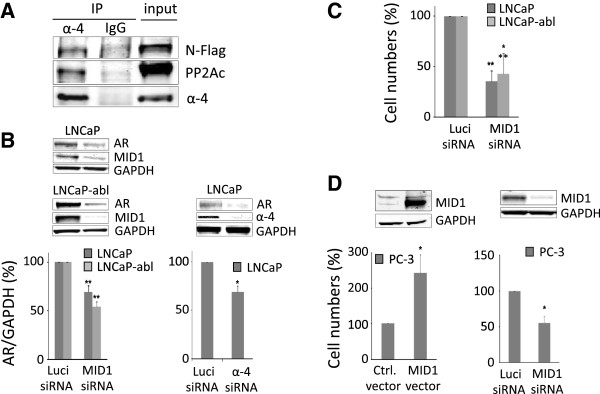
Regulation of AR protein level and cell growth via the MID1-α4/PP2A transcriptional regulator complex. MID1, α4 and PP2A form the core of a ribonuclear protein complex that enhances translation of associated mRNAs such as AR mRNA. Physical interaction of the complex components was confirmed in LNCaP cells overexpressing a flag-tagged MID1. MID1 and PP2A were co-precipitated in an α4 pull-down (α4); normal rabbit IgG was used as negative control (IgG). A representative western blot of two independent experiments is shown in (A). Disruption of the complex by MID1 or α4 protein knockdown mimics the effect of metformin. MID1 knockdown in LNCaP and LNCaP-abl cells or α4 in LNCaP cells resulted in a reduction of AR protein levels (B) and the inhibition of cell growth (C). In the AR-negative PC3 cells, MID1 overexpression enhanced, whereas MID1 knockdown inhibited cell growth (D). Successful knockdown or overexpression, respectively, was verified by western blot; inserts show representative fluoroscans (B, D). Luciferase (Luci) siRNA was used as negative control for siRNA transfections, empty vector for overexpression control. Cell numbers were determined after 10 days. Statistical significant differences are indicated as *, p < 0.05; **, p = <0.01 and ***, p < 0.001.
Figure 5
Figure 5
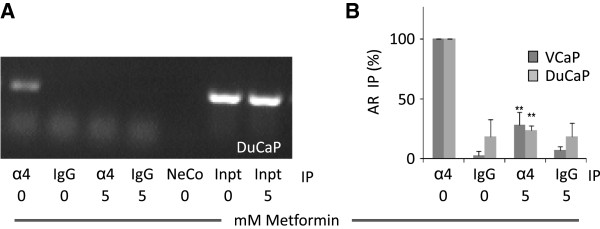
Metformin disrupts the MID1-α4/PP2A complex and releases associated AR mRNA. DuCaP or VCaP prostate cancer cells were treated with 5 mM of metformin or vehicle control for 24 h. Afterwards the MID1-α4/PP2A complex was immunoprecipitated using an α4 specific antibody. Normal rabbit IgG was used as negative control. Complex-associated RNA was isolated and transcribed to cDNA. Using PCR and real-time PCR amplification of an AR cDNA fragment containing the CAG-repeat region (A) or a fragment of the AR hormone-binding region (B), respectively, were amplified. The agarose gel image (A) shows a representative PCR result of 3 independent experiments with DuCaP cells, the histogram (B) shows the relative real-time PCR AR fragment levels standardized to the input amount and normalized to the control for 3 independent experiments for DuCaP and VCaP cells. NeCo, negative control; Inpt, input. PCR primer and fragment information is provided in the supplementary data. Statistical significant differences are indicated as *, p < 0.05; **, p <0.01 and ***, p < 0.001.

References

    1. Hitron A, Adams V, Talbert J, Steinke D. The influence of antidiabetic medications on the development and progression of prostate cancer. Cancer Epidemiol. 2012;36:e243–250. doi: 10.1016/j.canep.2012.02.005. - DOI - PubMed
    1. Wright JL, Stanford JL. Metformin use and prostate cancer in Caucasian men: results from a population-based case–control study. Cancer Causes Control. 2009;20:1617–1622. doi: 10.1007/s10552-009-9407-y. - DOI - PMC - PubMed
    1. Soranna D, Scotti L, Zambon A, Bosetti C, Grassi G, Catapano A, La Vecchia C, Mancia G, Corrao G. Cancer risk associated with use of metformin and sulfonylurea in type 2 diabetes: a meta-analysis. Oncologist. 2012;17:813–822. doi: 10.1634/theoncologist.2011-0462. - DOI - PMC - PubMed
    1. Ben Sahra I, Laurent K, Loubat A, Giorgetti-Peraldi S, Colosetti P, Auberger P, Tanti JF, Le Marchand-Brustel Y, Bost F. The antidiabetic drug metformin exerts an antitumoral effect in vitro and in vivo through a decrease of cyclin D1 level. Oncogene. 2008;27:3576–3586. doi: 10.1038/sj.onc.1211024. - DOI - PubMed
    1. Del Barco S, Vazquez-Martin A, Cufi S, Oliveras-Ferraros C, Bosch-Barrera J, Joven J, Martin-Castillo B, Menendez JA. Metformin: multi-faceted protection against cancer. Oncotarget. 2011;2:896–917. - PMC - PubMed

Publication types

MeSH terms