


Prostaglandin E2 resistance in granulocytes from patients with aspirin-exacerbated respiratory disease
- PMID: 24486071
- PMCID: PMC4040319
- DOI: 10.1016/j.jaci.2013.12.1034
Prostaglandin E2 resistance in granulocytes from patients with aspirin-exacerbated respiratory disease
Abstract
Background: Aspirin-exacerbated respiratory disease (AERD) is an inflammatory condition of the respiratory tract and is characterized by overproduction of leukotrienes (LT) and large numbers of circulating granulocyte-platelet complexes. LT production can be suppressed by prostaglandin E(2) (PGE(2)) and the cyclic AMP-dependent protein kinase A (PKA).
Objective: To determine if PGE(2)-dependent control of LT production by granulocytes is dysregulated in AERD.
Methods: Granulocytes from well-characterized patients with and without AERD were activated ex vivo and subjected to a range of functional and biochemical analyses.
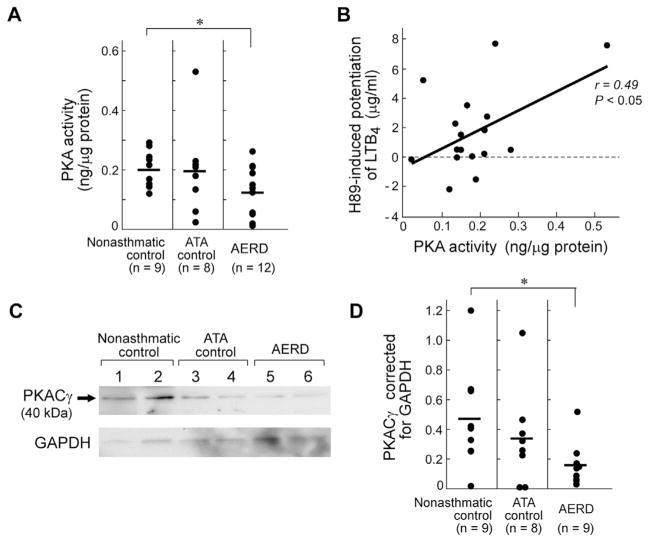
Results: Granulocytes from subjects with AERD generated more LTB4 and cysteinyl LTs than did granulocytes from controls with aspirin-tolerant asthma and controls without asthma. When compared with controls, granulocytes from subjects with AERD had comparable levels of EP(2) protein expression and PGE(2)-mediated cAMP accumulation, yet were resistant to PGE(2)-mediated suppression of LT generation. Percentages of platelet-adherent neutrophils correlated positively with LTB4 generation and inversely with responsiveness to PGE(2)-mediated suppression of LTB(4). The PKA inhibitor H89 potentiated LTB4 generation by control granulocytes but was inactive in granulocytes from individuals with AERD and had no effect on platelet P-selectin induction. Both tonic PKA activity and levels of PKA catalytic gamma subunit protein were significantly lower in granulocytes from individuals with AERD relative to those from controls.
Conclusions: Impaired granulocyte PKA function in AERD may lead to dysregulated control of 5-lipoxygenase activity by PGE(2), whereas adherent platelets lead to increased production of LTs, which contributes to the features of persistent respiratory tract inflammation and LT overproduction.
Keywords: AERD; Samter's triad; aspirin triad; aspirin-exacerbated respiratory disease; asthma; cyclic AMP; leukotriene; nonsteroidal anti-inflammatory drug; prostaglandin E(2); protein kinase A.
Copyright © 2014 American Academy of Allergy, Asthma & Immunology. Published by Mosby, Inc. All rights reserved.
Conflict of interest statement
Conflicts of interest: J. A. Boyce has received consultancy fees from ONO Pharmaceuticals. The rest of the authors declare that they have no relevant conflicts of interest.
Figures


References
-
- Szczeklik A, Stevenson DD. Aspirin-induced asthma: advances in pathogenesis, diagnosis, and management. J Allergy Clin Immunol. 2003;111:913–21. - PubMed
-
- Mascia K, Haselkorn T, Deniz YM, Miller DP, Bleecker ER, Borish L. Aspirin sensitivity and severity of asthma: evidence for irreversible airway obstruction in patients with severe or difficult-to-treat asthma. J Allergy Clin Immunol. 2005;116:970–5. - PubMed
-
- Jantti-Alanko S, Holopainen E, Malmberg H. Recurrence of nasal polyps after surgical treatment. Rhinol Suppl. 1989;8:59–64. - PubMed
-
- Adamjee J, Suh YJ, Park HS, Choi JH, Penrose JF, Lam BK, et al. Expression of 5-lipoxygenase and cyclooxygenase pathway enzymes in nasal polyps of patients with aspirin-intolerant asthma. J Pathol. 2006;209:392–9. - PubMed
Publication types
MeSH terms
Substances
Grants and funding
- R01 HL117945/HL/NHLBI NIH HHS/United States
- T32 AI007306/AI/NIAID NIH HHS/United States
- U19 AI095219/AI/NIAID NIH HHS/United States
- K23 HL111113/HL/NHLBI NIH HHS/United States
- R21 AI082369/AI/NIAID NIH HHS/United States
- AI095219/AI/NIAID NIH HHS/United States
- AT002782/AT/NCCIH NIH HHS/United States
- R37 AI052353/AI/NIAID NIH HHS/United States
- P50 AT002782/AT/NCCIH NIH HHS/United States
- AI078908/AI/NIAID NIH HHS/United States
- P01 HL036110/HL/NHLBI NIH HHS/United States
- AI082369/AI/NIAID NIH HHS/United States
- R01 AI078908/AI/NIAID NIH HHS/United States
- HL36110/HL/NHLBI NIH HHS/United States
LinkOut - more resources
Full Text Sources
Other Literature Sources
