


Prevalence and knowledge of heavy menstrual bleeding among African American women
- PMID: 24486125
- PMCID: PMC4017925
- DOI: 10.1016/j.ijgo.2013.09.027
Prevalence and knowledge of heavy menstrual bleeding among African American women
Abstract
Objective: To assess self-reported prevalence, knowledge, and health literacy regarding heavy menstrual bleeding (HMB) among African American women.
Methods: A quantitative cross-sectional survey study was conducted. An original survey was developed and distributed to a convenience sample of African American women aged 18-60 years at a community fair in a large city in the Midwestern region of the USA.
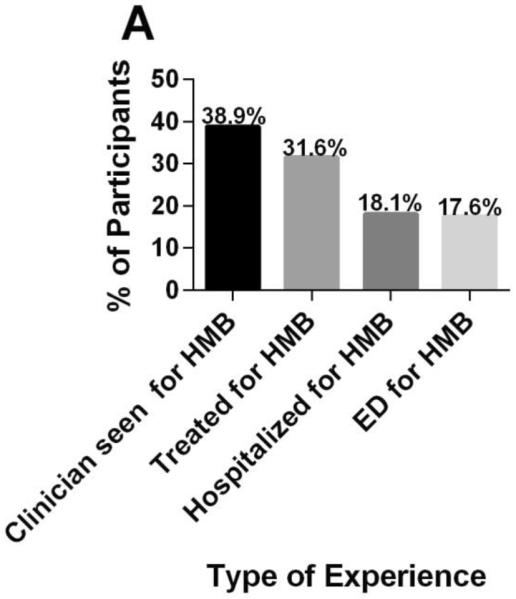
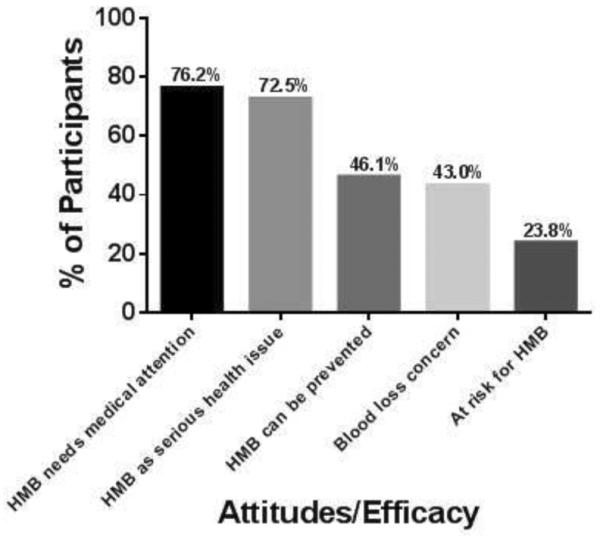
Results: Of the 274 surveys distributed, 247 were returned, 193 of which met the inclusion criteria. Overall, 163 (84.5%) participants demonstrated adequate health literacy; however, 168 (87.0%) answered fewer than 8 of 15 knowledge questions correctly. Although 75 (38.9%) women reported seeing a clinician for HMB, 89 (46.1%) believed that there was nothing that they could do to prevent it from occurring.
Conclusion: The present study found that the proportion of HMB among participants was higher than the nationwide prevalence. However, a gap existed in knowledge of HMB among the women surveyed. The study findings indicate an opportunity for community-based education to raise awareness of HMB, its associated clinical presentations, and available treatment modalities.
Keywords: African American; Fibroids; Health literacy; Heavy menstrual bleeding; Knowledge.
Copyright © 2014 International Federation of Gynecology and Obstetrics. Published by Elsevier Ireland Ltd. All rights reserved.
Figures
References
-
- Oehler MK, Rees MC. Menorrhagia: an update. Acta Obstet Gynecol Scand. 2003;82(5):405–22. - PubMed
-
- Zacur HA. Chronic menorrhagia or anovulatory uterine bleeding. http://www.uptodate.com/contents/chronic-menorrhagia-or-anovulatory-uter....
-
- Barnard K, Frayne SM, Skinner KM, Sullivan LM. Health status among women with menstrual symptoms. J Womens Health (Larchmt) 2003;12(9):911–9. - PubMed
-
- Côté I, Jacobs P, Cumming DC. Use of health services associated with increased menstrual loss in the United States. Am J Obstet Gynecol. 2003;188(2):343–8. - PubMed
-
- Frick KD, Clark MA, Steinwachs DM, Langenberg P, Stovall D, Munro MG, et al. Financial and quality-of-life burden of dysfunctional uterine bleeding among women agreeing to obtain surgical treatment. Womens Health Issues. 2009;19(1):70–8. - PubMed
Publication types
MeSH terms
Grants and funding
LinkOut - more resources
Full Text Sources
Other Literature Sources
Medical
Miscellaneous
