Alcohol and mortality in Russia: prospective observational study of 151,000 adults
- PMID: 24486187
- PMCID: PMC4007591
- DOI: 10.1016/S0140-6736(13)62247-3
Alcohol and mortality in Russia: prospective observational study of 151,000 adults
Erratum in
- Lancet. 2014 Apr 26;383(9927):1464
Abstract
Background: Russian adults have extraordinarily high rates of premature death. Retrospective enquiries to the families of about 50,000 deceased Russians had found excess vodka use among those dying from external causes (accident, suicide, violence) and eight particular disease groupings. We now seek prospective evidence of these associations.
Methods: In three Russian cities (Barnaul, Byisk, and Tomsk), we interviewed 200,000 adults during 1999-2008 (with 12,000 re-interviewed some years later) and followed them until 2010 for cause-specific mortality. In 151,000 with no previous disease and some follow-up at ages 35-74 years, Poisson regression (adjusted for age at risk, amount smoked, education, and city) was used to calculate the relative risks associating vodka consumption with mortality. We have combined these relative risks with age-specific death rates to get 20-year absolute risks.
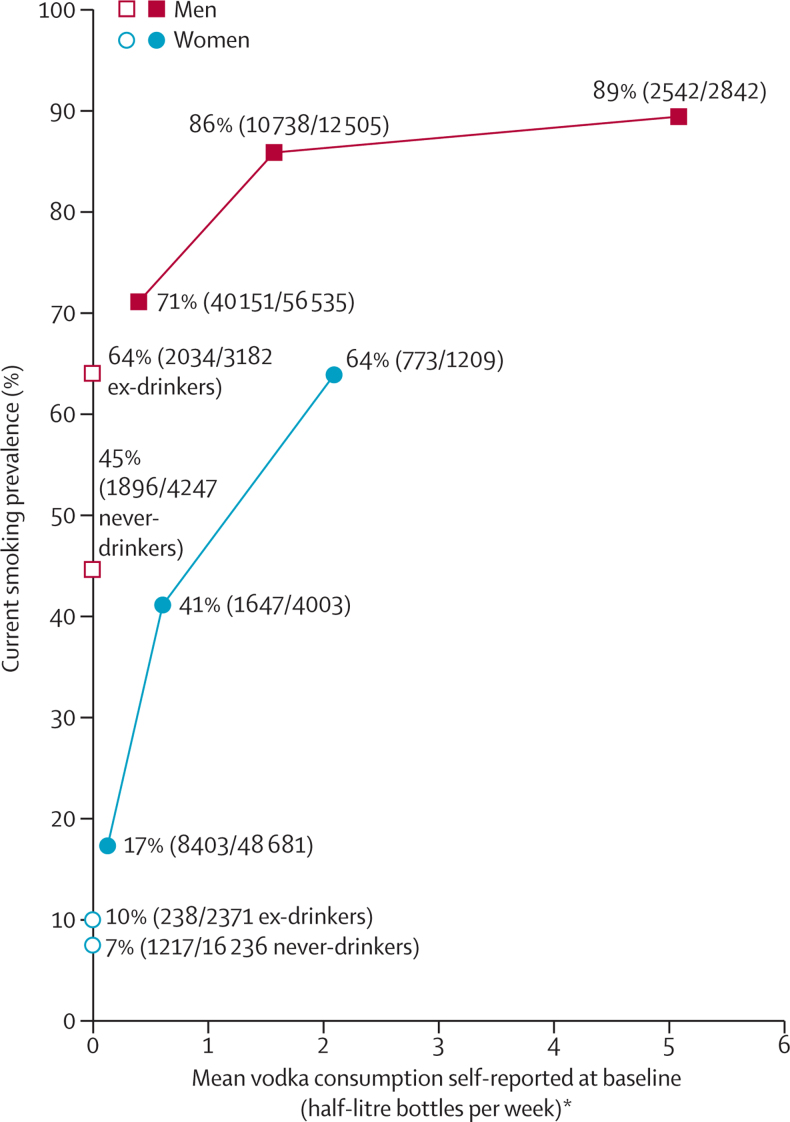
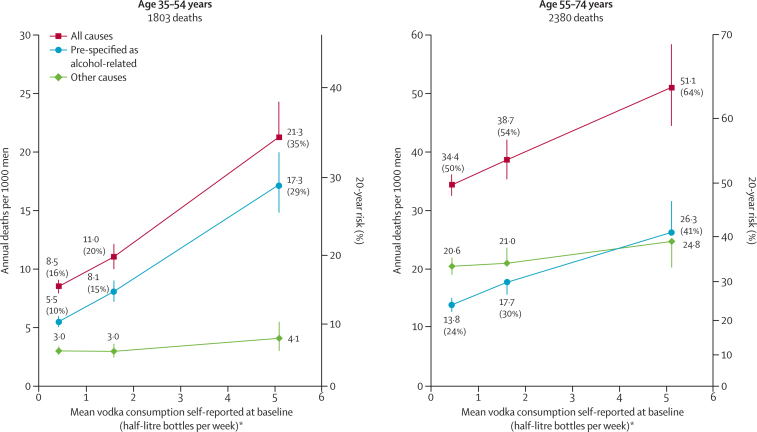
Findings: Among 57,361 male smokers with no previous disease, the estimated 20-year risks of death at ages 35-54 years were 16% (95% CI 15-17) for those who reported consuming less than a bottle of vodka per week at baseline, 20% (18-22) for those consuming 1-2·9 bottles per week, and 35% (31-39) for those consuming three or more bottles per week; trend p<0·0001. The corresponding risks of death at ages 55-74 years were 50% (48-52) for those who reported consuming less than a bottle of vodka per week at baseline, 54% (51-57) for those consuming 1-2·9 bottles per week, and 64% (59-69) for those consuming three or more bottles per week; trend p<0·0001. In both age ranges most of the excess mortality in heavier drinkers was from external causes or the eight disease groupings strongly associated with alcohol in the retrospective enquiries. Self-reported drinking fluctuated; of the men who reported drinking three or more bottles of vodka per week who were reinterviewed a few years later, about half (185 of 321) then reported drinking less than one bottle per week. Such fluctuations must have substantially attenuated the apparent hazards of heavy drinking in this study, yet self-reported vodka use at baseline still strongly predicted risk. Among male non-smokers and among females, self-reported heavy drinking was uncommon, but seemed to involve similar absolute excess risks.
Interpretation: This large prospective study strongly reinforces other evidence that vodka is a major cause of the high risk of premature death in Russian adults.
Funding: UK Medical Research Council, British Heart Foundation, Cancer Research UK, European Union, WHO International Agency for Research on Cancer.
Copyright © 2014 Zaridze et al. Open Access article distributed under the terms of CC BY. Published by Elsevier Ltd. All rights reserved.
Figures
Comment in
-
Russia: lessons for alcohol epidemiology and alcohol policy.Lancet. 2014 Apr 26;383(9927):1440-1442. doi: 10.1016/S0140-6736(14)60038-6. Epub 2014 Jan 31. Lancet. 2014. PMID: 24486186 No abstract available.
References
-
- World Health Organisation. WHO Mortality Database, 2013. Country codes 4272 and 4308 in http://www.who.int/healthinfo/statistics/mortality_rawdata/en/index.html (accessed Aug 5, 2013).
-
- Leon DA, Chenet L, Shkolnikov VM. Huge variations in Russian mortality rates 1984–1994; artefact, alcohol, or what? Lancet. 1997;350:383–388. - PubMed
-
- Shkolnikov V, McKee M, Leon DA. Changes in life expectancy in Russia in the mid-1990s. Lancet. 2001;357:917–921. - PubMed
-
- McKee M, Shkolnikov V, Leon D. Alcohol is implicated in the fluctuations in cardiovascular diseases in Russia since the 1980s. Ann Epidemiol. 2001;11:1–6. - PubMed
-
- Nemtsov AV. Alcohol-related human losses in Russia in the 1980s and 1990s. Addiction. 2002;97:1413–1425. - PubMed
Publication types
MeSH terms
Grants and funding
LinkOut - more resources
Full Text Sources
Other Literature Sources
Medical