


Novel genetic markers associate with atrial fibrillation risk in Europeans and Japanese
- PMID: 24486271
- PMCID: PMC4009240
- DOI: 10.1016/j.jacc.2013.12.015
Novel genetic markers associate with atrial fibrillation risk in Europeans and Japanese
Abstract
Objectives: This study sought to identify nonredundant atrial fibrillation (AF) genetic susceptibility signals and examine their cumulative relations with AF risk.
Background: AF-associated loci span broad genomic regions that may contain multiple susceptibility signals. Whether multiple signals exist at AF loci has not been systematically explored.
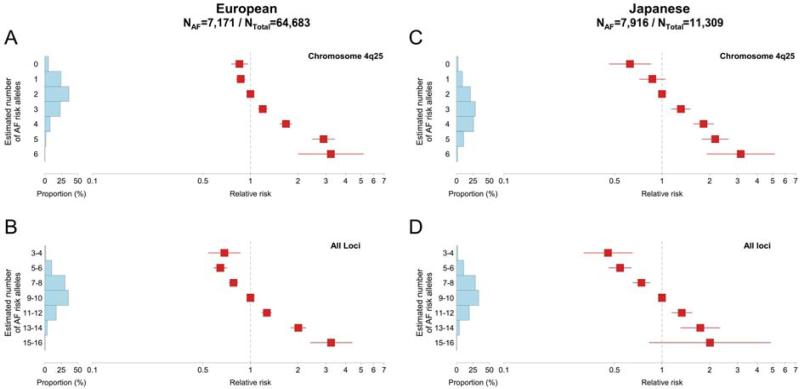
Methods: We performed association testing conditioned on the most significant, independently associated genetic markers at 9 established AF loci using 2 complementary techniques in 64,683 individuals of European ancestry (3,869 incident and 3,302 prevalent AF cases). Genetic risk scores were created and tested for association with AF in Europeans and an independent sample of 11,309 individuals of Japanese ancestry (7,916 prevalent AF cases).
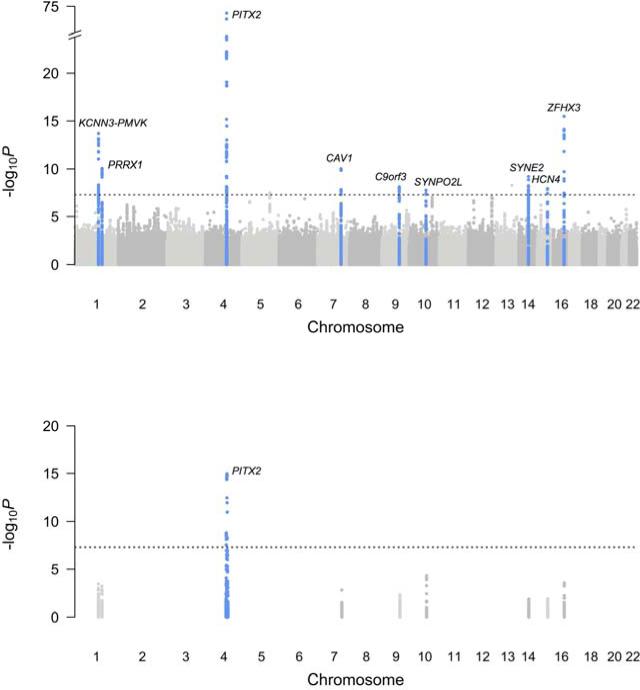
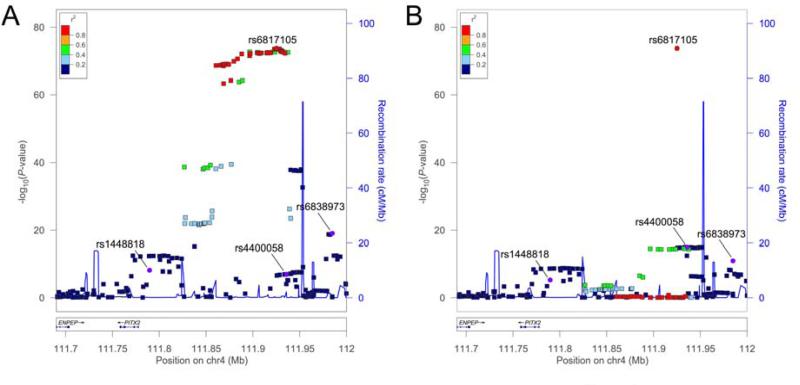
Results: We observed at least 4 distinct AF susceptibility signals on chromosome 4q25 upstream of PITX2, but not at the remaining 8 AF loci. A multilocus score comprised 12 genetic markers demonstrated an estimated 5-fold gradient in AF risk. We observed a similar spectrum of risk associated with these markers in Japanese. Regions containing AF signals on chromosome 4q25 displayed a greater degree of evolutionary conservation than the remainder of the locus, suggesting that they may tag regulatory elements.
Conclusions: The chromosome 4q25 AF locus is architecturally complex and harbors at least 4 AF susceptibility signals in individuals of European ancestry. Similar polygenic AF susceptibility exists between Europeans and Japanese. Future work is necessary to identify causal variants, determine mechanisms by which associated loci predispose to AF, and explore whether AF susceptibility signals classify individuals at risk for AF and related morbidity.
Keywords: atrial fibrillation; atrial flutter; genetic; prognosis; risk.
Copyright © 2014 American College of Cardiology Foundation. Published by Elsevier Inc. All rights reserved.
Figures
Comment in
-
Atrial fibrillation genomics: time to take the next step.J Am Coll Cardiol. 2014 Apr 1;63(12):1211-1213. doi: 10.1016/j.jacc.2013.12.016. Epub 2014 Jan 30. J Am Coll Cardiol. 2014. PMID: 24486270 No abstract available.
References
-
- Fox CS, Parise H, D'Agostino RB, Sr., et al. Parental atrial fibrillation as a risk factor for atrial fibrillation in offspring. JAMA. 2004;291:2851–5. - PubMed
-
- Ellinor PT, Yoerger DM, Ruskin JN, MacRae CA. Familial aggregation in lone atrial fibrillation. Hum Genet. 2005;118:179–84. - PubMed
-
- Arnar DO, Thorvaldsson S, Manolio TA, et al. Familial aggregation of atrial fibrillation inIceland. Eur Heart J. 2006;27:708–12. - PubMed
MeSH terms
Substances
Grants and funding
LinkOut - more resources
Full Text Sources
Other Literature Sources
Medical
Molecular Biology Databases