


Nicotine administration in adolescence reprograms the subsequent response to nicotine treatment and withdrawal in adulthood: sex-selective effects on cerebrocortical serotonergic function
- PMID: 24487013
- PMCID: PMC3972282
- DOI: 10.1016/j.brainresbull.2014.01.004
Nicotine administration in adolescence reprograms the subsequent response to nicotine treatment and withdrawal in adulthood: sex-selective effects on cerebrocortical serotonergic function
Abstract
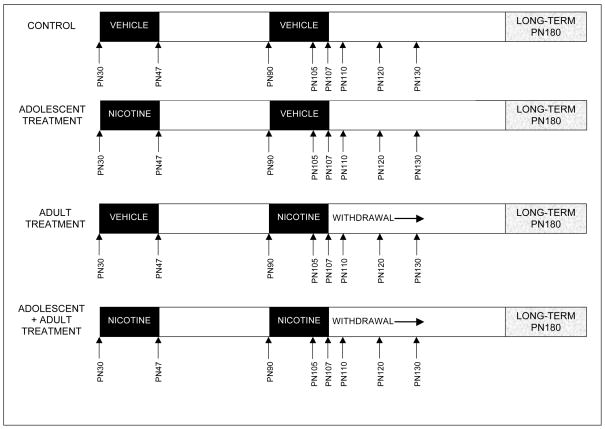
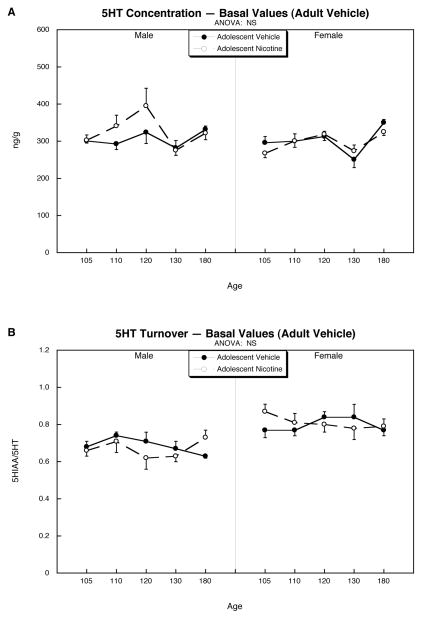
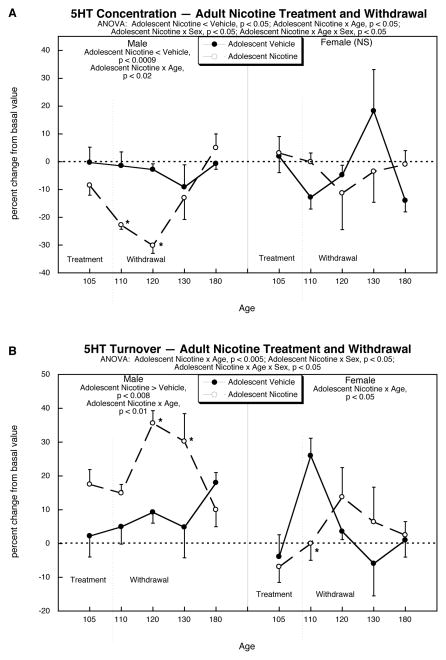
Nicotine exposure in adolescence produces lasting changes in subsequent behavioral responses to addictive agents. We gave nicotine to adolescent rats (postnatal days PN30-47), simulating plasma levels in smokers, and then examined the subsequent effects of nicotine given again in adulthood (PN90-107), focusing on cerebrocortical serotonin levels and utilization (turnover) as an index of presynaptic activity of circuits involved in emotional state. Our evaluations encompassed responses during the period of adult nicotine treatment (PN105) and withdrawal (PN110, PN120, PN130), as well as long-term changes (PN180). In males, prior exposure to nicotine in adolescence greatly augmented the increase in serotonin turnover evoked by nicotine given in adulthood, an interaction that was further exacerbated during withdrawal. The effect was sufficiently large that it led to significant depletion of serotonin stores, an effect that was not seen with nicotine given alone in either adolescence or adulthood. In females, adolescent nicotine exposure blunted or delayed the spike in serotonin turnover evoked by withdrawal from adult nicotine treatment, a totally different effect from the interaction seen in males. Combined with earlier work showing persistent dysregulation of serotonin receptor expression and receptor coupling, the present results indicate that adolescent nicotine exposure reprograms future responses of 5HT systems to nicotine, changes that may contribute to life-long vulnerability to relapse and re-addiction.
Keywords: Adolescence; Nicotine; Serotonin; Sex differences; Withdrawal.
Copyright © 2014 Elsevier Inc. All rights reserved.
Conflict of interest statement
Figures
References
-
- Abreu-Villaça Y, Seidler FJ, Qiao D, Tate CA, Cousins MM, Thillai I, Slotkin TA. Short-term adolescent nicotine exposure has immediate and persistent effects on cholinergic systems: critical periods, patterns of exposure, dose thresholds. Neuropsychopharmacology. 2003;28:1935–1949. - PubMed
-
- Adriani W, Deroche-Gamonet V, Le Moal Ml, Laviola G, Piazza PV. Preexposure during or following adolescence differently affects nicotine-rewarding properties in adult rats. Psychopharmacology. 2006;184:382–390. - PubMed
-
- Adriani W, Granstrem O, Macri S, Izykenova G, Dambinova S, Laviola G. Behavioral and neurochemical vulnerability during adolescence in mice: studies with nicotine. Neuropsychopharmacology. 2004;29:869–878. - PubMed
-
- Barone S, Das KP, Lassiter TL, White LD. Vulnerable processes of nervous system development: a review of markers and methods. Neurotoxicology. 2000;21:15–36. - PubMed
Publication types
MeSH terms
Substances
Grants and funding
LinkOut - more resources
Full Text Sources
Other Literature Sources
