


Curcumin derivative C817 inhibits proliferation of imatinib-resistant chronic myeloid leukemia cells with wild-type or mutant Bcr-Abl in vitro
- PMID: 24487968
- PMCID: PMC4647898
- DOI: 10.1038/aps.2013.180
Curcumin derivative C817 inhibits proliferation of imatinib-resistant chronic myeloid leukemia cells with wild-type or mutant Bcr-Abl in vitro
Abstract
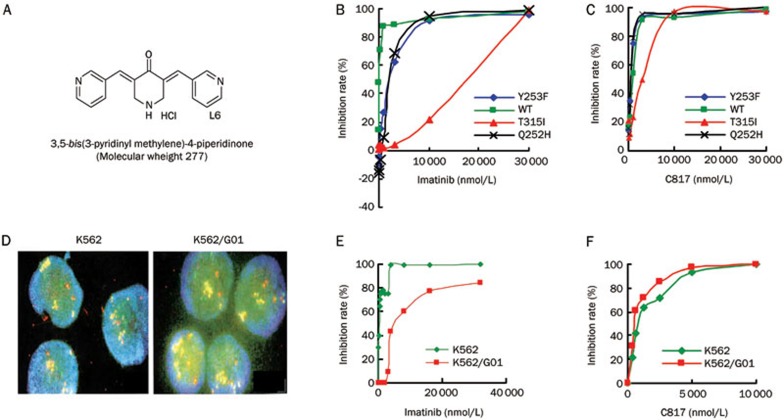
Aim: To find new kinase inhibitors that overcome the imatinib resistance in treatment of chronic myeloid leukemia (CML), we synthesized C817, a novel derivative of curcumin, and tested its activities against wild-type (WT) and imatinib-resistant mutant Abl kinases, as well as in imatinib-sensitive and resistant CML cells in vitro.
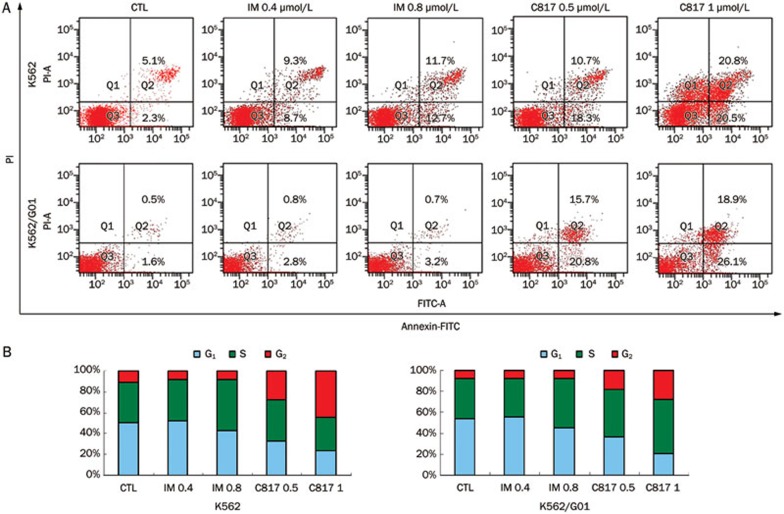
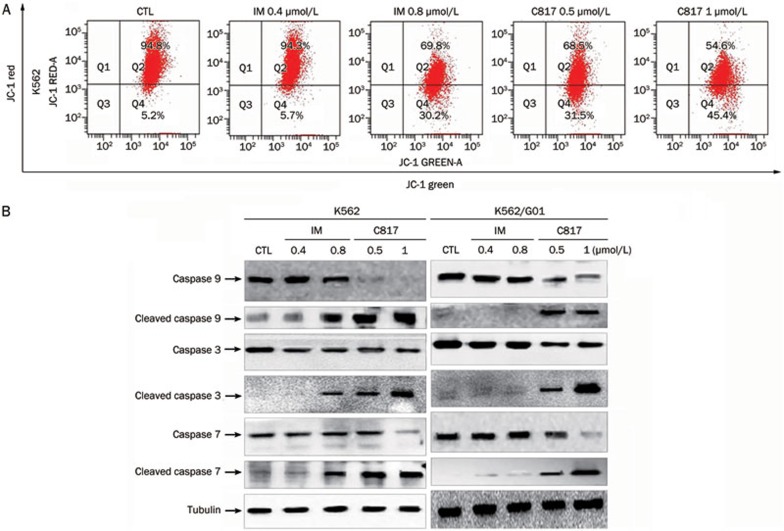
Methods: 32D cells harboring WT or mutant Abl kinases (nucleotide binding P-loop mutants Q252H, Y253F, and imatinib contact residue mutant T315I), as well as K562/G01 cells (with whole Bcr-Abl gene amplication) were tested. Kinase activity was measured using Kinase-Glo Luminescent Kinase Assay Platform in recombinant WT and mutant (Q252H, Y253F, and T315I) Abl kinases. Cell proliferation and apoptosis were examined using MTT assay and flow cytometry, respectively. The phosphorylation levels of Bcr-Abl initiated signaling proteins were analyzed using Western blotting. Colony forming units (CFU) growth and long term culture-initiating cells (LTC-ICs) were used to test the effects of C817 on human leukemia progenitor/stem cells.
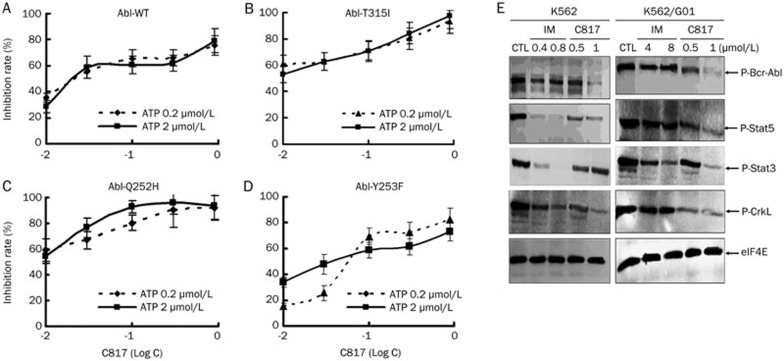
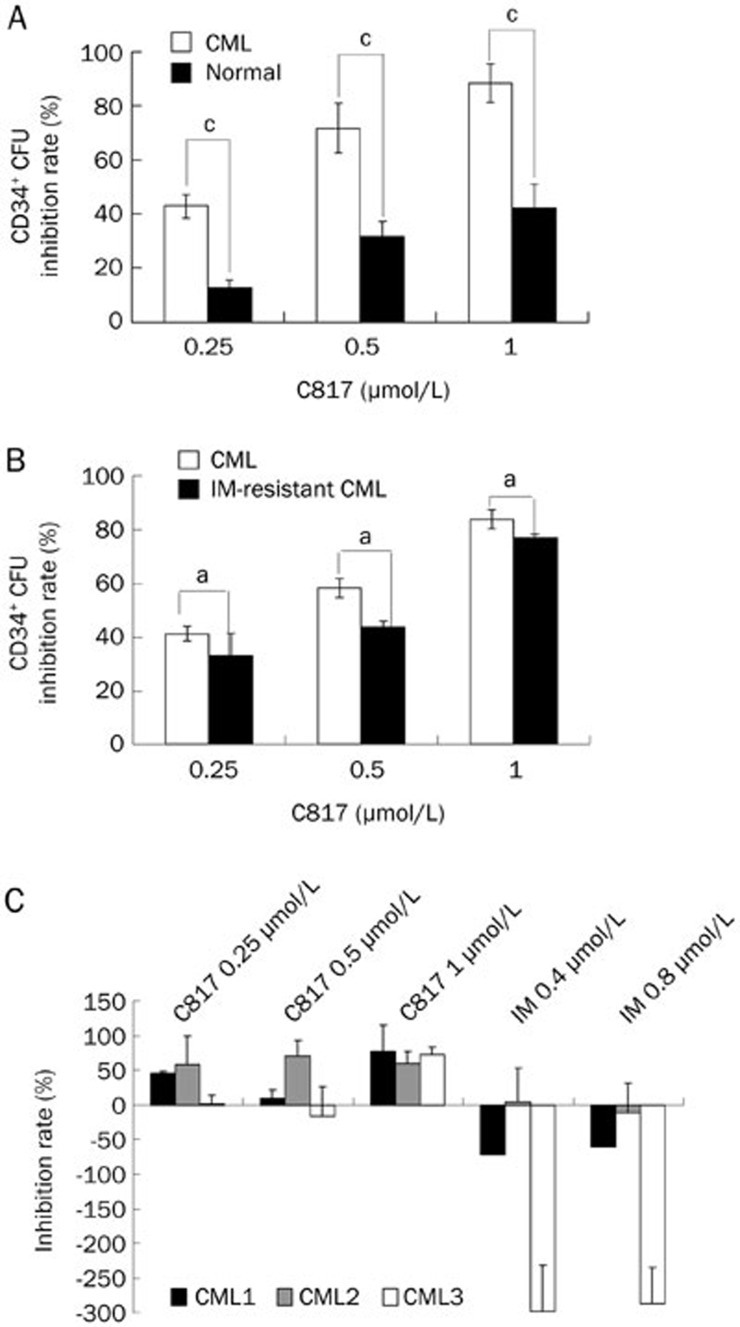
Results: C817 potently inhibited both WT and mutant (Q252H, Y253F, and T315I) Abl kinase activities in a non-ATP competitive manner with the values of IC₅₀ at low nanomole levels. In consistent with above results, C817 suppressed the growth of both imatinib-sensitive and resistant CML cells, including wild-type K562, K562/G01, 32D-T315I, 32D-Q252H, and 32D-Y253F cells with the values of IC₅₀ at low micromole levels. C817 (0.5 or 1 μmol/L) dose-dependently inhibited the phosphorylation of Bcr-Abl and downstream proteins STAT-5 and CrkL in imatinib-resistant K562/G01 cells. Furthermore, C817 significantly suppressed CFU growth and LTC-ICs, implicating that C817 could eradiate human leukemia progenitor/stem cells.
Conclusion: C817 is a promising compound for treatment of CML patients with Bcr-Abl kinase domain mutations that confer imatinib resistance.
Figures
References
-
- 1Druker BJ, Talpaz M, Resta DJ, Peng B, Buchdunger E, Ford JM, et al. Efficacy and safety of a specific inhibitor of the BCR-ABL tyrosine kinase in chronic myeloid leukemia. N Engl J Med 2001; 344: 1031–7. - PubMed
-
- 2Gorre ME, Mohammed M, Ellwood K, Hsu N, Paquette R, Rao PN, et al. Clinical resistance to STI-571 cancer therapy caused by BCR-ABL gene mutation or amplification. Science 2001; 293: 876–80. - PubMed
-
- 3von Bubnoff N, Schneller F, Peschel C, Duyster J. BCR-ABL gene mutations in relation to clinical resistance of Philadelphia-chromosome-positive leukaemia to STI571: a prospective study. Lancet 2002; 359: 487–91. - PubMed
Publication types
MeSH terms
Substances
LinkOut - more resources
Full Text Sources
Other Literature Sources
Medical
Miscellaneous
