


Effect of lifestyle intervention on the reproductive endocrine profile in women with polycystic ovarian syndrome: a systematic review and meta-analysis
- PMID: 24488490
- PMCID: PMC3938041
- DOI: 10.1530/EC-14-0010
Effect of lifestyle intervention on the reproductive endocrine profile in women with polycystic ovarian syndrome: a systematic review and meta-analysis
Abstract
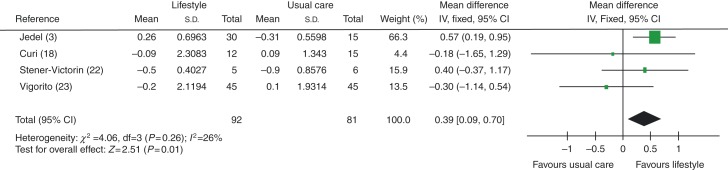
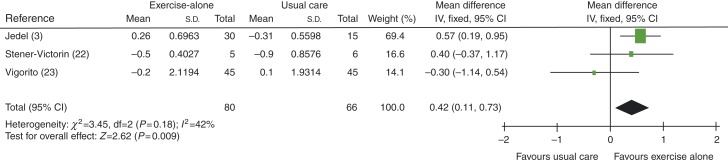
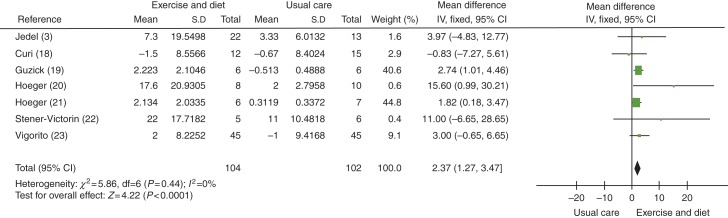
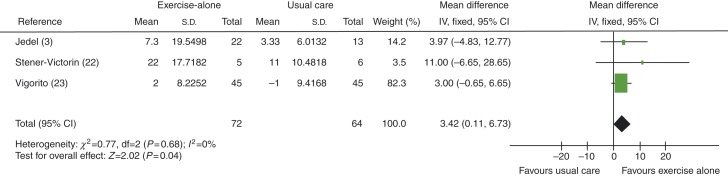
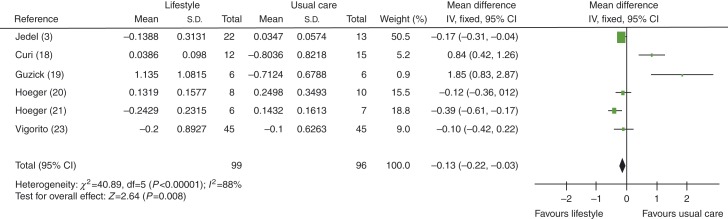
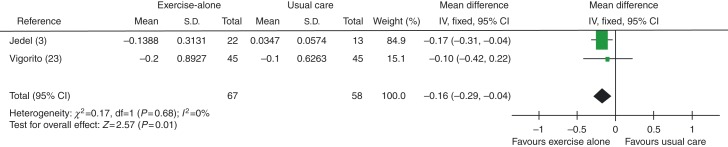
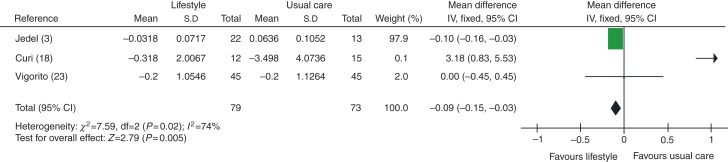
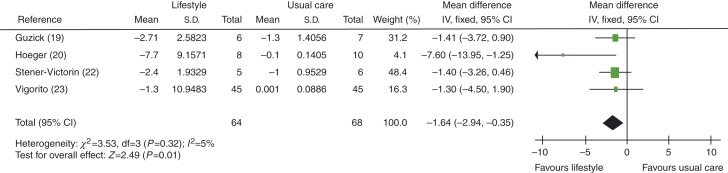
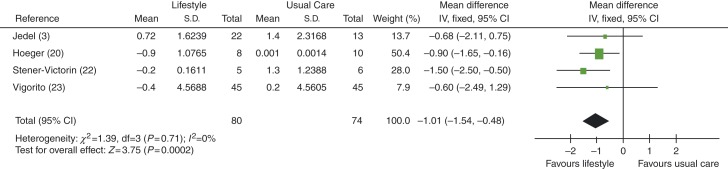
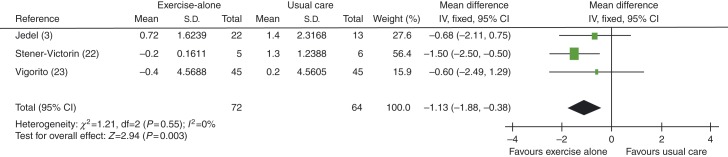
Polycystic ovarian syndrome (PCOS) affects 18-22% of women at reproductive age. We conducted a systematic review and meta-analysis evaluating the expected benefits of lifestyle (exercise plus diet) interventions on the reproductive endocrine profile in women with PCOS. Potential studies were identified by systematically searching PubMed, CINAHL and the Cochrane Controlled Trials Registry (1966-April 30, 2013) systematically using key concepts of PCOS. Significant improvements were seen in women receiving lifestyle intervention vs usual care in follicle-stimulating hormone (FSH) levels, mean difference (MD) 0.39 IU/l (95% CI 0.09 to 0.70, P=0.01), sex hormone-binding globulin (SHBG) levels, MD 2.37 nmol/l (95% CI 1.27 to 3.47, P<0.0001), total testosterone levels, MD -0.13 nmol/l (95% CI -0.22 to -0.03, P=0.008), androstenedione levels, MD -0.09 ng/dl (95% CI -0.15 to -0.03, P=0.005), free androgen index (FAI) levels, MD -1.64 (95% CI -2.94 to -0.35, P=0.01) and Ferriman-Gallwey (FG) score, MD -1.01 (95% CI -1.54 to -0.48, P=0.0002). Significant improvements were also observed in women who received exercise-alone intervention vs usual care in FSH levels, MD 0.42 IU/l (95% CI 0.11 to 0.73, P=0.009), SHBG levels, MD 3.42 nmol/l (95% CI 0.11 to 6.73, P=0.04), total testosterone levels, MD -0.16 nmol/l (95% CI -0.29 to -0.04, P=0.01), androstenedione levels, MD -0.09 ng/dl (95% CI -0.16 to -0.03, P=0.004) and FG score, MD -1.13 (95% CI -1.88 to -0.38, P=0.003). Our analyses suggest that lifestyle (diet and exercise) intervention improves levels of FSH, SHBG, total testosterone, androstenedione and FAI, and FG score in women with PCOS.
Keywords: exercise; female reproduction; follicle-stimulating hormone; insulin resistance; luteinizing hormone; polycystic ovarian syndrome.
Figures

References
-
- Stein I, Leventhal ML. Amenorrhea associated with bilateral polycystic ovaries. American Journal of Obstetrics and Gynecology. 1935;29:181–191.
-
- Jedel E, Labrie F, Odén A, Holm G, Nilsson L, Janson PO, Lind AK, Ohlsson C, Stener-Victorin E. Impact of electro-acupuncture and physical exercise on hyperandrogenism and oligo/amenorrhea in women with polycystic ovary syndrome: a randomized controlled trial. American Journal of Physiology. Endocrinology and Metabolism. 2011;300:E37–E45. doi: 10.1152/ajpendo.00495.2010. - DOI - PubMed
-
- Thomson RL, Buckley JD, Noakes M, Clifton PM, Norman RJ, Brinkworth GD. The effect of a hypocaloric diet with and without exercise training on body composition, cardiometabolic risk profile, and reproductive function in overweight and obese women with polycystic ovary syndrome. Journal of Clinical Endocrinology and Metabolism. 2008;93:3373–3380. doi: 10.1210/jc.2008-0751. - DOI - PubMed
LinkOut - more resources
Full Text Sources
Other Literature Sources
Miscellaneous
