


Indiscriminate behaviors in previously institutionalized young children
- PMID: 24488743
- PMCID: PMC3934326
- DOI: 10.1542/peds.2013-0212
Indiscriminate behaviors in previously institutionalized young children
Abstract
Objective: This study included 54-month-old children with a history of institutional care. Our goal was to: (1) examine differences in indiscriminate social behaviors in children with a history of institutional care compared with home-reared children; (2) test whether foster care reduces indiscriminate social behaviors in a randomized controlled trial; and (3) examine early predictors of indiscriminate behaviors.
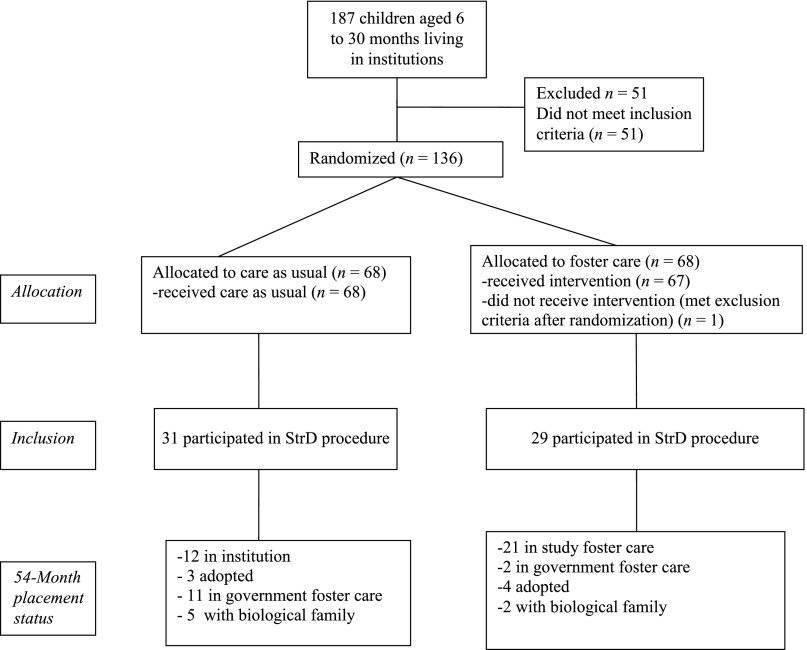
Methods: Participants were 58 children with a history of institutional care and 31 never-institutionalized control (NIG) subjects enrolled in a randomized controlled trial of foster care for institutional care, assessed from toddlerhood to 54 months. Indiscriminate social behaviors were measured naturalistically by using the Stranger at the Door procedure.
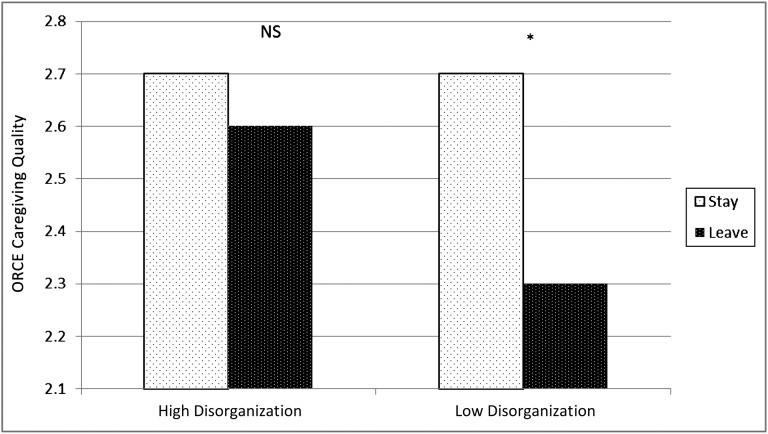
Results: In the Stranger at the Door procedure, children with a history of institutional care left with a stranger at higher rates than NIG subjects (33% vs. 3.5%; P < .001). Children in the care as usual group left more than NIG subjects (41.9% vs. 3.6%; P ≤ .001). The differences between the foster care group (24.1%) and the care as usual group and between foster care group and NIG were not significant. In a logistic regression, early disorganized attachment behaviors, baseline developmental quotient, and caregiving quality after randomization contributed to variance at 54 months. In the same analysis using only children with a history of institutional care, only disorganized attachment contributed significantly to 54-month indiscriminate social behaviors (Exp[B] = 1.6 [95% confidence interval: 1.1-2.5]).
Conclusions: Observed socially indiscriminate behaviors at 54 months were associated with prolonged exposure to institutional care. Young children raised in conditions of deprivation who fail to develop organized attachments as toddlers are at increased risk for subsequent indiscriminate behaviors.
Keywords: attachment; indiscriminate social behaviors; institutional care.
Figures
References
-
- Zeanah CH, Smyke AT, Dumitrescu A. Attachment disturbances in young children. II: Indiscriminate behavior and institutional care. J Am Acad Child Adolesc Psychiatry. 2002;41(8):983–989 - PubMed
-
- Chisholm K. A three year follow-up of attachment and indiscriminate friendliness in children adopted from Romanian orphanages. Child Dev. 1998;69(4):1092–1106 - PubMed
-
- Rutter M, Kreppner J, Sonuga-Barke E. Emanuel Miller Lecture: Attachment insecurity, disinhibited attachment, and attachment disorders: where do research findings leave the concepts? J Child Psychol Psychiatry. 2009;50(5):529–543 - PubMed
Publication types
MeSH terms
Grants and funding
LinkOut - more resources
Full Text Sources
Other Literature Sources
Medical
