


Epidemiology of spinal cord injuries and risk factors for complete injuries in Guangdong, China: a retrospective study
- PMID: 24489652
- PMCID: PMC3904832
- DOI: 10.1371/journal.pone.0084733
Epidemiology of spinal cord injuries and risk factors for complete injuries in Guangdong, China: a retrospective study
Abstract
Background: Spinal cord injuries are highly disabling and deadly injuries. Currently, few studies focus on non-traumatic spinal cord injuries, and there is little information regarding the risk factors for complete injuries. This study aims to describe the demographics and the injury characteristics for both traumatic and non-traumatic spinal cord injuries and to explore the risk factors for complete spinal cord injuries.
Methods: A retrospective study was performed by reviewing the medical records of 3,832 patients with spinal cord injuries who were first admitted to the sampled hospitals in Guangdong, China. The demographics and injury characteristics of the patients were described and compared between the different groups using the chi-square test. Logistic regression was conducted to analyze the risk factors for complete spinal cord injuries.
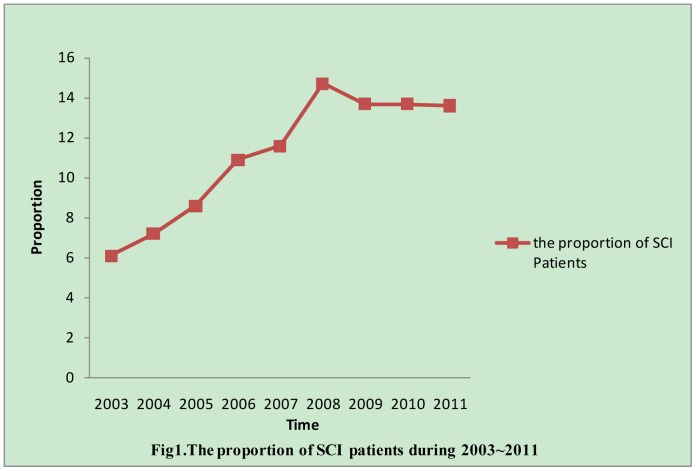
Results: The proportion of patients increased from 7.0% to 14.0% from 2003 to 2011. The male-to-female ratio was 3.0 ∶ 1. The major cause of spinal cord injuries was traffic accidents (21.7%). Many of the injured were workers (36.2%), peasants (22.8%), and unemployed people (13.9%); these occupations accounted for 72.9% of the total sample. A multivariate logistic regression model revealed that the OR (95% CI) for male gender compared to female gender was 1.25 (1.07-1.89), the OR (95%CI) for having a spinal fracture was 1.56 (1.35-2.60), the OR (95%CI) for having a thoracic injury was 1.23 (1.10-2.00), and the OR (95%CI) for having complications was 2.47 (1.96-3.13).
Conclusion: The proportion of males was higher than the proportion of females. Workers, peasants and the unemployed comprised the high-risk occupational categories. Male gender, having a spinal fracture, having a thoracic injury, and having complications were the major risk factors for a complete injury. We recommend that preventive measures should focus on high-risk populations, such as young males.
Conflict of interest statement
Figures
References
-
- O'Connor P (2002) Incidence and patterns of spinal cord injury in Australia. Accid Anal Prev 34: 405–415. - PubMed
-
- Jackson AB, Dijkers M, Devivo MJ, Poczatek RB (2004) A demographic profile of new traumatic spinal cord injury–changes and stablity over 30 years. Arch Phys Med Rehabil 85: 1740–1748. - PubMed
-
- Behrman AL, Trimble SA (2012) Outcomes of spinal cord injuries in young children. Dev Med Child Neurol 54: 1078. - PubMed
-
- Chiu WT, Lin HC, Lam C, Chu SF, Chiang YH, et al. (2010) Review paper: epidemiology of traumatic spinal cord injury: comparisons between developed and developing countries. Asia Pac J Public Health 22: 9–18. - PubMed
-
- Albert T, Ravaud JF (2005) Rehabilitation of spinal cord injury in France: a nationwide multicentre study of incidence and regional disparities. Spinal Cord 43: 357–365. - PubMed
Publication types
MeSH terms
LinkOut - more resources
Full Text Sources
Other Literature Sources
Medical
