


Untreated sleep-disordered breathing: links to aging-related decline in sleep-dependent memory consolidation
- PMID: 24489679
- PMCID: PMC3906012
- DOI: 10.1371/journal.pone.0085918
Untreated sleep-disordered breathing: links to aging-related decline in sleep-dependent memory consolidation
Abstract
Background: Increasing age is associated with a decline in cognition and motor skills, while at the same time exacerbating one's risk of developing obstructive sleep apnea (OSA). OSA-related cognitive deficits are highly prevalent and can affect various memory systems including overnight memory consolidation on a motor sequence task. Thus, the aim of our study was to examine the effect of aging on sleep-dependent motor memory consolidation in patients with and without OSA.
Methods: We studied 44 patients (19-68 years) who had been referred by a physician for a baseline polysomnography (PSG) evaluation. Based on their PSG, patients were assigned either to the OSA group (AHI>5/h), or control (Non-OSA) group (AHI<5/h). All subjects performed the Psychomotor Vigilance Task (PVT) and the Motor Sequence Learning Task (MST) in the evening and again in the morning after their PSG.
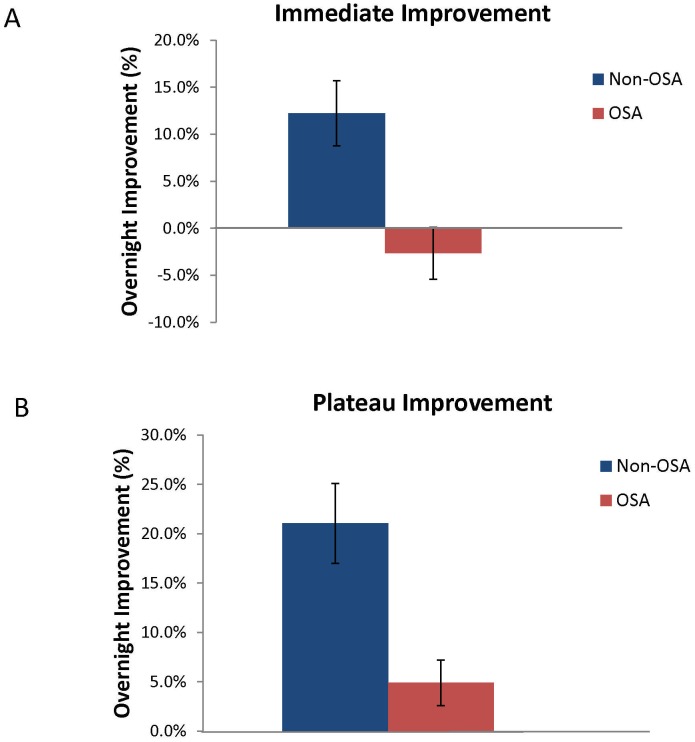
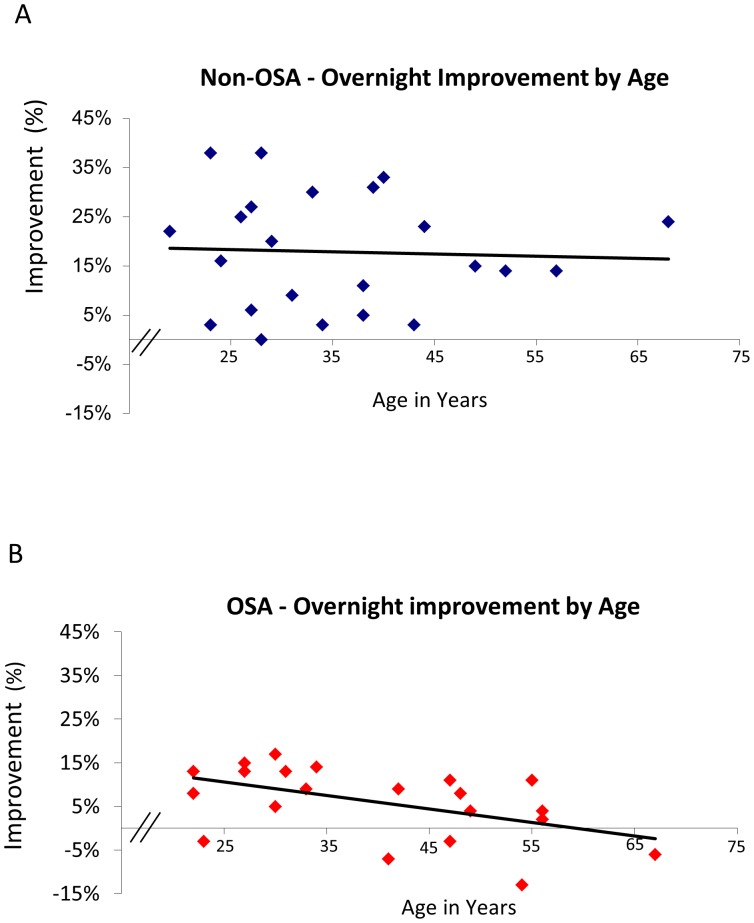
Results: Despite similar learning in the evening, OSA subjects showed significantly less overnight improvement on the MST, both for immediate (OSA -2.7% ± 2.8% vs. controls 12.2% ± 3.5%; p = 0.002) and plateau improvement (OSA 4.9% ± 2.3% vs. controls 21.1%± 4.0%; p = 0.001). Within the OSA group, there was a significant negative correlation between overnight MST improvement and age (r(2) = 0.3; p = 0.01), an effect that was not observed in the Non-OSA group (r(2) = 0.08; p = 0.23).
Conclusions: Consistent with previous research, healthy sleepers demonstrated a higher degree of sleep-dependent overnight improvement on the MST, an effect not mitigated by increasing age. However, the presence of untreated obstructive sleep apnea is associated with an aging-related cognitive deficit, otherwise not present in individuals without OSA. As other research has linked the presence of OSA to a higher likelihood of developing dementia, future studies are necessary to examine if the inhibition of memory consolidation is tied to the onset of neurodegenerative disease.
Conflict of interest statement
Figures
References
-
- Federal Interagency Forum on Aging Related Statistics. (2010) Older Americans 2012: Key Indicators of Well-Being. Available: http://www.agingstats.gov/chartbook2004/population.html.
-
- Young T, Palta M, Dempsey J, Skatrud J, Weber S, et al. (1993) The occurrence of sleep-disordered breathing among middle-aged adults. N Engl J Med 328: 1230–1235. - PubMed
-
- Ancoli-Israel S, Klauber MR, Stepnowsky C, Estline E, Chinn A, et al. (1995) Sleep-disordered breathing in African-American elderly. Am J Respir Crit Care Med 152: 1946–1949. - PubMed
Publication types
MeSH terms
Grants and funding
LinkOut - more resources
Full Text Sources
Other Literature Sources
Medical
Research Materials
