


Sarcopenia as a determinant of blood pressure in older Koreans: findings from the Korea National Health and Nutrition Examination Surveys (KNHANES) 2008-2010
- PMID: 24489804
- PMCID: PMC3906091
- DOI: 10.1371/journal.pone.0086902
Sarcopenia as a determinant of blood pressure in older Koreans: findings from the Korea National Health and Nutrition Examination Surveys (KNHANES) 2008-2010
Abstract
Background: Blood pressure (BP) is directly and causally associated with body size in the general population. Whether muscle mass is an important factor that determines BP remains unclear.
Objective: To investigate whether sarcopenia is associated with hypertension in older Koreans.
Participants: We surveyed 2,099 males and 2,747 females aged 60 years or older.
Measurements: Sarcopenia was defined as an appendicular skeletal muscle mass divided by body weight (ASM/Wt) that was <1 SD below the gender-specific mean for young adults. Obesity was defined as a body mass index (BMI) ≥ 25 kg/m(2). Subjects were divided into four groups based on presence or absence of obesity or sarcopenia. Hypertension was defined as a systolic BP (SBP) ≥ 140 mmHg, a diastolic BP (DBP) ≥ 90 mmHg, or a self-reported current use of antihypertensive medications.
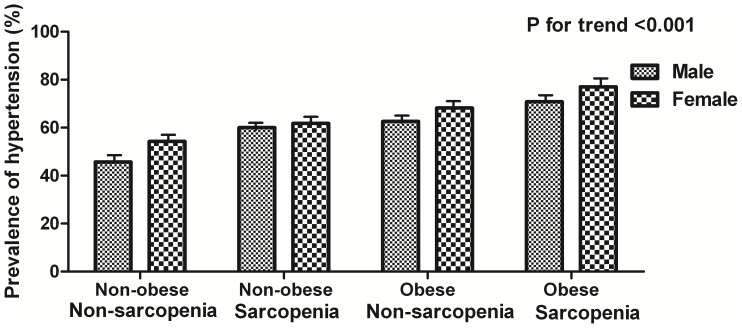
Results: The overall prevalence of hypertension in the four groups was as follows 49.7% for non-obese non-sarcopenia, 60.9% for non-obese sarcopenia, 66.2% for obese non-sarcopenia and 74.7% for obese sarcopenia. After adjustment for age, gender, regular activity, current smoking and alcohol use, the odds ratio (OR) for having hypertension was 1.5 (95% confidence interval (CI) = 1.23-1.84) in subjects in the non-obese sarcopenia group, 2.08 (95% CI = 1.68-2.57) in the obese non-sarcopenia group and 3.0 (95% CI = 2.48-3.63) in the obese sarcopenia group, compared with the non-obese non-sarcopenia group (p for trend <0.001). Controlling further for body weight and waist circumference did not change the association between hypertension and sarcopenia. The association between sarcopenia and hypertension was more robust in the subjects with diabetes mellitus.
Conclusion: Body composition beyond BMI has a considerable impact on hypertension in elderly Koreans. Subjects with sarcopenic obesity appear to have a greater risk of hypertension than simply obese or sarcopenia subjects.
Conflict of interest statement
Figures
References
-
- Miller MD, Crotty M, Giles LC, Bannerman E, Whitehead C, et al. (2002) Corrected arm muscle area: an independent predictor of long-term mortality in community-dwelling older adults?. J Am Geriatr Soc 50: 1272–1277. - PubMed
-
- Snijder MB, Henry RM, Visser M, Dekker JM, Seidell JC, et al. (2004) Regional body composition as a determinant of arterial stiffness in the elderly: The Hoorn Study. J Hypertens 22: 2339–47. - PubMed
MeSH terms
LinkOut - more resources
Full Text Sources
Other Literature Sources
Medical
